10 Questions Students Should Ask Before Accepting a Clinical Preceptor
Finding a clinical preceptor can feel like a huge relief.
After weeks of searching, you finally find someone who appears to fit your specialty and rotation dates. You are ready to accept the opportunity and move on.
But wait.
Before you say yes, have you asked the right questions?
Finding a preceptor is only the first step. You also want to make sure the clinical experience will meet your school's requirements, support your learning goals, and give you the opportunity to develop the skills you need.
A preceptor may look perfect on paper, but the right clinical rotation is about more than availability.
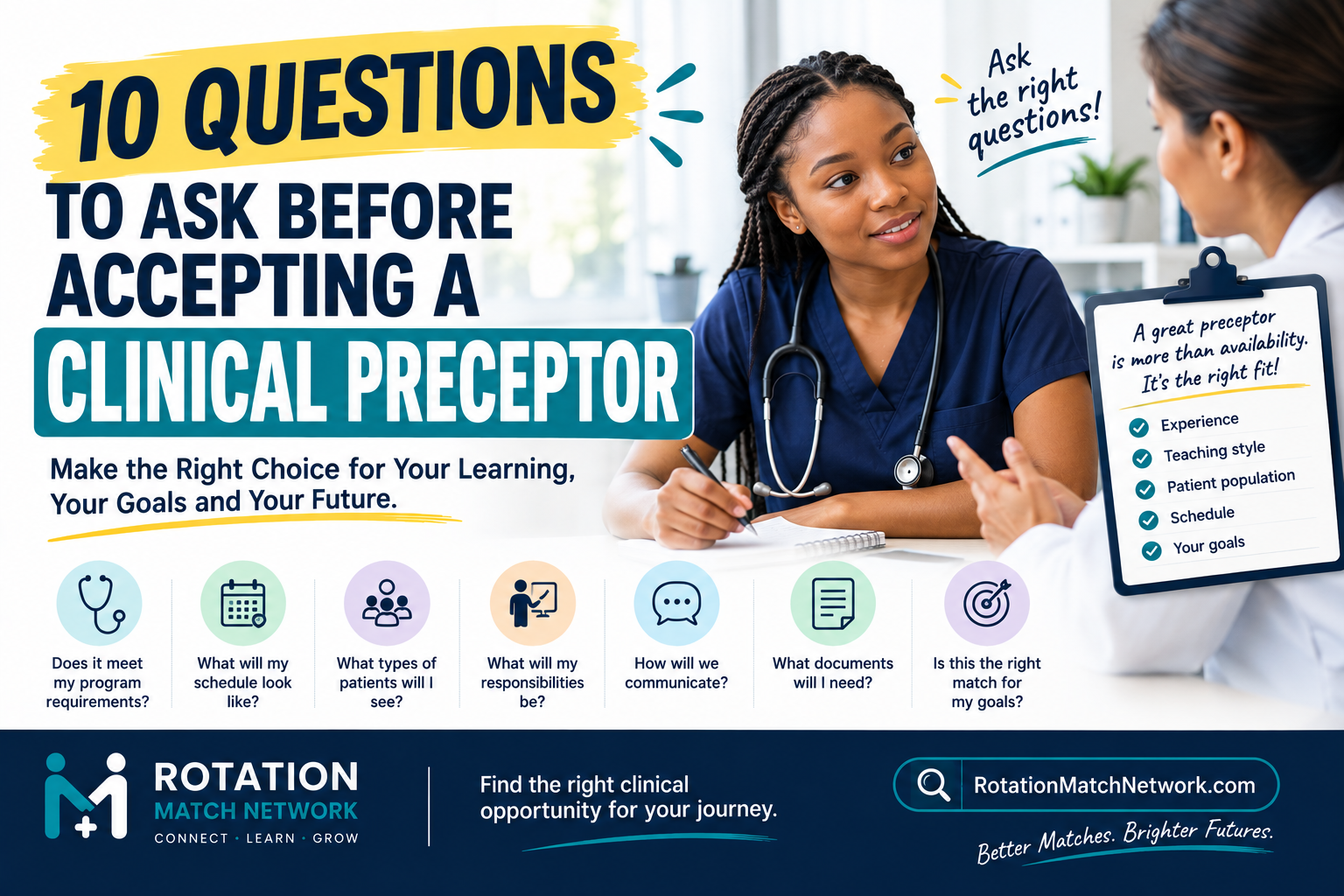
Here are 10 important questions to ask before accepting a clinical preceptor.
1. Does Your Clinical Experience Match My Program Requirements?
This should be your first question.
Before accepting a placement, confirm that the preceptor's specialty, clinical setting, patient population, and responsibilities align with your program's requirements.
Ask yourself:
Will this rotation count toward my required clinical hours?
Does the specialty meet my school's requirements?
Will I get the patient exposure my program requires?
A placement that does not satisfy your school's requirements can create problems later, even if the preceptor is excellent.
2. What Will My Typical Clinical Schedule Look Like?
Do not assume that your schedule will automatically match your expectations.
Ask about:
Start and end times
Days of the week
Number of clinical hours
Expected attendance
Scheduling flexibility
Holidays or planned closures
Understanding the schedule before you accept the placement can help you avoid conflicts later.
3. What Types of Patients Will I See?
Your patient population can have a major impact on your learning experience.
Ask what types of patients you are likely to encounter and whether the clinical setting provides the patient experiences required by your program.
For example, a student may need exposure to a specific age group, condition, specialty, or patient population.
The goal is not simply to complete your hours. It is to gain the right clinical experience while completing them.
4. What Will My Responsibilities Be?
Every clinical environment is different.
Ask your potential preceptor what you will be expected to do during the rotation.
Will you primarily observe?
Will you participate in patient assessments?
Will you be able to take histories?
Will you participate in procedures within your scope and program requirements?
What level of independence will be expected as you progress?
Understanding expectations before your first day can help you arrive prepared.
5. How Do You Usually Teach and Give Feedback?
A good clinical experience involves more than observing.
You want a preceptor who is willing to help you learn.
Ask how they typically provide feedback and whether you will have opportunities to discuss your performance.
Some preceptors may provide feedback throughout the day, while others may prefer scheduled discussions.
There is no single perfect teaching style. What matters is knowing what to expect and making sure the environment supports your learning.
6. How Will We Communicate Before and During the Rotation?
Communication problems can make an otherwise good clinical placement stressful.
Before accepting, find out how you and your preceptor will communicate.
Will you use email?
Phone?
A messaging platform?
How quickly should you expect responses?
Who should you contact if there is a scheduling issue?
Clear communication from the beginning can prevent confusion later.
Rotation Match Network provides built-in messaging so students and preceptors can coordinate their clinical placement through the platform.
7. What Documents or Compliance Requirements Do I Need?
Do not wait until the last minute to discover that you are missing an important document.
Ask what the preceptor or clinical site requires before you begin.
Depending on your program and placement, requirements may include:
A professional license
Resume or CV
Immunization records
Background check
CPR or BLS certification
Health documentation
School approval
Other compliance documents
Your school's requirements should always take priority, so confirm them before accepting the rotation.
RMN includes a document and compliance workflow that allows students to upload required documents and track their placement progress.
8. What Happens If My Schedule or Rotation Requirements Change?
Life happens.
Your school may adjust your dates. Your required hours may change. You may have an unexpected academic or personal issue.
Before accepting the placement, ask how schedule changes are handled.
Understanding this beforehand can save you from unnecessary stress later.
And if your school has strict rules about changing clinical placements, make sure you understand those rules before making any commitments.
9. What Can I Expect to Learn During This Rotation?
This is the question students sometimes forget to ask.
Instead of thinking only about completing your required hours, think about what you want to learn.
Ask yourself:
What skills will I develop?
What clinical situations might I encounter?
Will this experience expose me to my area of interest?
Will this rotation help me become more confident in my future role?
A clinical rotation should be more than a box you check on your academic journey.
It is an opportunity to connect what you have learned in the classroom with real patients and real clinical situations.
10. Is This the Right Clinical Match for Me?
Finally, ask the biggest question:
Is this actually the right match?
Consider the complete picture.
Does the specialty fit?
Do the dates work?
Does the location work?
Does the schedule fit your circumstances?
Does the clinical environment support your learning goals?
Does the preceptor's experience align with your program?
Do you understand the expectations?
If the answer is yes, you may have found a strong clinical opportunity.
If not, it may be better to continue your search.
Don't Accept a Clinical Rotation Just Because It Is Available
When students have been searching for a preceptor for weeks or months, it can be tempting to accept the first opportunity that comes along.
But available does not always mean suitable.
The best clinical placement is one that meets your program requirements while giving you a meaningful learning experience.
Taking a few minutes to ask the right questions before accepting a preceptor can save you significant stress later.
Finding the Right Preceptor Starts With the Right Match
This is one of the reasons having a structured clinical placement platform can be helpful.
Rotation Match Network allows students to search available clinical rotation opportunities by factors such as location and specialty, review rotation details and preceptor requirements, submit requests, and track application progress.
Instead of simply asking, “Who will take me?”, you can ask a better question:
“Which clinical opportunity is the right fit for me?”
RMN is designed to help students and preceptors connect around clinical placement opportunities while keeping important parts of the process organized in one place.
Before You Say Yes, Ask These 10 Questions
Save this checklist before accepting your next clinical preceptor:
☐ Does this placement meet my school's requirements?
☐ What will my clinical schedule look like?
☐ What patient population will I see?
☐ What will my responsibilities be?
☐ How will my preceptor teach and provide feedback?
☐ How will we communicate?
☐ What documents and compliance requirements do I need?
☐ What happens if my dates or requirements change?
☐ What will I learn during this rotation?
☐ Is this the right clinical match for my goals?
If you can confidently answer these questions, you will be in a much better position to make an informed decision.
Final Thoughts
Getting a clinical preceptor is important.
But getting the right clinical preceptor is even more important.
Don't be afraid to ask questions before accepting a placement. You are not being difficult or demanding. You are making sure that the clinical experience you choose supports your education and professional development.
Take your time.
Understand the expectations.
Check the requirements.
Ask questions.
And choose a placement that makes sense for your goals.
When you're ready to explore clinical opportunities, Rotation Match Network can help you search for available preceptors, review placement details, submit requests, and keep your clinical placement journey organized.
Don't just find a preceptor. Find the right match.