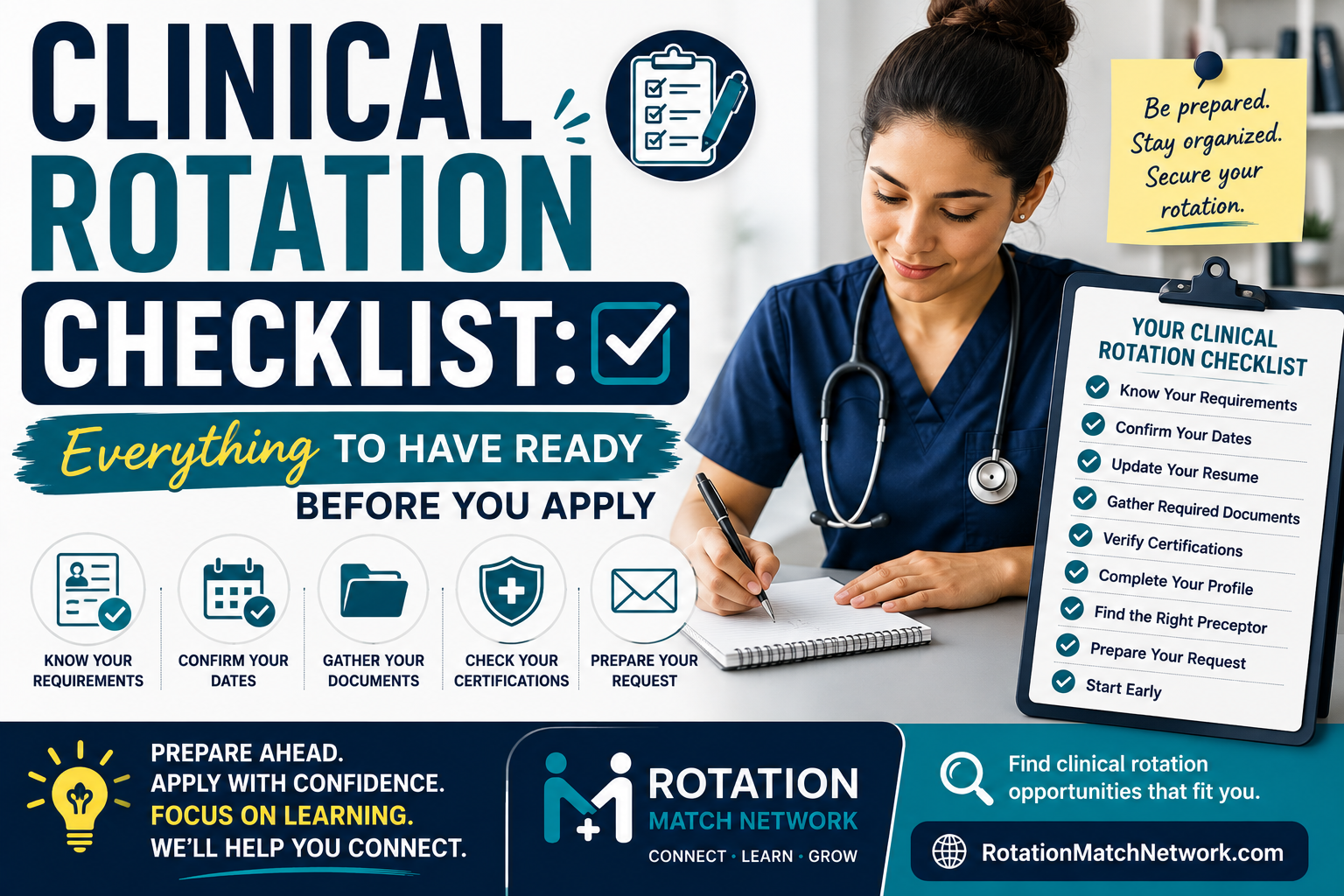
Clinical Rotation Checklist: Everything to Have Ready Before You Apply
Applying for a clinical rotation can feel overwhelming, especially when you are trying to figure out what documents you need, where to find a preceptor, what your school requires, and when everything needs to be completed.
The good news is that you can make the process much easier by getting organized before you start applying.
Whether you are a nursing, nurse practitioner, physician assistant, CRNA, PMHNP, FNP, or other healthcare student, having your clinical rotation requirements ready can save you time and help you avoid unnecessary delays.
Use this clinical rotation checklist before submitting your next preceptor request.
Clinical Rotation Checklist
1. Know Your Clinical Rotation Requirements
Before looking for a preceptor, make sure you understand exactly what your program requires.
Check:
☐ Required clinical hours
☐ Required specialty
☐ Required patient population
☐ Rotation start and end dates
☐ Location requirements
☐ Preceptor qualification requirements
☐ School approval requirements
☐ Application or placement deadlines
Your ideal preceptor may not be the right preceptor if they cannot meet your school's requirements.
Know what you need before you start searching.
2. Know Your Rotation Dates
Your rotation dates are one of the first things a preceptor will want to know.
Have your exact or expected start and end dates available before submitting a request.
If your school gives you a range of acceptable dates, know that range as well.
Starting your search early gives you more flexibility if your preferred dates are already taken.
3. Prepare Your Resume or CV
A professional resume or CV may be required when requesting a clinical rotation.
Make sure it is:
Current
Professional
Easy to read
Relevant to your healthcare program
Free from spelling and formatting errors
Include your education, certifications, relevant experience, clinical experience, and other information that helps a preceptor understand your background.
You do not need to make your resume unnecessarily long. Focus on information that is relevant to your clinical education.
4. Gather Your Clinical Documents
Do not wait until a preceptor accepts your request before looking for your documents.
Depending on your school and clinical site, you may need documents such as:
☐ Immunization records
☐ Physical examination documentation
☐ Background check
☐ Drug screening
☐ CPR or BLS certification
☐ Professional license
☐ Health insurance information
☐ Malpractice insurance, where applicable
☐ HIPAA or other required training
☐ School identification
☐ Resume or CV
Requirements vary between programs and clinical sites, so always confirm what your school requires.
5. Check That Your Certifications Are Current
An expired certification can create an unnecessary problem after you have already found a clinical placement.
Check the expiration dates on certifications such as BLS, CPR, ACLS, PALS, or any other certification required by your program.
If something is about to expire during your rotation, find out whether it needs to be renewed beforehand.
Do not assume that an expired document will be accepted.
6. Make Sure Your Profile Is Complete
If you are using an online platform to find a clinical preceptor, your profile is part of your first impression.
Make sure your information is accurate and complete.
Include relevant information such as:
Your healthcare program
Specialty
Location
Rotation requirements
Preferred dates
Required clinical hours
Professional experience
Certifications
A complete profile can make it easier for preceptors to understand whether you are a good fit.
With Rotation Match Network, students can create a profile, upload relevant documents, search for available rotations, and submit requests through the platform. (rotationmatchnetwork.com)
7. Know What Type of Preceptor You Need
Don't start searching without knowing what you're looking for.
Consider:
Specialty: What specialty does your program require?
Location: Where are you able to complete your rotation?
Schedule: What days or hours are you available?
Patient population: Does your program require specific patient encounters?
Experience: Does your school have specific preceptor qualifications?
Knowing these details helps you focus on opportunities that actually meet your requirements.
8. Prepare Your Clinical Rotation Request
Your request to a preceptor should be professional and straightforward.
Before you send it, make sure it explains:
Who you are
Your program
The rotation you need
Your preferred dates
Your required hours
Your relevant requirements
Why you are interested in the opportunity
Keep it concise.
A busy healthcare professional should be able to understand your request quickly.
9. Start Your Search Early
One of the most important items on your clinical rotation checklist is simply:
☐ Start early
Do not wait until your rotation deadline is approaching.
Ideally, begin looking for a clinical preceptor several months before your rotation.
Starting early gives you time to:
Search for suitable preceptors
Submit requests
Wait for responses
Follow up professionally
Consider alternative opportunities
Complete documentation
Resolve compliance issues
Prepare for your first day
If your first request does not work out, you still have time to find another opportunity.
10. Don't Rely on Only One Opportunity
Finding a preceptor can take time.
A preceptor may be unavailable, fully booked, or unable to accommodate your required dates.
That is why it is important to keep exploring suitable opportunities while your requests are being reviewed.
Rotation Match Network allows students to search available clinical rotations and submit requests while tracking their application progress from their dashboard. (rotationmatchnetwork.com)
This can make it easier to stay organized instead of keeping track of multiple opportunities through separate emails and spreadsheets.
Your Clinical Rotation Application Checklist
Before you submit a request, run through this quick checklist:
☐ I know my school's clinical requirements
☐ I know how many clinical hours I need
☐ I know my rotation dates
☐ I know my required specialty
☐ I know my location requirements
☐ My resume or CV is updated
☐ My certifications are current
☐ My clinical documents are ready
☐ My profile is complete
☐ I understand the preceptor's requirements
☐ My clinical rotation request is professional
☐ I have started my search early
☐ I am not relying on only one opportunity
If you can check most of these boxes, you are in a much better position to begin your clinical placement search.
What If You Don't Have Everything Ready Yet?
Don't panic.
You do not necessarily need to have every possible document completed before you begin researching preceptors.
However, you should understand your school's requirements and begin gathering your documents as early as possible.
Some requirements can take time to obtain, so waiting until after you secure a preceptor can create unnecessary pressure.
The earlier you know what you need, the easier it is to plan.
Find Your Clinical Rotation With Rotation Match Network
Once your checklist is ready, the next step is finding the right clinical opportunity.
Rotation Match Network helps students connect with preceptors and clinical rotation opportunities based on factors such as specialty and location.
Students can search available opportunities, review rotation details and requirements, submit requests, and track their application progress through the platform. (rotationmatchnetwork.com)
Instead of searching blindly and trying to manage everything across different platforms, RMN gives you a centralized place to manage important parts of your clinical placement journey.
Have your documents ready. Know your requirements. Then start your search.
Final Thoughts
Securing a clinical rotation is much easier when you prepare before you apply.
Don't wait until you find a preceptor to start gathering your documents. Don't wait until your deadline is close to begin searching. And don't send requests without first checking whether the opportunity actually meets your program's requirements.
Use this clinical rotation checklist to get organized, prepare your documents, understand your requirements, and approach your preceptor search with confidence.
And when you're ready to find a clinical rotation, Rotation Match Network can help you search for opportunities, connect with preceptors, submit requests, and keep track of your placement process.
Prepare first. Search early. Find the right match.
Your clinical rotation starts long before your first day at the clinical site.