Clinical Rotation Compliance: What Documents Do Students Usually Need?
Getting a clinical rotation is exciting until you receive a long list of documents you need to submit before you can actually start.
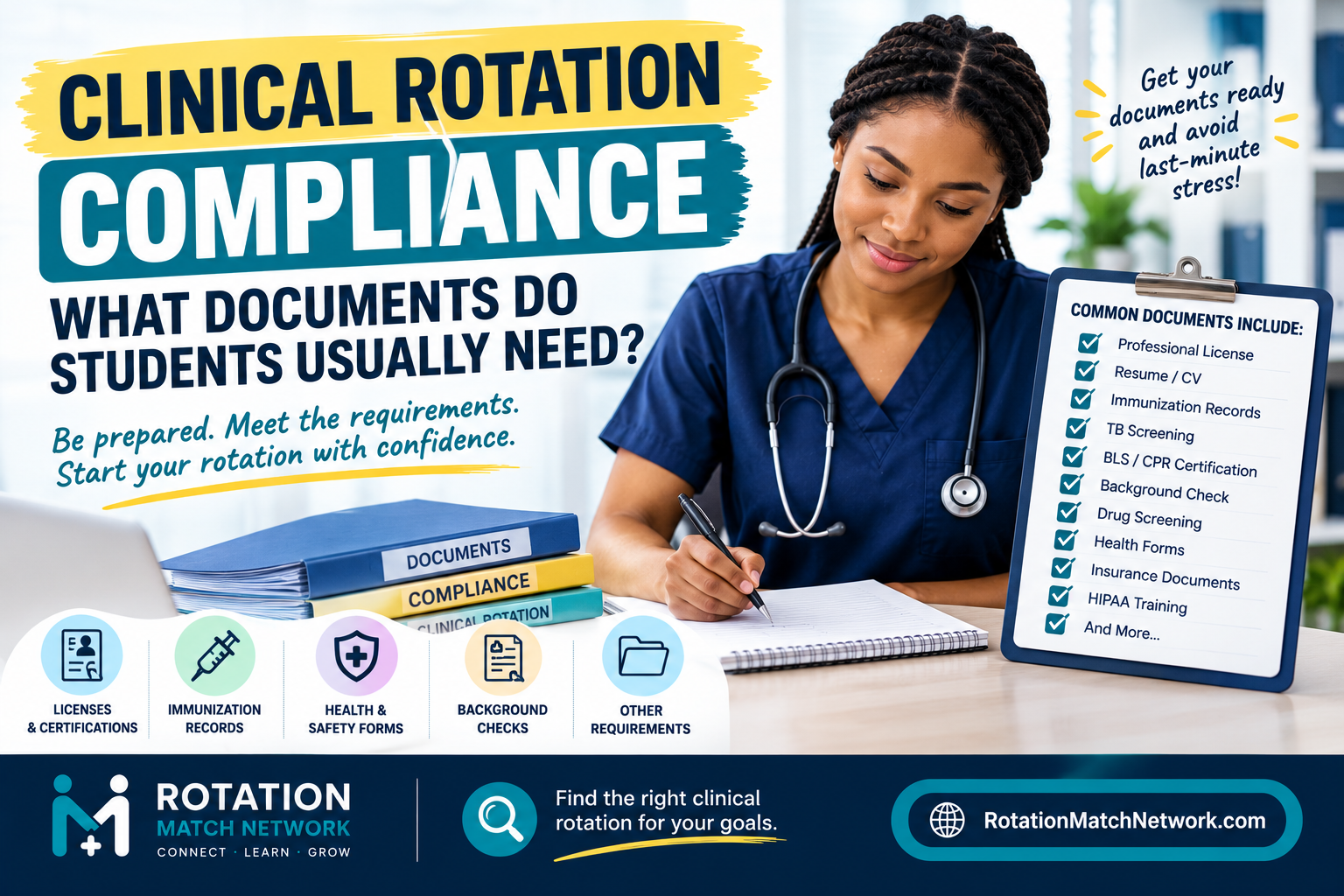
Nursing licenses. Immunization records. Background checks. Certifications. Health forms. Drug screens. Insurance documents.
Suddenly, finding a preceptor is only half the job.
Clinical rotation compliance is the process of making sure you have met the documentation, health, training, and administrative requirements needed to participate in a clinical placement. The exact requirements vary by school, program, specialty, preceptor, and clinical site, but there are several documents students are commonly asked to provide.
Knowing what to prepare early can save you from last minute stress and, in some cases, prevent delays to your clinical rotation.
What Documents Do Students Usually Need for a Clinical Rotation?
There is no single clinical rotation document checklist that applies to every healthcare student. Your university and clinical site will determine exactly what you need.
However, these are some of the most common requirements.
1. Professional License or License Verification
Depending on your program, you may need to provide proof of an active professional license.
For example, nursing students and advanced practice nursing students may be asked to provide a current nursing license or license verification.
Make sure your license is:
• Current and active
• Clearly readable
• Consistent with the information on your student profile
• Valid for the location and period of your rotation, when applicable
Do not wait until your rotation is about to begin to discover that your license has expired.
2. Resume or CV
Many preceptors and clinical programs want to understand your educational and professional background before accepting you.
Your resume or CV may include:
• Your education
• Professional experience
• Clinical experience
• Certifications
• Relevant skills
• Professional credentials
• Contact information
Keep your resume updated before you start contacting preceptors.
A clear, professional resume can also help a preceptor quickly understand who you are and what you are hoping to accomplish during the rotation.
3. Immunization Records
Immunization documentation is one of the most common parts of clinical compliance.
Depending on the program and clinical site, students may be asked to provide documentation for vaccinations such as:
• Hepatitis B
• MMR
• Varicella
• Tetanus, diphtheria, and pertussis
• Influenza
• COVID 19 vaccination, where applicable
Some sites may also require evidence of immunity through blood titers rather than vaccination records alone.
The important thing is not to assume that your school's requirements are identical to your clinical site's requirements.
4. Tuberculosis Screening
Students may also need proof of tuberculosis screening before entering a clinical environment.
This could involve a TB skin test or another approved screening method depending on the requirements of your school or clinical site.
Pay attention to expiration dates. A TB test that was valid several months ago may no longer meet the requirements for your upcoming rotation.
5. CPR or BLS Certification
Many healthcare programs require students to maintain current CPR or Basic Life Support certification.
Some clinical sites may have specific requirements regarding which organization issued the certification.
Before uploading your certification, check:
• Whether the certification is still active
• Whether the clinical site accepts it
• Whether both sides of the certificate are required
• Whether the certification must remain valid throughout the rotation
If your certification expires during your rotation, ask your school or clinical site how they want you to handle it.
6. Background Check
A background check may be required before you can enter a clinical facility or interact with patients.
The purpose is generally to help clinical sites evaluate safety, regulatory, and placement requirements.
Background check requirements can vary significantly between schools and clinical sites, so follow the instructions provided by your program.
If you have completed a background check previously, do not automatically assume it will still be accepted. Some organizations require a recent check completed through a specific provider.
7. Drug Screening
Some clinical programs and healthcare facilities require students to complete a drug screening before beginning a rotation.
The timing and process can vary. Your school may provide specific instructions about where and when the screening should be completed.
If this is part of your compliance requirements, complete it early enough to allow time for processing.
8. Health or Physical Examination Form
Some programs require a healthcare provider to confirm that you are physically able to participate in clinical activities.
You may be asked to submit a health clearance or physical examination form completed by an appropriate healthcare professional.
The form may address general health status and, depending on the program, other requirements necessary for clinical participation.
9. Health Insurance or Professional Liability Coverage
Some clinical sites require students to show proof of health insurance or professional liability coverage.
The requirement depends on the program, institution, and clinical site.
If you are unsure whether you need this documentation, ask your school or clinical coordinator before your placement begins.
10. HIPAA and Other Required Training Certificates
Clinical sites may require students to complete specific training before they begin working with patients or accessing clinical information.
HIPAA training is one common example.
Other training may include:
• OSHA or workplace safety training
• Infection prevention training
• Bloodborne pathogens training
• Electronic health record training
• Facility specific orientation
Keep copies of your completion certificates so you can provide them when requested.
11. School or Program Approval Documents
Your clinical site may also need documentation showing that your school has approved the placement.
This could include:
• Clinical approval forms
• Affiliation documentation
• Student placement forms
• Clinical agreements
• Proof of enrollment
• Course information
• Rotation objectives
The exact paperwork depends on your educational institution and clinical site.
12. Clinical Rotation Details
Not every compliance item is a formal certificate.
You should also have your rotation information organized, including:
• Rotation specialty
• Required clinical hours
• Start and end dates
• Preferred schedule
• Location
• Learning objectives
• Course requirements
• Preceptor information
Having these details ready makes it easier to submit accurate requests and avoid unnecessary back and forth.
Why Do Clinical Rotation Documents Matter So Much?
Clinical sites work with real patients, sensitive health information, and professional standards. That means students may need to demonstrate that they meet certain health, safety, training, licensing, and educational requirements before they can participate.
A missing document can create a surprisingly large problem.
For example, you may find the perfect preceptor, receive an acceptance, and then discover that your background check has expired.
Your rotation could be delayed while you complete the requirement.
That is why clinical rotation compliance should start before you secure your placement, not after.
How to Organize Your Clinical Rotation Documents
Instead of searching through your email every time someone asks for a document, create a dedicated clinical rotation folder.
You can organize it like this:
Clinical Rotation
→ License
→ Resume or CV
→ Immunizations
→ TB screening
→ BLS or CPR
→ Background check
→ Drug screening
→ Health clearance
→ Insurance
→ HIPAA and other training
→ School forms
→ Clinical approval documents
Give every file a clear name.
For example:
Amarachi_BLS_Certification_2026.pdf
is much easier to identify than:
certificate_final_new2.pdf
Also keep track of expiration dates. A document can be complete today but become invalid before your rotation starts.
What If I Am Missing a Required Document?
Don't panic.
First, identify exactly what is missing.
Then ask your school, clinical coordinator, preceptor, or clinical site what they require and where the document should come from.
If the requirement involves a certification, screening, vaccination, or health clearance, give yourself enough time to complete the process.
Most importantly, do not submit a document simply because you think it is probably what they want.
When compliance is involved, accuracy matters.
Does Every Clinical Rotation Require the Same Documents?
No.
This is one of the most important things students should understand.
A PMHNP student may have different requirements from an FNP student. A nursing student may have different requirements from a PA student. One hospital may also have different onboarding requirements from another clinical site.
Your university may have its own checklist, while your preceptor or facility may have additional requirements.
Think of your compliance checklist as having three layers:
School requirements + Clinical site requirements + Program requirements
Your goal is to satisfy all three.
How RotationMatch Network Helps Students Stay Organized
Finding a preceptor is only one part of preparing for clinical placement. You also need to keep track of applications, requirements, documents, deadlines, and placement updates.
Rotation Match Network helps bring these pieces together in one place.
Students can create a profile, search for available rotations by factors such as location and specialty, review preceptor requirements, submit placement requests, upload required documents, and track application progress. The platform also provides compliance tracking and secure document storage to help students stay organized.
Instead of managing every part of your clinical placement through scattered emails and files, you can keep your placement process more organized from one workspace.
Your Clinical Rotation Compliance Checklist
Before applying for or starting a clinical rotation, check whether you have the following:
☐ Active professional license or license verification
☐ Updated resume or CV
☐ Immunization records
☐ TB screening
☐ BLS or CPR certification
☐ Background check
☐ Drug screening, if required
☐ Health or physical examination form
☐ Health insurance documentation, if required
☐ Professional liability insurance, if required
☐ HIPAA training
☐ OSHA or safety training, if required
☐ School or program forms
☐ Clinical site forms
☐ Proof of enrollment, if required
☐ Rotation dates and required clinical hours
☐ Learning objectives and course requirements
☐ Any additional documents requested by your preceptor or clinical site
Don't Wait Until the Last Minute
One of the biggest mistakes students make is treating compliance paperwork as something they can handle after finding a preceptor.
By then, you may already be working against the clock.
Some documents take time to obtain, some expire, and some require appointments or verification from another organization.
The better approach is simple:
Know the requirements. Gather your documents. Check expiration dates. Organize everything. Then start your clinical placement search.
When your paperwork is ready, you can focus more of your energy on finding the right clinical experience rather than chasing missing documents.
Ready to Find Your Clinical Rotation?
Finding the right preceptor can be easier when your documents and requirements are already organized.
With Rotation Match Network, students can search for clinical opportunities, review requirements, submit requests, manage documents, and track their placement progress in one place.
Your clinical rotation starts long before your first day with a patient.
Start prepared. Stay organized. Find the right clinical match.