
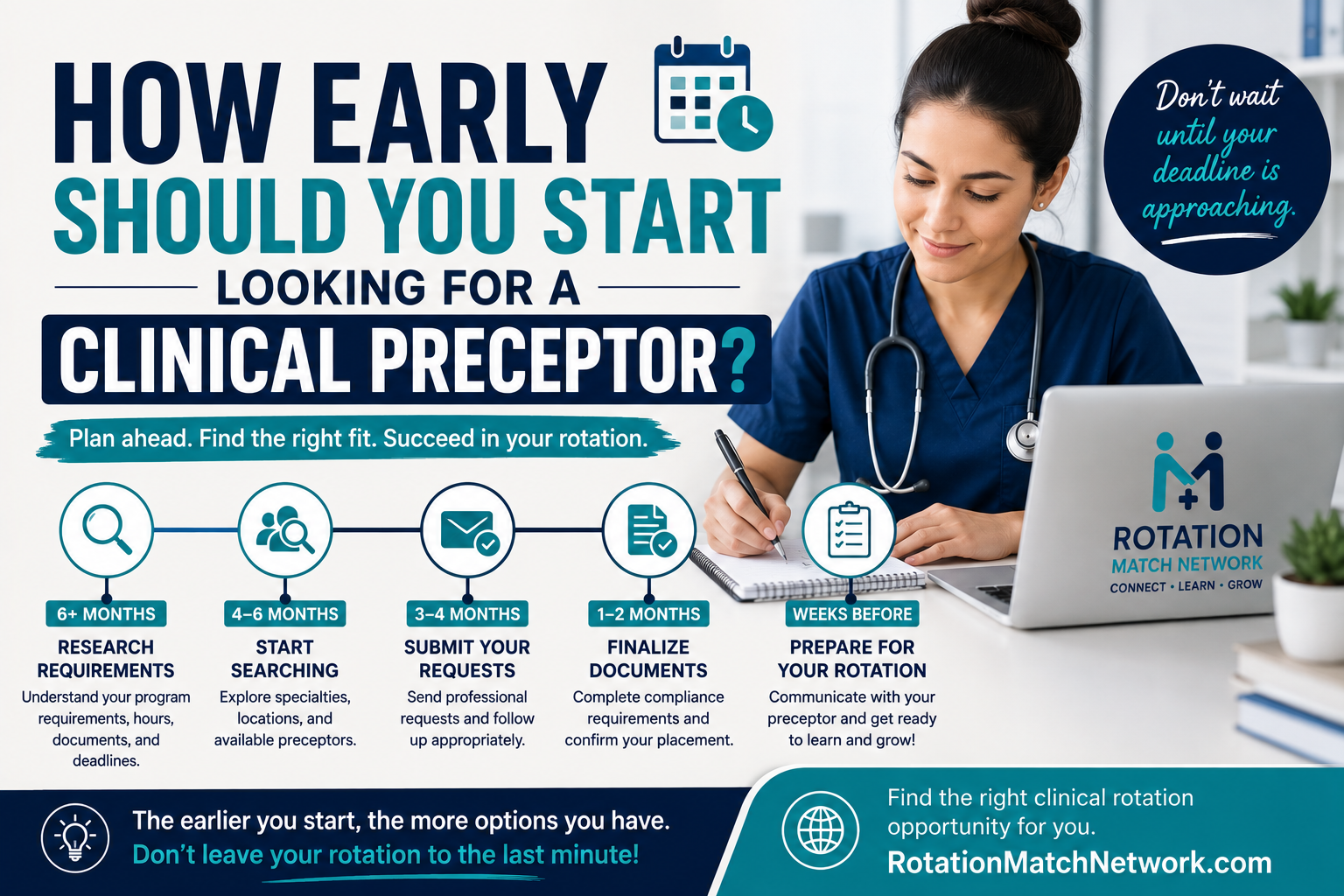
How Early Should You Start Looking for a Clinical Preceptor?
If you need a clinical preceptor for your upcoming rotation, one of the most important questions to ask is:
When should I start looking?
The short answer is: earlier than you think.
Finding a clinical preceptor can take time. A preceptor may already be booked, unavailable during your required dates, unable to meet your school's requirements, or simply not respond to your request.
Waiting until your clinical rotation is only a few weeks away can leave you with very limited options.
A good rule is to start your clinical preceptor search at least 3 to 6 months before your rotation, and even earlier if your program recommends it.
The earlier you start, the more time you have to find the right match, submit your request, complete your documents, and prepare for your clinical experience.
Why You Should Start Looking for a Preceptor Early
Clinical placements are not always secured immediately.
You may need to contact several preceptors before finding one who matches your:
Specialty
Location
Rotation dates
Required clinical hours
Patient population
School requirements
Availability
Starting early gives you room to handle unexpected delays.
For example, if your first preceptor does not respond, you can follow up and continue searching without immediately worrying about missing your school's deadline.
If a preceptor declines your request, you still have time to find another opportunity.
The biggest mistake students make is waiting until their deadline is approaching before starting their preceptor search.
How Early Should You Start? A Simple Clinical Rotation Timeline
There is no universal timeline for every healthcare program. Your school may have its own requirements, so always check your program's instructions first.
However, this general timeline can help you plan.
6+ Months Before Your Rotation: Research Your Requirements
If you have six months or more before your clinical rotation, start by understanding exactly what you need.
Check:
Your required clinical hours
Specialty requirements
Location requirements
Patient population requirements
Required documents
School deadlines
Preceptor qualifications
Any approval requirements
This is also a good time to identify the type of clinical experience you want.
Knowing exactly what you need makes it easier to search for the right clinical preceptor.
4 to 6 Months Before: Start Your Preceptor Search
This is a good time to actively start looking for a clinical preceptor.
Search for opportunities that match your specialty, location, and required dates.
Do not focus on finding just any preceptor.
Look for a preceptor who can provide the clinical experience your program requires and who fits your learning goals.
Rotation Match Network allows students to search available rotations by specialty and location, view rotation details and preceptor requirements, and submit requests through the platform.
Find a Clinical Preceptor with Rotation Match Network
3 to 4 Months Before: Submit Your Requests
Once you find suitable opportunities, start submitting your clinical rotation requests.
Make sure your information is accurate and your required documents are ready.
Your request should clearly communicate:
Who you are
Your program
Your specialty
Your required dates
Your required hours
Any relevant requirements
A professional and complete request makes it easier for a preceptor to determine whether you are a good fit.
And don't rely on only one opportunity.
If your timeline allows, continue exploring suitable options while you wait for responses.
1 to 2 Months Before: Finalize Documents and Compliance
By this point, you should be moving from finding a preceptor to preparing for your rotation.
Make sure your required documents are complete and up to date.
Depending on your program, these may include items such as:
Licenses
Certifications
Immunization records
Background checks
Resume
School documentation
Other compliance requirements
RMN's student workflow allows students to upload required documents, track application status, and manage their placement information from their dashboard.
Do not leave compliance requirements until the last minute. A missing or expired document can delay an otherwise successful placement.
A Few Weeks Before: Prepare for Your First Day
Once your placement is confirmed, shift your attention toward preparation.
Contact your preceptor and confirm:
Your start date
Arrival time
Clinical schedule
Location
Dress code
Parking or transportation
Required equipment
First-day expectations
You should also review important topics related to your specialty and think about what you want to learn during the rotation.
Securing the placement is only the beginning. The goal is to make the most of the clinical experience once you arrive.
What If You Are Already Close to Your Rotation Date?
Don't panic, but don't wait any longer.
If your rotation begins in less than three months and you have not secured a preceptor, start your search immediately.
Use every appropriate resource available to you.
Contact potential preceptors.
Submit professional requests.
Follow up appropriately.
Check with your school or program for additional resources.
And continue looking while you wait for responses.
If one preceptor does not respond, don't allow that single unanswered request to stop your entire search.
Rotation Match Network can help students search available clinical rotation opportunities, submit requests, and track their applications in one place.
Start Your Clinical Rotation Search on Rotation Match Network
How Many Preceptors Should You Contact?
There is no magic number.
The important thing is to focus on quality and fit, rather than sending dozens of random requests.
Look for preceptors who match your program's requirements, specialty, location, and dates.
A targeted request to a suitable preceptor is much more useful than sending the same generic message to everyone.
And remember: a preceptor being listed as available does not guarantee acceptance. Availability, requirements, and student fit all matter.
What Happens If Your First Choice Says No?
Keep going.
A rejection does not mean you will not find a clinical placement.
A preceptor may decline because they are already at capacity, your dates do not work, or your rotation requirements do not match their practice.
It does not necessarily reflect your qualifications.
The important thing is to avoid waiting too long before exploring other options.
Your goal is not to get one particular preceptor to say yes. Your goal is to secure the right clinical placement on time.
The Earlier You Start, the More Options You Have
There is no guaranteed number of months that will work for every student or program.
But one principle remains true:
Do not wait until your clinical rotation deadline is approaching before looking for a preceptor.
Starting 3 to 6 months ahead gives you more time to search, submit requests, handle rejections, complete documentation, and prepare.
And if your program has a specific placement deadline, use that deadline to work backward and create your own timeline.
Start Your Preceptor Search Before You're Under Pressure
Finding a clinical preceptor does not have to become a last-minute emergency.
Start early.
Know your requirements.
Prepare your documents.
Search for suitable opportunities.
Submit professional requests.
Track your applications.
And keep looking until your placement is confirmed.
Rotation Match Network gives students a centralized way to search for available rotations, submit requests, upload required documents, and track application progress.
Your clinical rotation deadline should be a deadline for preparation, not the date you begin looking for a preceptor.
Start early. Find the right match. Be ready when your rotation begins.
Primary Keyword
how early should you start looking for a clinical preceptor
Secondary Keywords
when should I start looking for a clinical preceptor
how early to find a clinical preceptor
when to find a preceptor for clinical rotation
how far in advance should I find a clinical preceptor
clinical rotation preceptor
how to find a clinical preceptor
when to start looking for a clinical rotation
clinical placement timeline
clinical rotation planning
how long does it take to find a clinical preceptor