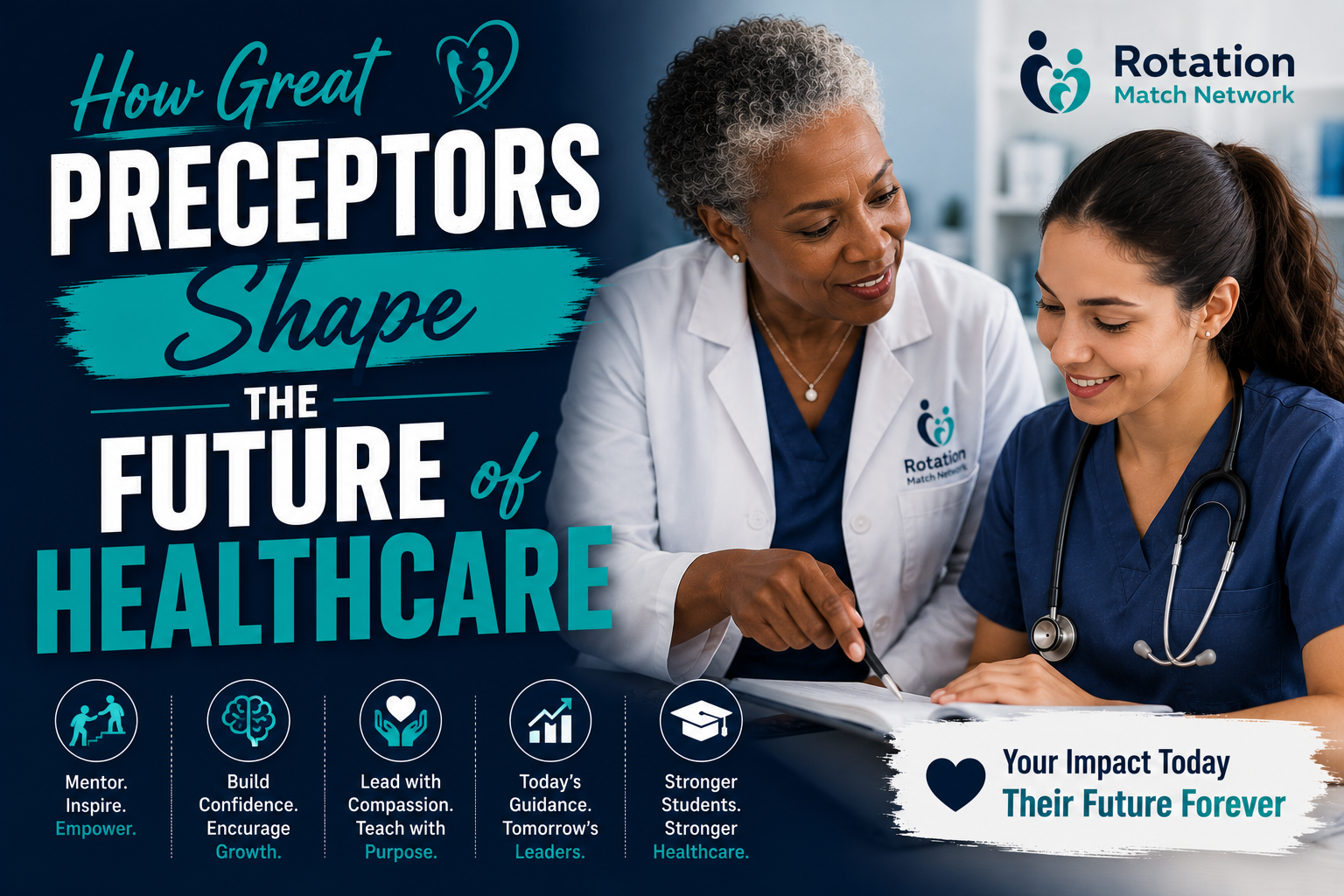
How Great Preceptors Shape the Future of Healthcare | Rotation Match Network
Every healthcare professional can remember someone who made a difference in their journey.
It may have been a professor who encouraged them when they struggled, a nurse who patiently demonstrated a clinical skill, a physician who allowed them to ask questions without judgment, or a preceptor who saw potential in them before they saw it in themselves.
These experiences often become more than memories. They shape the kind of healthcare professional a student eventually becomes.
This is the power of a great preceptor.
A clinical preceptor does more than supervise a student during a rotation. Great preceptors teach, challenge, encourage, correct, listen, and inspire. They help students turn classroom knowledge into practical skills and give them the confidence to step into the healthcare profession.
At a time when healthcare continues to evolve and the demand for qualified healthcare professionals continues to grow, the role of preceptors has never been more important.
What Is a Clinical Preceptor?
A clinical preceptor is an experienced healthcare professional who guides and supervises a student during a clinical rotation.
Depending on the student's program, a preceptor may be a nurse practitioner, physician assistant, physician, registered nurse, certified registered nurse anesthetist, pharmacist, or another qualified healthcare professional.
The preceptor provides students with opportunities to observe, practice, ask questions, develop clinical judgment, and experience what it is like to work directly with patients.
But the role goes beyond clinical supervision.
A preceptor is also a teacher, mentor, role model, and professional guide.
The Difference Between a Preceptor and a Great Preceptor
Having clinical knowledge is important, but being knowledgeable alone does not automatically make someone a great preceptor.
A great preceptor understands that students are still learning.
They remember what it felt like to be unsure of themselves, make mistakes, ask questions, and encounter situations they had only previously studied in a classroom.
Instead of simply telling students what to do, great preceptors help them understand why something should be done.
They encourage students to think critically rather than simply memorize information.
They create an environment where students can learn without being afraid to ask questions.
Most importantly, they understand that the goal is not to create a student who depends on them. The goal is to help develop a confident healthcare professional who can eventually practice independently and responsibly.
Great Preceptors Bridge the Gap Between the Classroom and Real Life
Healthcare education involves extensive classroom learning.
Students study anatomy, physiology, pharmacology, pathophysiology, assessment, diagnosis, treatment, and countless other subjects.
But real patients do not always behave like textbook examples.
A patient may present with several conditions at the same time. A patient's history may be incomplete. A treatment plan may need to be adjusted. A conversation with a patient may require empathy and patience rather than simply clinical knowledge.
This is where clinical experience becomes invaluable.
Preceptors help students connect what they have learned in the classroom to what actually happens in a healthcare setting.
A student may know the clinical guidelines for managing a condition, but a preceptor can help them understand how to apply those guidelines while considering the patient's individual circumstances.
That transition from theory to practice is one of the most important parts of healthcare education.
Great Preceptors Teach Students How to Think
One of the greatest gifts a preceptor can give a student is the ability to think critically.
Instead of immediately providing an answer, a good preceptor may ask:
"What do you think is happening?"
"What information would you need before making that decision?"
"What other possibilities should we consider?"
"Why would you choose this approach?"
Questions like these encourage students to analyze situations instead of simply waiting for instructions.
Over time, students become more comfortable making clinical decisions, explaining their reasoning, and recognizing when they need additional information or assistance.
These skills remain valuable long after the clinical rotation ends.
Great Preceptors Build Confidence
Starting a clinical rotation can be intimidating.
Students may worry about making mistakes, communicating with patients, answering questions incorrectly, or failing to meet expectations.
A supportive preceptor can completely change that experience.
This does not mean giving students constant praise or avoiding constructive criticism. In fact, effective preceptors provide honest feedback while helping students understand that learning takes time.
A simple statement such as "You are improving" or "Let's work through this together" can make a significant difference to a student who is struggling with confidence.
When students feel supported, they are more likely to ask questions, accept feedback, and challenge themselves.
Confidence developed during clinical training can follow a student throughout their professional career.
Great Preceptors Teach Professionalism
Healthcare is not only about clinical knowledge.
Patients remember whether they were treated with dignity. Colleagues remember whether someone communicated respectfully. Healthcare organizations depend on professionals who are reliable, ethical, accountable, and compassionate.
Preceptors have an opportunity to model these qualities every day.
Students observe how their preceptors:
- Communicate with patients
- Handle difficult conversations
- Work with colleagues
- Respond to stressful situations
- Protect patient privacy
- Manage their time
- Respond to mistakes
- Treat support staff
- Approach difficult clinical decisions
Sometimes students learn more from what a preceptor does than from what the preceptor says.
This is why leading by example is such an important part of clinical education.
Great Preceptors Teach That Patients Are People, Not Just Cases
Clinical education can sometimes become focused on diagnoses, medications, laboratory results, and treatment plans.
But behind every diagnosis is a person.
Great preceptors help students remember this.
They demonstrate the importance of listening to patients, understanding their concerns, respecting their backgrounds, and involving them in decisions about their care.
For students entering fields such as psychiatric mental health, family practice, physician assistant studies, nursing, anesthesia, and other healthcare specialties, developing strong patient communication skills is just as important as developing technical knowledge.
A great preceptor helps students understand that excellent healthcare combines competence with compassion.
Feedback Can Change a Student's Career
One of the most valuable responsibilities of a preceptor is providing meaningful feedback.
Students need to know what they are doing well, but they also need to know where they can improve.
Effective feedback should be specific, respectful, and focused on growth.
Instead of simply saying:
"You need to communicate better."
A preceptor might explain:
"Your clinical assessment was thorough, but try slowing down when explaining the treatment plan so the patient has more opportunity to ask questions."
The second approach gives the student something practical to work on.
When feedback is delivered constructively, it becomes a tool for development rather than a source of discouragement.
Great Preceptors Encourage Students to Ask Questions
A student who is afraid to ask questions may miss valuable learning opportunities.
Great preceptors create an environment where appropriate questions are welcomed.
They understand that asking questions does not necessarily indicate a lack of knowledge. Often, it demonstrates curiosity and a desire to understand.
A student may remember a preceptor who patiently answered their questions years after forgetting the details of the clinical case that prompted the conversation.
That is the lasting impact of mentorship.
Great Preceptors Help Students Discover Their Strengths
Clinical rotations can help students discover what they enjoy and where their strengths lie.
A student who begins a rotation uncertain about their future specialty may discover a passion for a particular patient population or area of healthcare.
Preceptors can help students recognize these strengths by observing their performance and providing encouragement.
Perhaps a student demonstrates exceptional communication with patients.
Perhaps they have strong analytical skills.
Perhaps they remain calm during challenging situations.
A preceptor who notices these qualities can help students understand their potential and encourage them to develop it further.
The Impact of One Preceptor Can Reach Far Beyond One Student
Consider a healthcare professional who mentors ten students over several years.
Those students may eventually care for thousands of patients.
Some may become preceptors themselves.
Some may become clinical leaders, educators, researchers, or healthcare administrators.
Some may mentor other students and continue the cycle.
This means the impact of a single preceptor can extend far beyond the students they directly supervise.
Knowledge and professional values can be passed from one generation of healthcare professionals to the next.
That is the true power of clinical mentorship.
Why Healthcare Needs More Great Preceptors
Healthcare education depends on meaningful clinical experiences.
As more students pursue advanced healthcare careers, the need for qualified and committed clinical preceptors becomes increasingly important.
Without enough preceptors, students may struggle to find the clinical placements required to complete their programs.
But increasing the number of preceptors is only part of the solution.
The healthcare profession also needs clinicians who are willing to invest in students and provide meaningful learning experiences.
Precepting is not simply about filling a placement requirement.
It is about preparing the next generation to provide safe, competent, and compassionate care.
Becoming a Preceptor Is an Opportunity to Give Back
Many experienced healthcare professionals have benefited from mentors throughout their own careers.
Becoming a preceptor provides an opportunity to continue that tradition.
You can share the lessons you learned through years of education and practice.
You can help students avoid mistakes that you once made.
You can introduce them to perspectives they may not encounter in a classroom.
And you can encourage them during moments when they doubt themselves.
For many clinicians, watching a student grow from an uncertain learner into a confident healthcare professional is one of the most rewarding parts of precepting.
How to Become the Preceptor Students Remember
If you are considering becoming a preceptor, you do not need to have all the answers.
What students often need most is someone who is willing to teach, communicate, provide honest feedback, and allow them to learn.
Here are a few principles that can help you become an effective preceptor:
Be Approachable
Students should feel comfortable asking questions and seeking clarification.
Set Clear Expectations
At the beginning of the rotation, discuss expectations, responsibilities, communication, and learning objectives.
Give Regular Feedback
Do not wait until the end of the rotation to tell students how they are performing.
Lead by Example
Demonstrate professionalism, empathy, accountability, and respect in your daily practice.
Encourage Critical Thinking
Ask students to explain their reasoning instead of simply giving them the answer.
Recognize Progress
Small improvements matter. Recognizing progress can motivate students to continue developing their skills.
Be Patient
Students are learning. Mistakes and uncertainty are part of the educational process, provided they are addressed safely and appropriately.
How Rotation Match Network Supports Clinical Connections
Finding the right student or preceptor can sometimes be challenging.
Healthcare professionals may be interested in mentoring but may not know how to connect with students who need clinical experiences. At the same time, students may spend significant time searching for qualified preceptors who are available during their required rotation period.
Rotation Match Network helps bridge this gap by providing a platform designed to connect healthcare students with preceptors and simplify the clinical placement process.
By creating opportunities for students and experienced healthcare professionals to connect, the platform supports the development of meaningful clinical learning experiences.
The ultimate goal is simple: help students gain the clinical experience they need while giving qualified professionals an opportunity to contribute to the future of healthcare.
A Student May Remember You for Years
Years from now, a student may not remember every patient they encountered during their clinical rotation.
They may not remember every diagnosis they discussed or every procedure they observed.
But they may remember the preceptor who encouraged them when they were struggling.
They may remember the clinician who patiently explained something they did not understand.
They may remember the person who trusted them with a little more responsibility as their confidence grew.
They may remember being treated with respect.
That is the legacy of a great preceptor.
Final Thoughts
Great healthcare professionals do not simply treat patients. They also help prepare the people who will care for patients in the future.
A preceptor has the opportunity to influence a student's knowledge, confidence, professionalism, communication, and approach to patient care.
The impact may begin with one student and one clinical rotation, but it can continue for decades through every patient that student eventually serves and every future clinician they may mentor.
If you are an experienced healthcare professional considering becoming a preceptor, remember that your knowledge and experience are valuable.
Someone is looking for the opportunity to learn from someone like you.
Through Rotation Match Network, you can take that next step and become part of the journey of an aspiring healthcare professional.
Because when you mentor a student, you are not simply teaching someone how to practice healthcare.
You are helping shape the future of healthcare.
Primary keyword:
Clinical preceptors
Secondary keywords:
- Great clinical preceptor
- Clinical preceptor mentorship
- How to become a preceptor
- Benefits of being a preceptor
- Healthcare preceptor
- Clinical rotation
- Clinical education
- Healthcare student mentorship
- Preceptor for healthcare students
- Clinical placement
- Student preceptor relationship
- Healthcare professionals
- Rotation Match Network