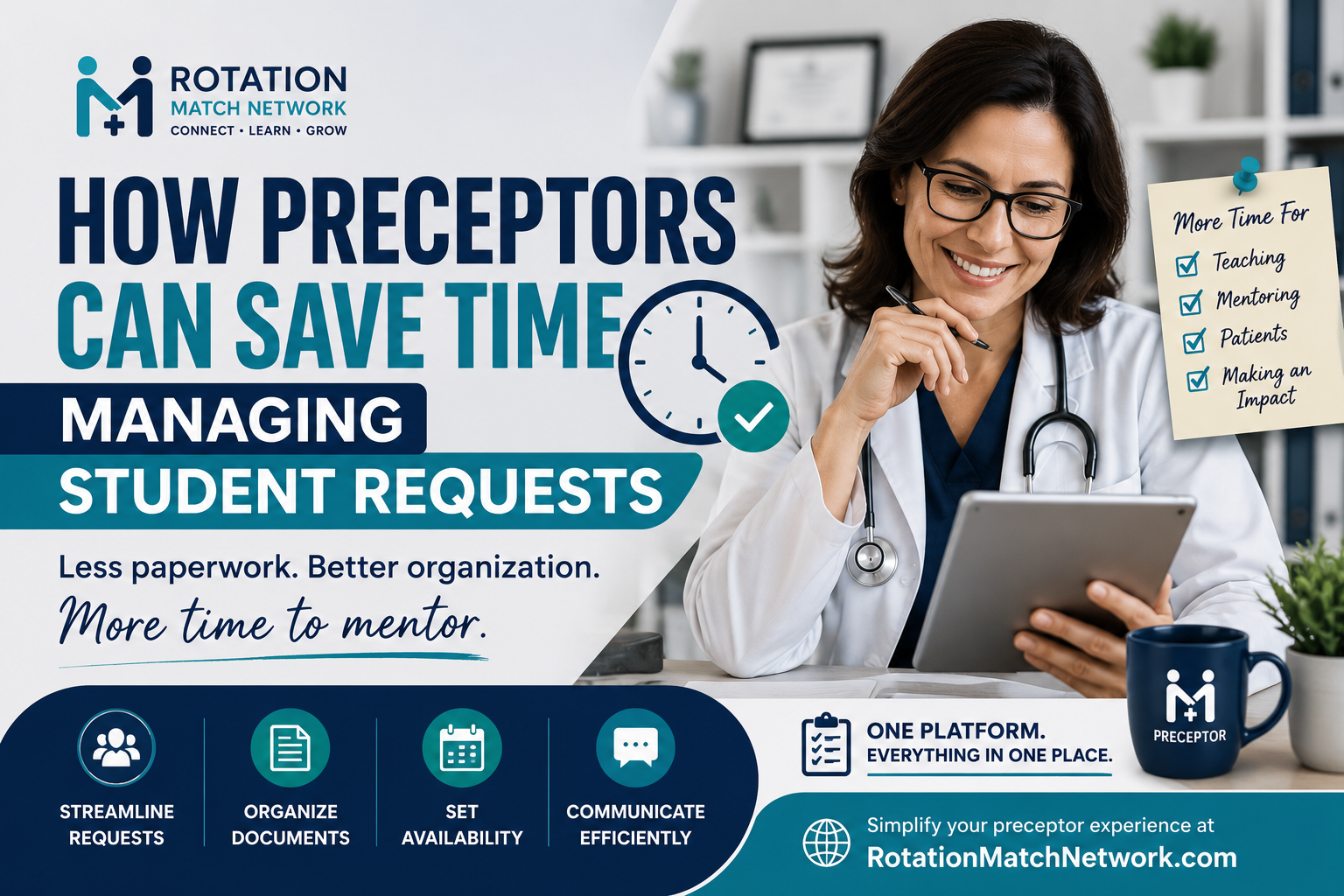
HOW PRECEPTORS CAN SAVE TIME MANAGING STUDENT REQUESTS
Being a clinical preceptor can be incredibly rewarding.
You get the opportunity to mentor the next generation of healthcare professionals, share your experience, and help students turn classroom knowledge into real clinical skills.
But there is another side to being a preceptor that does not always get talked about.
The emails.
The student requests.
The questions about availability.
The documents.
The follow ups.
The schedule changes.
And the constant back and forth trying to determine which students are a good fit for your practice and rotation schedule.
For busy physicians, nurse practitioners, physician assistants, nurses, and other healthcare professionals, managing student clinical rotation requests can quickly become another administrative responsibility.
The good news is that it does not have to be this complicated.
With a few simple strategies and the right clinical placement management platform, preceptors can spend less time managing requests and more time doing what matters most: providing excellent mentorship.
Why Managing Student Requests Can Become Time Consuming
A single student request may seem easy to handle.
But when multiple students are contacting you about different rotation dates, specialties, requirements, and schedules, things can quickly become difficult to organize.
You may find yourself answering the same questions repeatedly:
Are you accepting students?
What dates are you available?
What specialty do you precept in?
How many students can you take?
What documents do you require?
What are your rotation expectations?
Do you accept students from my program?
When you manage these conversations through scattered emails, text messages, phone calls, and spreadsheets, it becomes difficult to see the full picture.
A better approach is to create a system that allows students to see relevant information before they submit a request and gives you a simple way to review and respond to requests.
1. Keep Your Preceptor Profile Up to Date
One of the easiest ways to save time is to make sure students have the information they need before they contact you.
Your preceptor profile should clearly communicate your:
Specialty
Clinical setting
Location
Available rotation dates
Preferred student programs
Clinical experience
Requirements
Expected rotation schedule
Number of students you can accommodate
The more information students can see upfront, the fewer basic questions you will have to answer repeatedly.
A clear profile also helps students determine whether you are actually a good match for their rotation requirements before submitting a request.
On Rotation Match Network, preceptors can create a professional profile that showcases their clinic, specialty, and availability, helping students find opportunities that fit their needs.
Create your preceptor profile on Rotation Match Network
2. Set Your Availability Before Requests Start Coming In
One of the biggest challenges for preceptors is receiving student requests for dates when they are already fully booked.
If students do not know when you are available, you may spend valuable time responding to requests that you ultimately have to decline.
Instead, keep your availability updated.
If you know that you can accept students during certain months or specific rotation periods, make those dates visible.
Likewise, if you are unavailable because of vacation, professional commitments, a full student schedule, or other responsibilities, update your availability accordingly.
Rotation Match Network allows preceptors to set their availability so that students can identify potential opportunities before submitting requests.
That simple step can reduce unnecessary back and forth and make the matching process more efficient.
3. Review Requests in a Consistent Way
When a student request arrives, it can be tempting to open it quickly, glance at the basic information, and decide whether to accept or decline.
A better approach is to develop a simple review process.
Consider checking:
Does the student's specialty match your practice?
Do the requested dates fit your availability?
Does the student's program meet your requirements?
Has the student provided the required information?
Does the student's clinical goal align with what your practice can offer?
Is the requested number of clinical hours realistic?
Having a consistent review process makes decisions faster and helps you avoid overlooking important details.
4. Do Not Let Student Requests Sit Unanswered
Students often work with strict academic deadlines.
A delayed response from a preceptor can create unnecessary stress for a student who is trying to secure a clinical placement.
If you are unable to accept a student, declining the request promptly is often more helpful than leaving it unanswered.
If you are interested but need additional information, let the student know what you need.
A quick response does not necessarily mean you need to write a long message.
Even a simple response such as:
"Thank you for your request. I am reviewing my availability and will get back to you shortly."
can help keep communication clear.
A centralized platform can make this process easier by bringing requests and status updates into one place.
5. Use Templates for Common Questions
If you frequently receive the same questions from students, create a few reusable responses.
For example, you could have a standard message explaining:
Your availability
Your clinical expectations
Required documents
Arrival time
Dress code
Communication preferences
Rotation schedule
This does not mean every message should feel robotic.
Personalize the important details, but avoid rewriting the same information from scratch every time.
Templates can save several minutes per request, and those minutes can add up quickly when you are managing multiple students.
6. Keep Student Documents Organized
Clinical placements often involve documentation and compliance requirements.
Depending on the school, program, and clinical site, students may need to provide documentation such as immunization records, background checks, certifications, or other requirements.
Managing these documents through email attachments can become difficult.
You may have files in different email threads, outdated attachments, or documents that are difficult to locate when you need them.
A centralized system can make document management much easier.
Rotation Match Network provides a secure clinical placement workspace where students can submit compliance documents while administrators can verify requirements. The platform also provides an audit ready timeline for document and status activity.
For preceptors, this means less time searching through emails and more visibility into whether a student is ready for placement.
7. Communicate Through One Organized Channel
One student might email you.
Another might text you.
Another might contact your clinic.
Another might send a message through a school coordinator.
Before long, important information can become scattered across multiple communication channels.
Whenever possible, keep rotation related communication organized in one place.
This makes it easier to look back at previous conversations, confirm what was agreed upon, and avoid repeating questions.
Rotation Match Network provides HIPAA compliant messaging as part of its preceptor workflow, helping keep communication connected to the student's placement process.
8. Know When to Accept and When to Decline
Being a good preceptor does not mean accepting every student who contacts you.
In fact, taking on more students than you can properly mentor can negatively affect both you and the student.
Consider declining a request when:
The requested dates do not fit your schedule.
You already have your maximum number of students.
The student's requirements do not match your clinical setting.
You cannot provide the required clinical experience.
The placement would interfere with patient care or your professional responsibilities.
A clear and timely decline is better than accepting a student and later realizing that you cannot provide the experience they need.
The goal is not to accept the most students.
The goal is to create meaningful clinical learning experiences for the students you do accept.
9. Set Expectations Before the Rotation Begins
Once you accept a student, establish expectations early.
Discuss:
Arrival and departure times
Dress code
Attendance
Clinical responsibilities
Patient interaction
Documentation
Learning objectives
Questions and feedback
Communication outside clinical hours
The more clearly expectations are communicated at the beginning, the fewer misunderstandings you are likely to encounter later.
It also helps students feel more confident because they know what is expected of them.
10. Let Technology Handle the Administrative Work
Your most valuable resource as a healthcare professional is your time.
Every minute spent searching through emails, checking spreadsheets, answering repetitive questions, or trying to determine the status of a student's paperwork is time that could be spent caring for patients or mentoring students.
This is why clinical placement technology can make such a difference.
Instead of managing every part of the process manually, preceptors can use a centralized platform to manage availability, review student requests, communicate with students, and stay organized.
That is exactly the problem Rotation Match Network is designed to address.
How Rotation Match Network Helps Preceptors Save Time
Rotation Match Network was built with the realities of clinical placement in mind.
The platform brings students and preceptors into one organized clinical placement environment.
For preceptors, that means you can:
Set your availability once
Let students know when you are available to accept rotations instead of answering the same availability questions repeatedly.
Review student requests
See student information and review requests in one place rather than managing scattered email conversations.
Manage your professional profile
Showcase your specialty, clinical setting, and availability so students can determine whether your opportunity fits their needs.
Communicate securely
Use the platform's HIPAA compliant messaging features to keep placement related communication organized.
Reduce paperwork headaches
Keep the placement process connected to document and compliance workflows instead of relying entirely on email attachments.
Spend more time mentoring
The less time you spend on administrative coordination, the more time you can dedicate to teaching and supporting your students.
Learn more about becoming a preceptor with Rotation Match Network
A Better Way to Manage Clinical Rotation Requests
Being a preceptor should not feel like taking on a second administrative job.
You became a preceptor because you want to teach, mentor, and contribute to the future of healthcare.
That is why your clinical placement process should be designed around your time.
Start by keeping your profile updated.
Set your availability.
Use a consistent process for reviewing requests.
Create templates for common questions.
Keep documents organized.
Communicate through a centralized channel.
And use technology to handle as much of the administrative work as possible.
These small changes can make a significant difference when you are managing multiple student requests.
Ready to Spend Less Time Managing Requests?
If you are a healthcare professional interested in becoming a preceptor, or you already precept students and want a more organized way to manage clinical rotation requests, Rotation Match Network can help.
Rotation Match Network brings student requests, preceptor availability, communication, documents, and placement tracking into one clinical placement workspace.
Instead of spending your time chasing emails and sorting through paperwork, you can focus on what matters most: mentoring the next generation of healthcare professionals.
Set your availability. Review requests. Mentor with confidence.
Join Rotation Match Network as a Preceptor
Primary keyword:
how preceptors can save time managing student requests
Secondary keywords:
preceptor student requests
how to manage student clinical rotation requests
clinical rotation preceptor
clinical preceptor management
preceptor management system
clinical placement management
how to become a clinical preceptor
preceptor availability
clinical rotation requests
managing nursing student requests
managing NP student requests
student placement requests
clinical preceptor tips