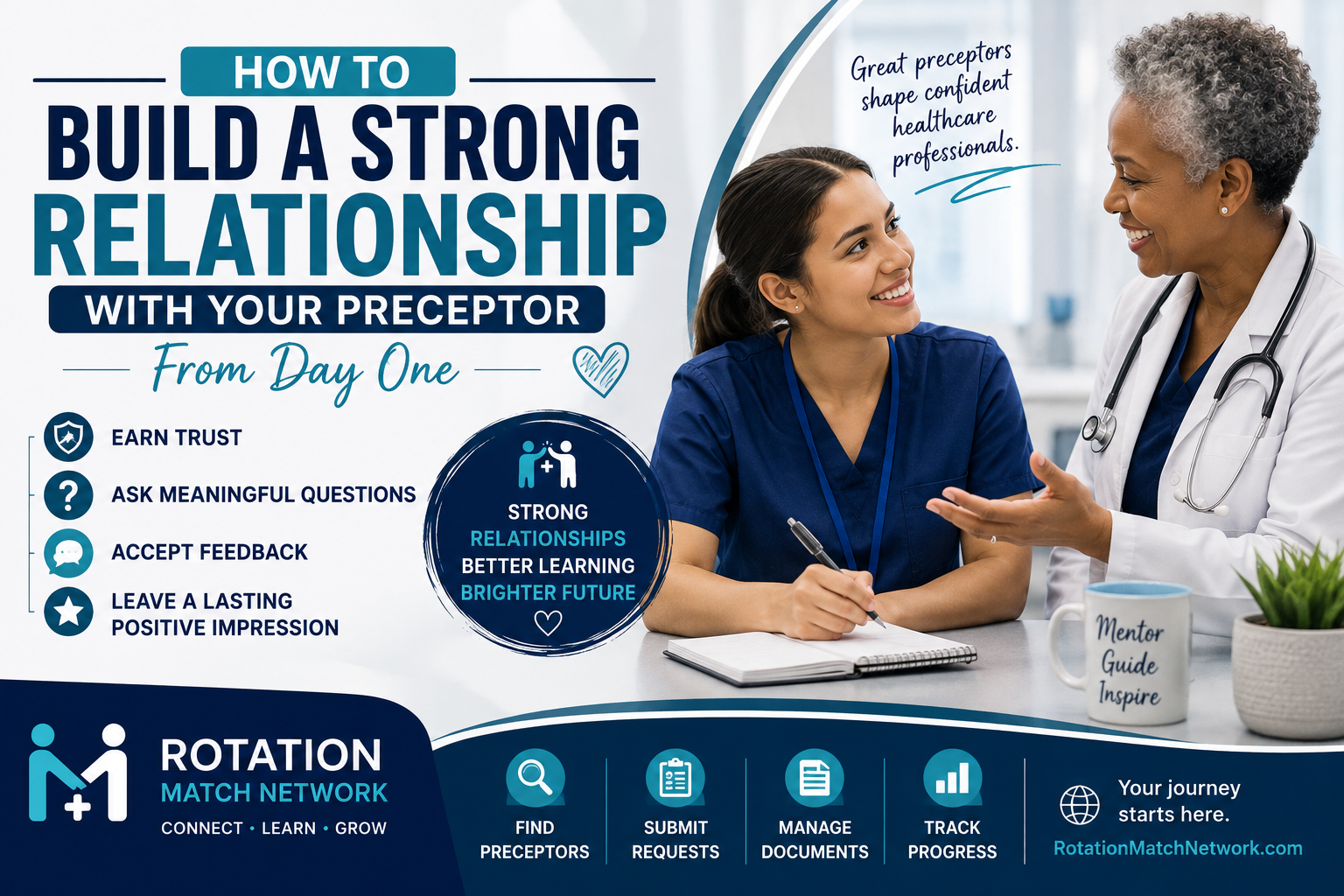
How to Build a Strong Relationship With Your Preceptor From Day One
Finding a clinical preceptor can feel like a huge accomplishment.
After searching for available opportunities, sending requests, completing your documents, and finally receiving that acceptance, it is tempting to think the hardest part is over.
But getting a clinical placement is only the beginning.
Your relationship with your preceptor can have a major influence on how much you learn, how comfortable you become in the clinical environment, and how prepared you feel when you eventually enter professional practice.
Your preceptor is not simply the person responsible for signing your clinical hours.
They are someone who can guide you, challenge your thinking, give you feedback, introduce you to real clinical situations, and help you understand what it means to work as a healthcare professional.
So how do you build a strong relationship with your preceptor from day one?
Start With Professional Communication
Your relationship with your preceptor begins before your first clinical day.
The way you communicate when you first connect can already tell your preceptor a lot about you.
Be clear, respectful, and professional in your messages.
Introduce yourself properly and briefly explain your program, specialty, expected rotation dates, and what you are hoping to learn.
Avoid sending messages that simply say, "Are you available?"
Instead, give your preceptor enough information to understand who you are and what you need.
For example, you could say:
Hello Dr. Smith, my name is Sarah, and I am an FNP student looking for a primary care clinical placement from September through November. I came across your profile and noticed that your practice aligns with my clinical requirements. I would appreciate the opportunity to discuss whether you might be available to precept during this period.
A thoughtful first message creates a much better impression than a rushed one.
Do Your Research Before Your First Day
Once your placement is confirmed, take some time to learn about your preceptor and clinical site.
Understand the type of practice you will be joining, the patient population you may encounter, and the specialty in which your preceptor works.
If your preceptor specializes in a particular area, review some relevant concepts before you arrive.
You are not expected to know everything.
But showing up prepared demonstrates that you respect your preceptor's time and are genuinely interested in learning.
It also gives you a foundation for asking better questions.
Ask Your Preceptor What They Expect From You
One of the best things you can do at the beginning of your rotation is ask about expectations.
Do not assume that every preceptor operates the same way.
Ask questions such as:
What time should I arrive?
What should I wear?
What should I bring?
How would you like me to communicate with you?
What should I do if I am unsure about something?
What are your expectations for documentation?
What should I review before seeing patients?
How would you like me to prepare for each clinical day?
These questions show initiative and help prevent misunderstandings later.
They also give your preceptor an opportunity to explain how they prefer to work with students.
Be Curious, But Ask Meaningful Questions
Your preceptor is there to help you learn, so do not be afraid to ask questions.
However, there is a difference between asking questions simply to get an answer and asking questions that demonstrate critical thinking.
Instead of immediately asking:
"What is the diagnosis?"
Try thinking through the situation first.
You might ask:
"What findings led you toward this diagnosis?"
"Would you consider any other possible diagnoses?"
"Why did you choose this treatment approach?"
"What would make you change the treatment plan?"
"What should I be watching for in this patient?"
Questions like these can turn ordinary clinical situations into valuable learning opportunities.
Your preceptor will also see that you are trying to understand the reasoning behind clinical decisions rather than simply memorizing answers.
Listen When Your Preceptor Gives Feedback
Feedback is one of the most valuable parts of clinical education.
Sometimes the feedback will be encouraging.
Other times, your preceptor may tell you that something needs to improve.
Do not take constructive feedback personally.
You are a student, and learning means discovering what you know, what you do not know, and what you need to improve.
Listen carefully.
Ask for clarification if you do not understand.
Then apply the feedback.
If your preceptor corrects the same issue repeatedly, take it seriously and make a deliberate effort to improve.
Nothing demonstrates growth more clearly than showing that you listened to previous feedback and acted on it.
Take Initiative
Being proactive can make a significant difference in your clinical experience.
This does not mean doing things you are not authorized or prepared to do.
It means taking responsibility for your learning.
If you know you will be seeing patients with a particular condition, review it beforehand.
If you notice that your preceptor is preparing for a procedure that you are allowed to observe, ask whether you can watch.
If you have finished your assigned task, ask what else you can learn from.
You do not have to wait for every learning opportunity to be handed to you.
A student who demonstrates genuine curiosity and initiative is much easier to mentor.
Respect Your Preceptor's Time
Your preceptor is a healthcare professional with responsibilities beyond teaching you.
They may have patients waiting, documentation to complete, staff to manage, and other clinical responsibilities.
Respect their time.
Arrive when you are expected to arrive.
Come prepared.
Avoid asking questions at inappropriate moments when your preceptor is dealing with an urgent situation.
Learn to recognize when your question can wait and when it needs to be addressed immediately.
Professionalism includes understanding that your preceptor is balancing mentorship with patient care.
Be Reliable
Trust is built through consistency.
If you say you will do something, do it.
If you are expected to arrive at a certain time, arrive on time.
If you have a problem that could affect your attendance, communicate as early as possible.
If you make a mistake, take responsibility instead of trying to hide it.
Your preceptor needs to know that they can depend on you.
You may not realize it at first, but small habits like punctuality, preparation, honesty, and follow through can have a significant impact on your professional reputation.
Treat Every Patient With Respect
Your relationship with your preceptor is important, but your relationship with patients matters just as much.
Always remember that the people you encounter during clinical rotations are not simply opportunities to practice your skills.
They are people who deserve dignity, privacy, empathy, and respect.
Listen when they speak.
Protect confidential information.
Be mindful of your language and body language.
Never allow your desire to learn to overshadow the patient's comfort or safety.
A strong clinical student understands that patient care comes first.
Keep Communication Open Throughout Your Rotation
Do not limit communication with your preceptor to your first day.
Check in regularly.
If something is unclear, ask.
If you are struggling with a particular skill, communicate that.
If you feel that you are not getting enough exposure to an area required by your program, discuss it professionally with your preceptor.
Good communication allows problems to be addressed before they become bigger issues.
It also helps your preceptor understand how they can support your learning.
Use Your Clinical Placement as an Opportunity to Grow
Your clinical rotation is about more than completing a required number of hours.
It is an opportunity to discover what kind of healthcare professional you want to become.
Pay attention to how your preceptor communicates with patients.
Observe how they handle difficult situations.
Notice how they organize their day.
Watch how they work with other members of the healthcare team.
Think about what you admire and what you would do differently.
Every clinical experience can teach you something about the professional you want to become.
Finding the Right Preceptor Is Only the Beginning
Before you can build a strong relationship with a preceptor, you first have to find the right clinical placement.
And that can be one of the most challenging parts of healthcare education.
Students often have to search for preceptors who match their specialty, location, schedule, and program requirements. They may also need to submit placement requests, communicate with clinicians, complete compliance requirements, and keep track of their application status.
Trying to manage all of this through scattered emails, spreadsheets, messages, and different websites can quickly become overwhelming.
This is where Rotation Match Network can help.
The platform is designed to bring students and preceptors together while keeping the clinical placement process organized. Students can search for available preceptors, review placement opportunities, submit requests, and track their applications from one place.
Your Clinical Placement Journey Starts With the Right Match
Finding a preceptor should not mean endlessly searching through random websites, sending unanswered emails, or trying to keep track of multiple conversations.
With Rotation Match Network, students can search for clinical preceptors based on their placement needs and submit requests through a structured platform.
Once you find a potential match, the process continues beyond the initial request.
RMN provides a centralized workspace where students can keep track of their applications, placement progress, deadlines, and required compliance documents.
That means you can spend less time worrying about where your placement stands and more time preparing for the experience itself.
Start your clinical placement search with Rotation Match Network and take the first step toward finding a preceptor who can support your clinical learning journey.
The Best Clinical Relationships Are Built on Trust
A strong student preceptor relationship does not happen overnight.
It develops through communication, preparation, reliability, curiosity, respect, and a willingness to learn.
Your preceptor does not expect you to know everything.
They do expect you to show up ready to learn.
So ask questions.
Listen to feedback.
Be prepared.
Take initiative.
Respect your patients.
Respect your preceptor's time.
And most importantly, take responsibility for your own growth.
The clinical relationship you build during your rotation may become one of the most valuable parts of your healthcare education.
Ready to Find Your Clinical Preceptor?
Your clinical journey starts with finding the right placement.
Rotation Match Network helps healthcare students discover available preceptors, submit placement requests, manage compliance requirements, and keep track of their clinical placement progress in one organized platform.
Whether you are looking for a PMHNP, FNP, PA, CRNA, or another clinical placement, starting your search early can give you more time to find the right opportunity and prepare for your rotation.
Find your preceptor. Build the relationship. Make the most of your clinical experience.