
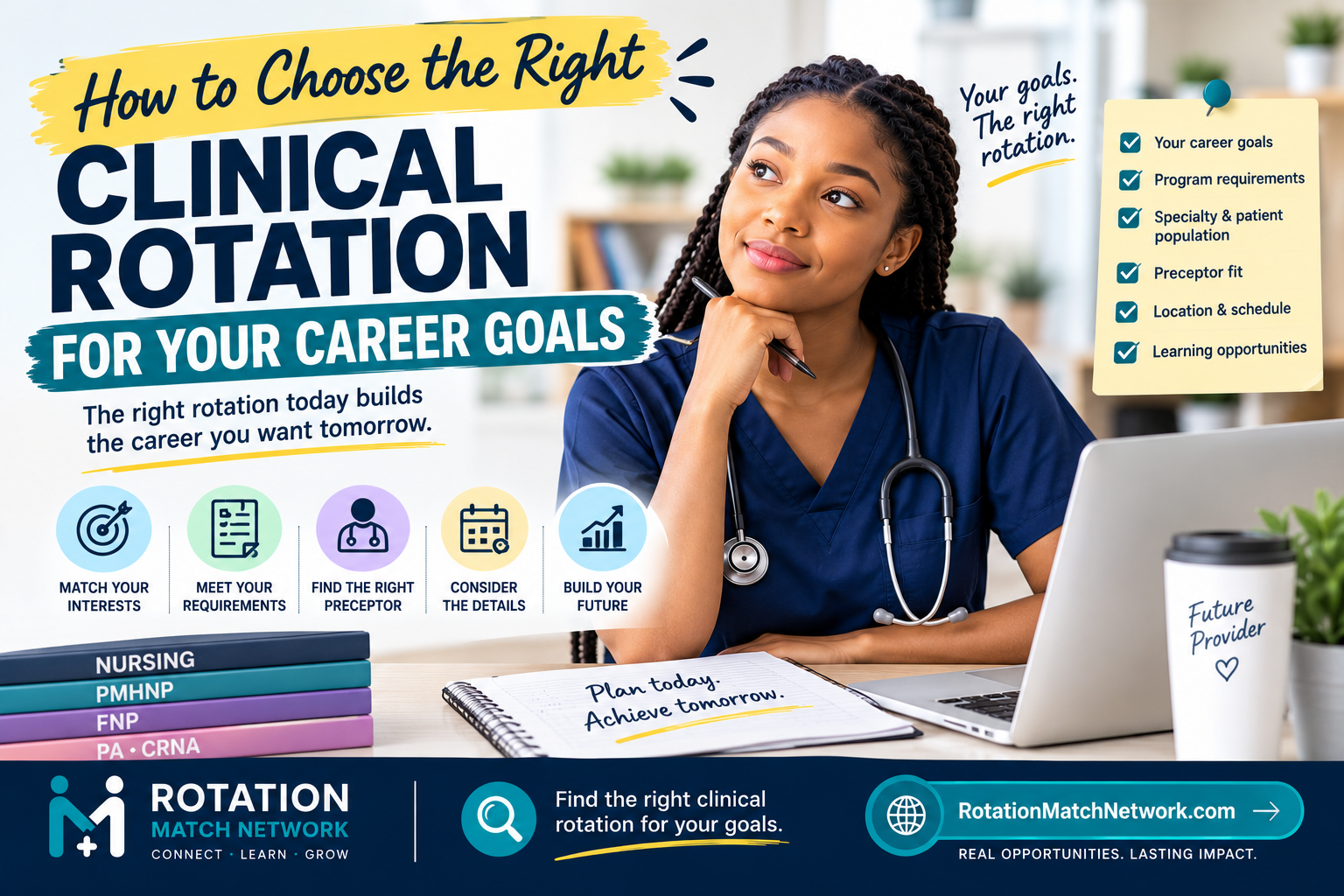
How to Choose the Right Clinical Rotation for Your Career Goals
Choosing a clinical rotation is about more than finding a preceptor who has an available spot.
The right clinical rotation can help you develop practical skills, explore a specialty, build professional confidence, and gain experience that supports your long term career goals. The wrong one may leave you with limited patient exposure, little connection to your interests, or an experience that does not fully meet your program requirements.
So, how do you choose the right clinical rotation?
Start by thinking beyond availability.
Your ideal rotation should fit your career goals, program requirements, specialty interests, schedule, learning needs, and professional development plans.
Here is how to evaluate your options before submitting a clinical rotation request.
1. Start With Your Career Goal
Before searching for a clinical rotation, ask yourself one important question:
What kind of healthcare professional do I want to become?
Your answer should influence the type of clinical experience you pursue.
For example, if you are interested in mental health, a psychiatry or behavioral health rotation may give you more relevant exposure than a general clinical placement.
If you are interested in family medicine, look for opportunities where you can interact with a broad range of patients and conditions.
If you are preparing for an advanced practice role, consider whether the rotation will allow you to develop the clinical decision making, assessment, communication, and patient management skills you will eventually need.
Your clinical rotation should move you closer to the professional you want to become.
2. Make Sure the Rotation Meets Your Program Requirements
A rotation can look perfect on paper and still be unsuitable if it does not satisfy your school's requirements.
Before accepting a clinical placement, confirm:
• Required clinical hours
• Specialty requirements
• Patient population requirements
• Required procedures or experiences
• Location requirements
• Start and end dates
• Preceptor qualifications
• Required documentation
• Any school specific clinical requirements
Do not assume that an available preceptor automatically meets your program's requirements.
If you are unsure, check with your program or clinical coordinator before accepting the placement.
3. Choose a Specialty That Supports Your Career Direction
Your specialty should be one of the biggest factors in choosing a clinical rotation.
Think about where you want your career to go.
Are you interested in:
• Family medicine?
• Psychiatry?
• Pediatrics?
• Women's health?
• Emergency medicine?
• Internal medicine?
• Primary care?
• Mental health?
• Acute care?
• Another specialized area?
Your clinical rotation gives you an opportunity to move beyond classroom learning and experience how healthcare is actually delivered in your area of interest.
You do not necessarily have to choose a specialty you are already committed to. A clinical rotation can also help you discover what you do not want to pursue.
That is valuable career information too.
4. Think About the Patient Population
The type of patients you work with can significantly affect what you learn.
Consider whether the rotation will expose you to:
• Children
• Adults
• Older adults
• Pregnant patients
• Patients with chronic conditions
• Patients with acute conditions
• Mental health patients
• Underserved populations
• Diverse patient populations
Ask yourself whether the patient population aligns with your program requirements and career interests.
If your goal is to work primarily with older adults, for example, a rotation that rarely exposes you to that population may not be the strongest choice.
5. Look at the Clinical Setting
The setting in which you complete your clinical rotation matters.
Different environments can provide very different experiences.
You might encounter opportunities in:
• Outpatient clinics
• Hospitals
• Urgent care centers
• Long term care facilities
• Skilled nursing facilities
• Community health settings
• Telehealth
• Specialty practices
• Inpatient settings
Think about the environment in which you want to develop your skills.
If your future career involves outpatient primary care, an outpatient rotation may give you more relevant experience than a placement focused entirely on another setting.
6. Consider What You Will Actually Get to Do
Do not choose a clinical rotation based only on the specialty or location.
Find out what your actual responsibilities will be.
Ask the preceptor:
What will I be allowed to do during the rotation?
Will you be able to:
• Participate in patient assessments?
• Take patient histories?
• Practice clinical skills?
• Observe procedures?
• Participate in patient education?
• Discuss cases with your preceptor?
• Develop clinical reasoning skills?
• Receive regular feedback?
A strong clinical rotation should give you opportunities to actively learn rather than simply observe.
Of course, your responsibilities will depend on your program, level of training, clinical site, and applicable rules.
7. Evaluate the Preceptor, Not Just the Placement
Two rotations in the same specialty can provide completely different experiences because of the preceptor.
A good clinical preceptor can influence how much you learn, how comfortable you feel asking questions, and how much feedback you receive.
Before accepting a preceptor, consider:
Does their experience match my learning goals?
Do they have experience working with students?
What is their teaching style?
How do they provide feedback?
Will they allow me to participate appropriately in patient care?
Are they available during the dates I need?
The right preceptor is not necessarily the person with the most impressive credentials.
It is the person whose experience, availability, teaching approach, and clinical environment fit your needs.
8. Consider the Schedule and Location
A great clinical opportunity is not useful if you cannot realistically attend it.
Before accepting a rotation, confirm:
• Where the clinical site is located
• How long the commute will take
• Which days you will be expected to attend
• The expected hours
• Whether the schedule fits your academic commitments
• Whether the rotation dates match your school's deadline
Be realistic about your availability.
A difficult commute or schedule conflict can affect your attendance, energy, and overall learning experience.
9. Think About the Skills You Want to Build
Your clinical rotation should help you become more capable, not simply help you complete your required hours.
Make a list of the skills you want to improve.
For example:
Clinical skills:
Patient assessment, documentation, procedures, diagnosis, treatment planning.
Communication skills:
Patient interviews, education, teamwork, professional communication.
Critical thinking:
Clinical reasoning, decision making, prioritization, and problem solving.
Professional skills:
Time management, confidence, leadership, collaboration, and professionalism.
Then ask whether the rotation will actually give you opportunities to develop those skills.
10. Consider Your Future Resume
Your clinical experience can become part of your professional story.
When you eventually apply for jobs, advanced programs, fellowships, or other opportunities, the clinical experiences you have gained may help demonstrate your exposure to specific patient populations, specialties, and healthcare environments.
Ask yourself:
Will this rotation give me experience that supports the professional direction I want to pursue?
You do not need to choose every rotation based on what will look impressive on a resume.
But when you have multiple suitable options, choosing the experience that aligns with your career goals can be a smart decision.
11. Do Not Choose Based on Location Alone
A convenient location is great.
But convenience should not be the only factor.
You might find a clinical placement five minutes from your home that provides limited exposure to the skills you need.
Another placement may require a longer commute but provide significantly better alignment with your specialty, patient population, learning objectives, and career plans.
The goal is not to find the closest clinical rotation.
The goal is to find the right clinical rotation.
12. Compare Your Options Before Accepting
If you have several clinical rotation opportunities available, create a simple comparison.
| FactorRotation ARotation BRotation C | |||
| Specialty | ✓ | ✓ | ✓ |
| Program requirements | ✓ | ? | ✓ |
| Patient population | ✓ | ✓ | ? |
| Clinical setting | ✓ | ✓ | ✓ |
| Schedule | ✓ | ? | ✓ |
| Location | ✓ | ✓ | ? |
| Learning opportunities | ✓ | ✓ | ? |
| Preceptor fit | ✓ | ? | ✓ |
| Career alignment | ✓ | ✓ | ? |
This makes it easier to separate what looks attractive from what actually fits your goals.
13. Ask Questions Before You Say Yes
Never be afraid to ask questions before accepting a clinical preceptor.
You can ask:
What will my typical clinical schedule look like?
What patient population will I primarily see?
What will my responsibilities be?
What skills will I have opportunities to practice?
How do you usually provide feedback to students?
What are your expectations for students?
Are there any additional clinical site requirements?
Does this rotation meet my required specialty and clinical hours?
These questions can help you identify potential problems before your rotation begins.
14. Start Your Search Early
Choosing the right clinical rotation becomes much harder when you are running out of time.
Starting early gives you more opportunities to:
• Compare different preceptors
• Find a better specialty match
• Review requirements
• Complete compliance documents
• Submit multiple requests
• Adjust your plans if a preceptor is unavailable
You should not wait until your rotation deadline is approaching before beginning your search.
The earlier you understand your requirements and begin looking, the more choices you are likely to have.
How Rotation Match Network Can Help You Find the Right Clinical Rotation
Once you know what you are looking for, the next challenge is finding an available clinical opportunity that actually matches your goals.
That is where Rotation Match Network can help.
Students can use Rotation Match Network to search available clinical rotations based on factors such as location and specialty, review preceptor requirements and rotation details, submit requests, upload required documents, and track application progress.
Instead of searching randomly and contacting preceptors one by one, you can use a platform designed specifically around clinical placement coordination.
Visit RotationMatchNetwork.com to explore available clinical rotation opportunities and begin your search.
A Simple Clinical Rotation Decision Checklist
Before accepting a clinical rotation, ask yourself:
☐ Does this rotation meet my school's requirements?
☐ Does the specialty support my career goals?
☐ Will I work with the patient population I need?
☐ Does the clinical setting provide relevant experience?
☐ Will I have meaningful opportunities to learn and participate?
☐ Is the preceptor a good fit for my learning style?
☐ Does the schedule work for me?
☐ Is the location realistic?
☐ Are the required documents and compliance requirements clear?
☐ Will this experience help me develop skills I need for my future career?
If you can confidently answer yes to most of these questions, you may have found a strong clinical match.
Your Clinical Rotation Should Be More Than a Requirement
It is easy to think of clinical rotations as something you simply have to complete before graduating.
But your rotation can be much more than required hours.
It can help you discover your interests, build confidence, develop practical skills, meet experienced healthcare professionals, and understand what your future career may actually look like.
So when choosing your next clinical rotation, do not ask only:
“Who has availability?”
Ask:
“Which clinical experience will help me become the healthcare professional I want to be?”
That question can lead you to a much better clinical placement.
And when you are ready to find that opportunity, start your search at RotationMatchNetwork.com.
Find the right rotation. Build the right experience. Move closer to your career goals.