How to Give Constructive Feedback to Clinical Students
Giving constructive feedback to clinical students is one of the most important responsibilities of a clinical preceptor. Students need more than the opportunity to observe and participate in patient care. They also need clear guidance on what they are doing well, where they need to improve, and how they can develop the skills required for their future careers.
However, giving feedback is not always easy. Some students may feel discouraged by criticism, while preceptors may struggle to address mistakes without affecting the student’s confidence.
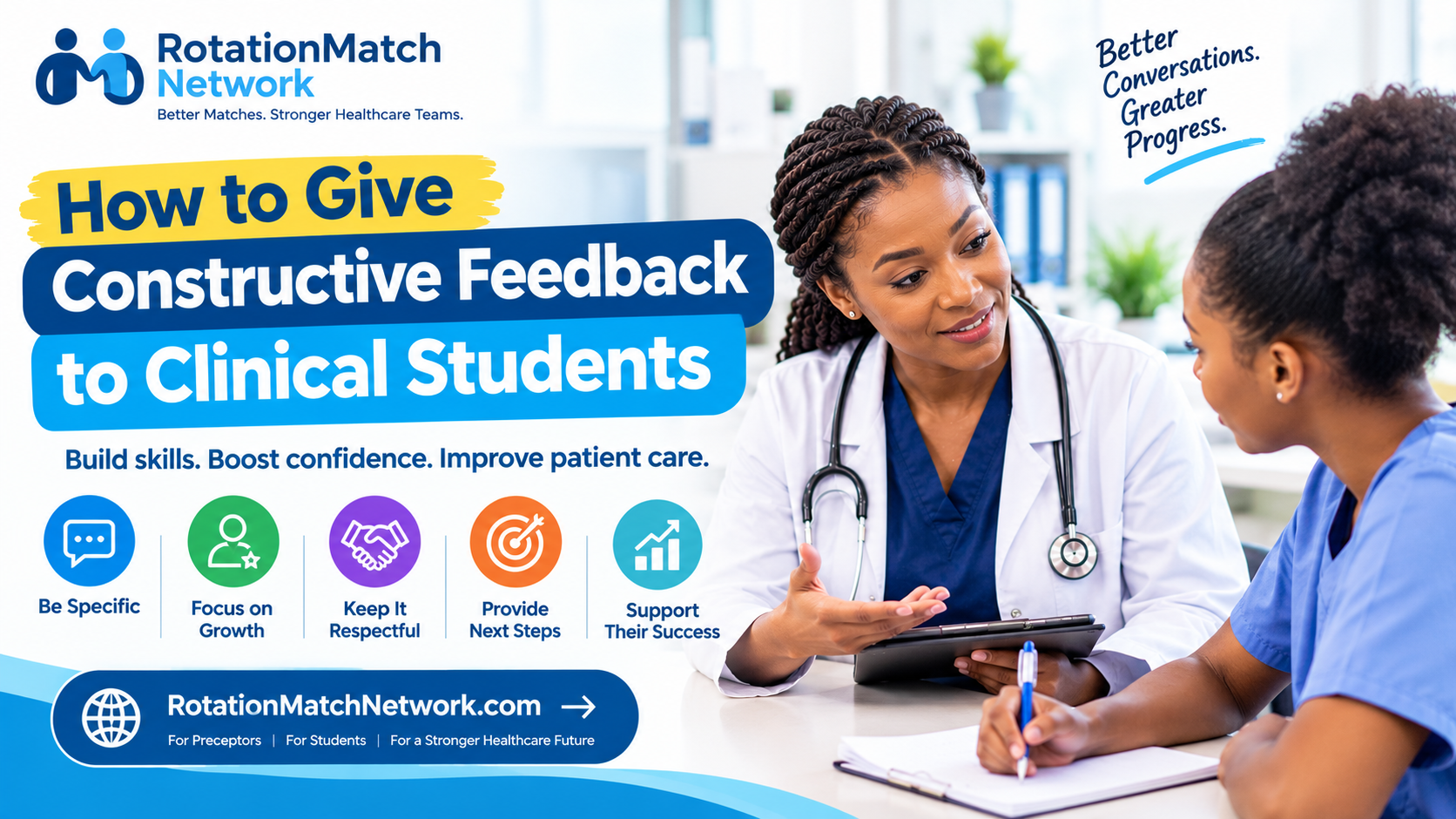
The key is to make feedback specific, respectful, timely, and focused on improvement.
Whether you are an experienced preceptor or mentoring your first clinical student, this guide explains how to give constructive feedback to clinical students, handle difficult conversations, and create a learning environment where students can grow.
If you are a healthcare professional looking to mentor students, or a student searching for a clinical placement, RotationMatchNetwork.com can help you take the next step toward a more organized clinical rotation experience.
What Is Constructive Feedback in Clinical Education?
Constructive feedback in clinical education is guidance that helps students understand their performance, recognize their strengths, correct mistakes, and improve their clinical knowledge and skills.
Effective feedback does not simply tell a student that something was wrong. It explains what happened, why it matters, and what the student can do differently next time.
For example, instead of telling a student, "You need to improve your communication," a preceptor could say:
"During today's patient interview, you moved to the next question before the patient had finished answering. Next time, allow the patient to finish speaking before asking your next question. This will help you gather more complete information and build trust."
The second example gives the student something specific to work on.
Constructive feedback can address clinical reasoning, communication, documentation, professionalism, time management, patient interactions, and other skills relevant to the student's training.
Why Is Constructive Feedback Important for Clinical Students?
Clinical rotations give students the opportunity to apply classroom knowledge in real healthcare settings. Feedback helps them understand how well they are applying that knowledge and where they need further development.
Here are some of the main benefits.
1. It Helps Students Improve Their Clinical Skills
Students may not always recognize gaps in their performance. A preceptor can identify these gaps early and guide the student toward improvement.
For example, a student may understand the importance of accurate documentation but struggle to organize clinical notes efficiently. Specific feedback can help the student develop a more consistent approach.
2. It Builds Confidence
Students are more likely to develop confidence when they understand what they are doing well and what they need to improve.
Constructive feedback should recognize progress while addressing areas that require attention. This helps students see mistakes as opportunities to learn rather than proof that they are incapable.
3. It Promotes Patient Safety
Clinical students are still learning, so appropriate supervision and timely feedback are essential.
If a student demonstrates a gap in knowledge or practice that could affect patient safety, the preceptor should address it promptly and ensure the student receives the necessary supervision.
Patient safety must always take priority over protecting a student's feelings.
4. It Encourages Professional Development
Clinical rotations help students develop professional habits, including accountability, communication, teamwork, and responsiveness to guidance.
Regular feedback helps students understand the standards expected of them in a healthcare environment.
5. It Strengthens the Preceptor Student Relationship
When preceptors communicate clearly and treat students respectfully, students are more likely to ask questions, acknowledge mistakes, and seek clarification.
A supportive relationship makes it easier to address problems before they become bigger challenges.
10 Tips for Giving Constructive Feedback to Clinical Students
1. Give Feedback as Soon as Possible
Feedback is usually more useful when it is given close to the event being discussed.
If a student struggles with patient communication during an interview, address the issue soon afterward while the details are still clear.
Waiting until the end of the rotation may leave the student repeating the same mistake without realizing that a problem exists.
However, choose the right moment. If the issue is not urgent, discuss it privately when the student can focus on the conversation.
If the issue creates an immediate patient safety concern, intervene at once and provide appropriate supervision.
2. Be Specific About What the Student Needs to Improve
General statements rarely give students enough information to change their behavior.
Comments such as "Do better next time" or "You need to be more professional" do not explain what the student should do differently.
Instead, identify the exact behavior and explain the expected improvement.
For example:
Instead of: "Your documentation is poor."
Try: "Your notes were missing important details about the patient's reported symptoms. Before submitting your next note, review it to ensure the relevant history and findings are documented according to our clinical requirements."
Specific feedback makes expectations easier to understand and follow.
3. Balance Positive Feedback With Areas for Improvement
Constructive feedback should recognize strengths as well as weaknesses.
If a student demonstrates good listening skills but needs to improve documentation, acknowledge both.
For example:
"You did a good job making the patient feel comfortable during the interview. Your next area of focus is documenting the relevant findings more clearly. Let's review how you can organize your notes."
This approach reinforces positive behavior while giving the student a clear development goal.
Remember that positive feedback should be genuine and specific. Do not use praise to avoid discussing a serious performance concern.
4. Focus on Behavior, Not Personality
Feedback should address what a student did, not make assumptions about who the student is.
Calling someone lazy, careless, or unintelligent can damage confidence without providing a useful path to improvement.
Instead of saying, "You are careless with patient information," explain the behavior:
"I noticed that you left part of the patient documentation incomplete. Accurate and complete documentation is essential, so let's review the process you should follow before submitting your notes."
This keeps the discussion professional and focused on an action the student can change.
5. Explain Why the Feedback Matters
Students are more likely to understand and apply feedback when they know why it is important.
For example, when discussing patient confidentiality, explain how protecting patient information supports trust, privacy, and professional responsibilities.
When discussing clinical documentation, explain how accurate records support communication among healthcare professionals and continuity of care.
Connecting feedback to real clinical responsibilities helps students understand that expectations exist for a reason.
6. Make Feedback a Two-Way Conversation
Constructive feedback should not always be a lecture.
Give students an opportunity to explain their thinking, ask questions, and identify areas where they need support.
You could ask:
- "How do you think that interaction went?"
- "What would you do differently next time?"
- "Was there anything about the situation you found difficult?"
- "What support would help you improve?"
Listening to the student's perspective may reveal that they misunderstood an instruction, lacked confidence, or had not received enough practice.
Understanding the reason behind a performance gap helps you provide more useful guidance.
7. Give Students Practical Steps to Improve
Identifying a problem is only part of the process. Students also need to know how to address it.
If a student struggles with clinical reasoning, you might encourage them to explain their assessment findings and the reasoning behind their proposed next steps, within their level of training and supervision.
If the student has difficulty with time management, work together to prioritize appropriate tasks and establish a plan for completing them.
Effective feedback should leave the student with a clear action to practice before the next review.
8. Choose the Right Setting
Whenever possible, discuss sensitive performance concerns privately.
Correcting a student in front of patients, colleagues, or other students may cause unnecessary embarrassment and make the student less receptive to the message.
If immediate intervention is necessary to protect a patient, act promptly. You can explain the situation and provide more detailed feedback privately afterward.
A respectful setting helps students focus on learning rather than feeling personally attacked.
9. Follow Up on the Student's Progress
Feedback should not end with the conversation.
Agree on what the student will work on and identify a reasonable time to review their progress.
For example, if a student needs to improve documentation, review their next few notes according to your supervisory responsibilities and the applicable clinical policies.
Recognize improvement when it happens. If the problem continues, explain the remaining concern, clarify expectations, and determine whether additional support or formal escalation is needed.
Consistent follow-up helps turn feedback into measurable progress.
10. Document Important Feedback When Necessary
Some feedback is part of routine teaching, while significant performance concerns may require formal documentation.
Follow your clinical site's and academic program's policies for recording feedback, student evaluations, improvement plans, and incidents involving patient safety.
Documentation should be factual, professional, and specific. Include relevant observations, expectations communicated, agreed actions, and follow-up where appropriate.
If a concern is serious or persistent, consult the appropriate faculty member, clinical coordinator, or supervisor.
How to Give Feedback to a Clinical Student Who Becomes Defensive
Not every student will respond positively to feedback. Some may become quiet, make excuses, disagree with the observation, or feel that they are being treated unfairly.
When this happens, remain calm and professional.
First, allow the student to explain their perspective without interrupting. Listen carefully, but do not abandon a legitimate concern simply because the conversation is uncomfortable.
Second, return to specific observations. Explain what happened, what standard was expected, and why the issue matters.
Third, invite the student to participate in developing an improvement plan.
You might say:
"I understand that this situation was challenging. I want to make sure you have the support you need to improve. Let's review what happened, discuss what you could do differently, and agree on the next steps."
If the student continues to reject important feedback or the issue affects patient safety, follow the relevant reporting and escalation procedures.
The goal is not to win an argument. It is to support learning while maintaining professional standards and patient safety.
Examples of Constructive Feedback for Clinical Students
Here are practical examples preceptors can adapt to different situations.
When a student struggles with time management:
"You completed your main tasks, but some documentation was left until the end of the shift. Let's work on prioritizing your responsibilities so that essential documentation is completed promptly and accurately."
When a student needs to improve communication:
"You explained the procedure clearly, which was helpful. Before moving forward, remember to check whether the patient understands and has any questions."
When a student makes a clinical mistake:
"I noticed that you missed an important step in this process. Let's review the correct procedure and discuss how you can recognize this situation in the future. For now, we need to ensure the patient receives appropriate care."
When a student demonstrates improvement:
"Your patient interviews have become more organized, and you are asking clearer follow-up questions. Keep practicing this approach, especially when gathering relevant patient history."
When a student arrives late:
"You arrived after the agreed start time today. Punctuality is important because it affects preparation, team coordination, and your learning opportunities. If something is affecting your ability to arrive on time, please communicate with me early so we can discuss the appropriate next steps."
When a student is hesitant to ask questions:
"I noticed that you were unsure about part of the task but did not ask for clarification. Questions are an important part of learning. If you are uncertain, please speak up before proceeding, especially when patient safety may be affected."
These examples work best when adapted to the specific situation, the student's level of training, and the expectations of the clinical site.
What Feedback Should Clinical Preceptors Avoid?
Even well-intentioned feedback can be ineffective when delivered poorly.
Preceptors should avoid:
- Vague criticism: Telling students to improve without explaining how.
- Personal attacks: Criticizing a student's character instead of addressing their behavior.
- Public embarrassment: Discussing sensitive performance concerns in front of others when a private conversation is appropriate.
- Comparing students unfairly: Using another student's performance to shame someone.
- Ignoring progress: Focusing only on mistakes without recognizing genuine improvement.
- Delayed communication: Waiting until the final evaluation to raise significant concerns.
- Unclear expectations: Criticizing students for requirements that were never properly explained.
- Inconsistent standards: Applying different expectations without a valid reason.
- Ignoring safety concerns: Allowing unsafe behavior to continue because the preceptor does not want an uncomfortable conversation.
Good feedback is honest, respectful, and focused on helping the student meet the required standard.
How Clinical Students Can Receive Constructive Feedback
Although preceptors have a responsibility to provide useful feedback, students also have a role in making the learning process effective.
If you are a clinical student, these steps can help you benefit from feedback.
Listen Before Responding
Give your preceptor time to explain the concern. Even if you disagree with part of the feedback, understanding the observation first can help you respond more productively.
Ask for Clarification
If the feedback is vague, ask for a specific example and what you should do differently.
For example, you could ask, "Could you show me what a stronger approach would look like?"
Reflect on Your Performance
Think about what happened, what contributed to the outcome, and what you can learn from the experience.
Reflection helps you identify patterns and prepare for similar situations.
Develop an Improvement Plan
Choose one or two practical actions to focus on rather than trying to change everything at once.
If necessary, ask your preceptor to help you identify suitable learning resources or opportunities to practice.
Follow Up
After applying the feedback, ask your preceptor whether they have noticed an improvement.
This demonstrates initiative and helps you understand whether your approach is meeting expectations.
If you believe feedback is inaccurate, inconsistent, or inappropriate, raise your concerns respectfully and follow your school's established process for resolving them.
Students looking for clinical rotation opportunities can visit RotationMatchNetwork.com to explore available preceptors and submit requests for placements that align with their program requirements.
How Preceptors Can Create a Strong Feedback Culture
Constructive feedback works best when it is part of the entire clinical rotation rather than something that happens only when a student makes a mistake.
Preceptors can encourage this by discussing expectations before the first day, setting learning goals, checking in regularly, and inviting students to ask questions.
It also helps to explain how feedback will be delivered and how student performance will be evaluated.
For example, a preceptor might schedule a brief check-in at the end of each week to discuss progress, challenges, and goals for the following week.
Regular conversations make it easier to identify concerns early and recognize improvement over time.
If you are a healthcare professional interested in mentoring students, RotationMatchNetwork.com offers a platform for creating a preceptor profile, sharing your availability, and managing student placement requests.
By taking an organized approach to clinical placement coordination, preceptors can spend more time focusing on meaningful mentorship and student development.
Frequently Asked Questions About Constructive Feedback in Clinical Education
How do you give constructive feedback to a clinical student?
Give feedback promptly, privately when appropriate, and with specific examples of the student's performance. Explain why the issue matters, identify practical steps for improvement, invite the student to share their perspective, and follow up on progress.
What is an example of constructive feedback in a clinical setting?
An example is: "You communicated clearly with the patient, but your documentation was missing some relevant details. Before submitting your next note, review the required information and check that your documentation is complete and accurate."
This identifies a strength, explains the area for improvement, and gives the student a practical next step.
How often should clinical preceptors give feedback?
Preceptors should provide feedback regularly throughout the rotation. Brief, timely conversations can address everyday learning needs, while more formal reviews may be required at scheduled points in the program. Significant safety or performance concerns should be addressed promptly.
How should a preceptor handle a clinical student who is not improving?
Clarify the expected standard, identify the specific performance gap, discuss possible barriers, and develop an appropriate improvement plan. Document concerns according to program policy and involve the relevant faculty member or supervisor when necessary. Patient safety must remain the priority.
Should clinical student feedback be documented?
Routine verbal feedback may not always require formal documentation. However, formal evaluations, significant performance concerns, improvement plans, and patient safety incidents may need to be recorded according to the clinical site's and academic program's policies.
How can students get more value from feedback during clinical rotations?
Students can listen carefully, ask questions, reflect on their performance, practice the recommended changes, and follow up with their preceptor. Being receptive to guidance can help them develop clinical competence and professional confidence.
Where can healthcare professionals find clinical students to mentor?
Healthcare professionals interested in becoming preceptors can visit RotationMatchNetwork.com to create a profile, provide their availability, and explore opportunities to connect with students seeking clinical placements.
Students can also visit the platform to explore available preceptors and request placements that match their specialty, location, and program needs.
Final Thoughts
Constructive feedback is one of the most valuable tools a clinical preceptor can use to support student learning. When feedback is specific, respectful, timely, and followed by practical guidance, students have a clearer path toward improving their clinical skills and professional judgment.
For preceptors, the goal is not simply to point out mistakes. It is to help students understand expectations, learn from experience, and develop the skills needed to provide safe, effective care.
For students, the goal is to remain open to guidance, ask questions, and apply what they learn.
Are you a healthcare professional looking to mentor clinical students, or a student searching for your next clinical placement? Visit RotationMatchNetwork.com to explore preceptor and student opportunities and take the next step in your clinical rotation journey.