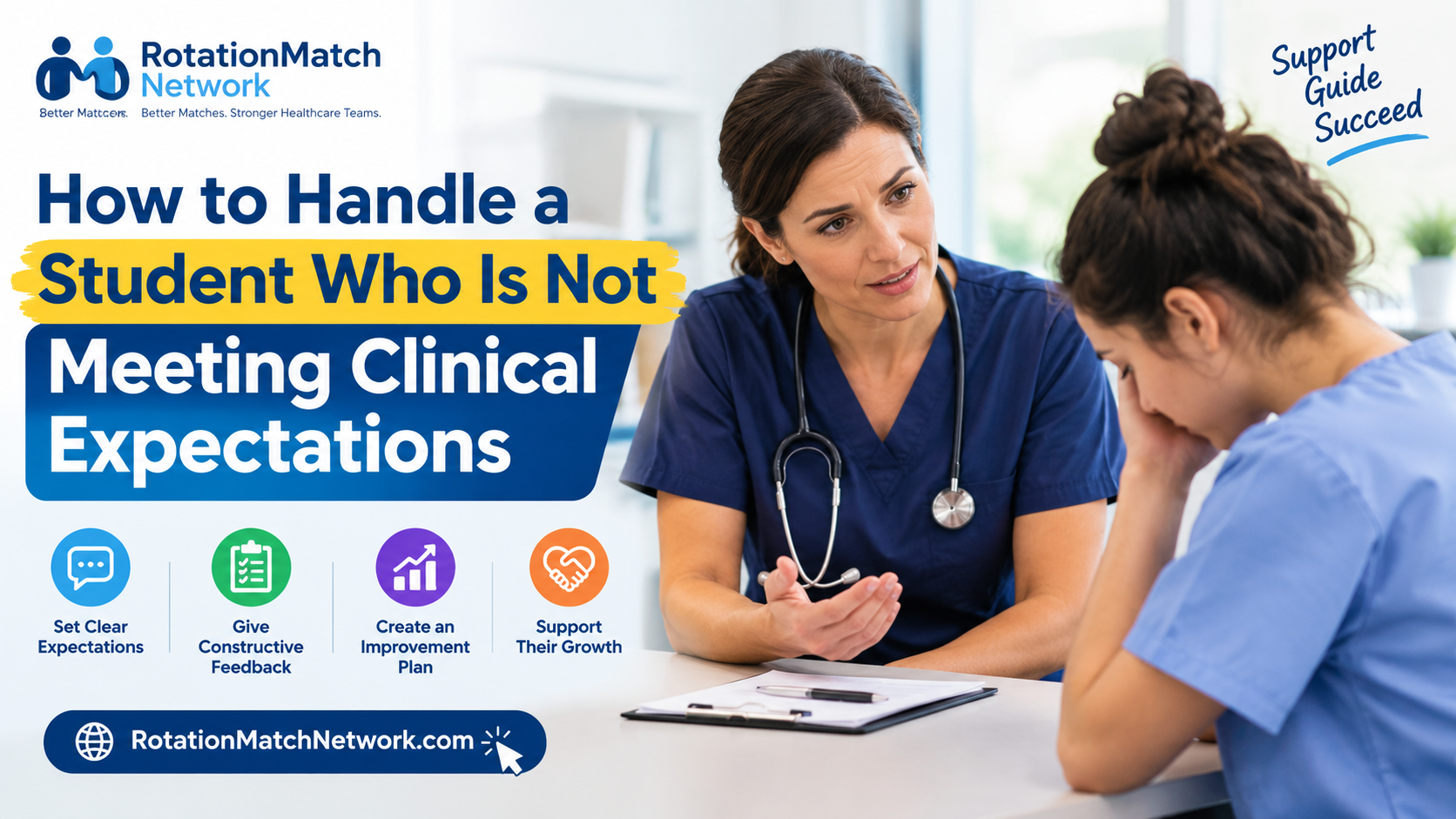
How to Handle a Student Who Is Not Meeting Clinical Expectations
Taking on a clinical student can be one of the most rewarding parts of being a healthcare professional.
You get the opportunity to share your experience, help someone develop practical skills, and contribute to the next generation of healthcare professionals.
But what happens when the student is not meeting your expectations?
Maybe they are consistently late.
Maybe they are not preparing for clinical days.
Maybe they struggle to communicate with patients.
Maybe they are not taking feedback seriously.
Or perhaps they simply are not progressing at the level you expected.
These situations can be uncomfortable for any clinical preceptor, especially if it is your first time mentoring a student.
The good news is that a struggling student does not automatically mean a failed clinical rotation.
In many cases, clear expectations, honest communication, specific feedback, and an appropriate improvement plan can help get the rotation back on track.
Here is how to handle a student who is not meeting clinical expectations while maintaining professionalism and supporting their learning.
What Does It Mean When a Student Is Not Meeting Clinical Expectations?
Before addressing a problem, it is important to identify exactly what is going wrong.
A student may be struggling with:
- Clinical knowledge
- Patient communication
- Professionalism
- Punctuality
- Preparation
- Documentation
- Clinical reasoning
- Time management
- Confidence
- Following instructions
- Communication with the healthcare team
- Meeting required clinical competencies
Not every weakness requires the same response.
A student who is nervous about speaking with patients may need encouragement and additional practice.
A student who repeatedly arrives late after being warned may require a much more direct conversation about professionalism.
The first step is to identify the actual problem rather than simply labeling the student as "difficult" or "unprepared."
1. Address the Problem Early
One of the biggest mistakes a clinical preceptor can make is waiting too long to address a concern.
You may think:
"Maybe they will improve next week."
Then another week passes.
Then another.
Eventually, the student is approaching the end of the rotation and the same problem still exists.
Address concerns as soon as you notice a consistent pattern.
Early feedback gives the student time to improve.
It also gives you an opportunity to determine whether the issue is a temporary learning gap or a more serious performance concern.
2. Make Sure the Expectations Were Clear
Before deciding that a student is failing to meet expectations, ask yourself:
Did I clearly explain what I expected from them?
Students cannot always meet expectations they did not understand.
At the beginning of the rotation, discuss important expectations such as:
- Arrival time
- Attendance
- Dress code
- Professional communication
- Patient interaction
- Preparation
- Clinical participation
- Documentation
- Questions and feedback
- Appropriate use of technology
- Clinical responsibilities
Clear expectations create a foundation for accountability.
This is also why setting expectations before the student's first clinical day is so important.
3. Speak to the Student Privately
If you have concerns, have a private conversation with the student.
Avoid embarrassing them in front of patients, colleagues, or other students.
Start by explaining what you have observed.
For example:
"I've noticed that you have been hesitant to participate in patient assessments, and I want to understand what may be causing that."
This opens the conversation without immediately becoming confrontational.
Give the student an opportunity to explain.
There may be something you were not aware of.
Perhaps they misunderstood an instruction.
Perhaps they are struggling with a particular concept.
Perhaps they are anxious about making a mistake.
Or perhaps they simply need more guidance.
Listen before deciding what should happen next.
4. Be Specific About the Problem
Avoid vague statements such as:
"You need to do better."
The student may leave the conversation without knowing what "better" actually means.
Instead, be specific.
Rather than:
"Your communication needs work."
Try:
"During today's patient interview, you interrupted the patient several times before they finished answering. For your next few interviews, focus on allowing the patient to finish before asking your next question."
Specific feedback gives the student something they can actually improve.
5. Separate the Person From the Performance
A student's performance may be below expectations.
That does not mean the student is a bad person or incapable of becoming a good healthcare professional.
Focus on the behavior or skill that needs improvement.
Instead of:
"You are not professional."
Say:
"You arrived 20 minutes after the agreed start time on two occasions. We need you to arrive on time and be ready to begin at the scheduled time."
This makes the conversation about an observable behavior rather than a personal judgment.
6. Ask the Student What They Think
Sometimes the student already knows there is a problem.
Ask:
"How do you think the rotation is going?"
"What areas do you feel most confident in?"
"What areas are you struggling with?"
"Is there anything you feel you need more support with?"
Their answers can reveal important information.
A student who says, "I know I am struggling with patient presentations," may be much easier to support than a student who does not recognize the problem at all.
Self-awareness is an important part of professional development.
7. Create a Simple Improvement Plan
If the problem is significant enough to require ongoing attention, create a clear plan.
The plan should answer three questions:
What needs to improve?
For example:
Patient presentations need to become more organized and clinically focused.
What will the student do?
For example:
The student will prepare a brief presentation for each assigned patient and review it before presenting.
How will progress be evaluated?
For example:
The preceptor will provide feedback after each presentation for the next two clinical days.
The goal is to turn a general concern into something measurable.
8. Give Constructive Feedback Regularly
Do not wait until the final evaluation to tell the student what needs to change.
Feedback should be part of the rotation.
A useful approach is:
What went well → What needs improvement → What to try next
For example:
"Your patient history was thorough, and you asked several good follow-up questions. Next time, try to organize the history more systematically so that you do not miss important information."
This allows the student to recognize their strengths while understanding what they need to improve.
9. Give the Student an Opportunity to Improve
Once you have explained the problem, allow the student a reasonable opportunity to demonstrate improvement.
If the concern is patient communication, give them more opportunities to interact with patients.
If the concern is clinical presentations, let them practice presenting cases.
If the concern is preparation, ask them to review relevant material before the next clinical day.
Improvement requires opportunity.
A student should not be judged solely on one poor performance if they have not been given a reasonable chance to correct it.
10. Document Important Concerns
Keep appropriate records of significant performance concerns and feedback according to your organization's and school's policies.
Document relevant facts such as:
- Date
- Observed behavior
- Feedback provided
- Student response
- Agreed improvement steps
- Follow-up
- Progress
Documentation can help everyone stay on the same page.
It can also become important if a serious performance issue needs to be escalated to the student's school or program.
Always follow the documentation and privacy requirements that apply to your clinical setting.
11. Communicate With the School When Necessary
Not every problem needs to be reported immediately.
However, serious or persistent concerns may require communication with the student's school, clinical coordinator, or program representative.
Examples may include:
- Repeated unprofessional behavior
- Patient safety concerns
- Failure to follow instructions
- Serious attendance problems
- Persistent failure to improve
- Conduct outside the student's scope of training
- Concerns that could affect successful completion of the rotation
If you are unsure what to do, review the school's preceptor guidelines or contact the appropriate program representative.
Do not try to handle a serious academic or safety concern entirely on your own.
12. Patient Safety Comes First
There is an important difference between allowing a student to learn from mistakes and allowing unsafe practice.
Students need supervised opportunities to develop clinical skills.
However, patient safety should always remain the priority.
If a student is about to perform an activity incorrectly or outside their appropriate level of training, intervene.
The purpose of clinical education is to develop competent professionals while protecting patients throughout the learning process.
13. Recognize Improvement
When a student improves, acknowledge it.
You might say:
"Your patient presentation today was much more organized than your previous ones. I can see the preparation you put into it."
Positive feedback reinforces progress.
It also helps students understand that your goal is not simply to criticize their performance.
You want to help them improve.
14. Know When the Problem Is Bigger Than You
Sometimes, despite your feedback and support, the student may continue to struggle.
If you have:
- Clearly explained expectations
- Provided specific feedback
- Given opportunities to improve
- Documented concerns
- Communicated with the appropriate school personnel
and the situation still does not improve, it may be time to involve the student's program.
A clinical preceptor should not feel responsible for solving every academic or professional problem alone.
Your role is to provide appropriate clinical education and mentorship within the expectations of the rotation.
What If the Student Becomes Defensive?
Students may become defensive when they receive criticism.
That does not necessarily mean they are unwilling to improve.
Try to keep the conversation focused on facts.
Avoid statements such as:
"You always..."
or
"You never..."
Instead, describe what you observed.
For example:
"On three of the last four clinical days, you arrived after the scheduled start time. Let's talk about what is making it difficult to arrive on time and how we can address it."
This keeps the conversation professional and solution-focused.
What If the Student Says They Were Never Told?
This is why clear communication matters from the beginning.
If expectations were not clearly explained, take responsibility for clarifying them.
You can say:
"I realize I may not have explained that expectation clearly at the beginning. Going forward, this is what I need from you..."
Being a preceptor does not mean you have to be perfect.
Good mentorship also involves recognizing when communication could have been better.
How to Prevent Performance Problems Before They Start
The best way to manage many student performance issues is to prevent confusion early.
Before the first clinical day:
Set expectations
Tell the student what you expect.
Understand their requirements
Know what the student needs to accomplish during the rotation.
Review their schedule
Make sure the requested dates and hours are realistic.
Discuss communication
Agree on how you will communicate about scheduling or urgent issues.
Encourage questions
Let students know that asking questions is part of learning.
Establish feedback
Tell the student that you will provide ongoing feedback throughout the rotation.
A strong beginning can prevent many problems later.
How Rotation Match Network Can Help Preceptors Stay Organized
Managing a clinical student involves more than teaching.
You may also need to review student requests, check availability, communicate about rotation dates, and manage placement information.
Rotation Match Network is designed to help streamline the clinical placement process by bringing students and preceptors together in one workspace. Preceptors can create profiles, showcase their specialty and availability, review student requests, and communicate with students through the platform.
The platform also allows preceptors to review student readiness as part of the placement process, helping establish expectations before the rotation begins.
For preceptors who want a more organized way to manage clinical placement requests and focus more of their time on mentorship, Rotation Match Network can be a useful part of the process.
Visit RotationMatchNetwork.com
A Quick Checklist for Preceptors
If a student is not meeting clinical expectations, ask yourself:
☐ Did I clearly explain my expectations?
☐ Have I identified the specific problem?
☐ Have I spoken to the student privately?
☐ Did I listen to their perspective?
☐ Did I provide specific feedback?
☐ Have I explained what needs to change?
☐ Did I give the student an opportunity to improve?
☐ Have I documented significant concerns appropriately?
☐ Am I following the school's policies?
☐ Does the school need to be involved?
☐ Is patient safety being protected?
☐ Have I recognized improvement where appropriate?
The Goal Is Improvement, Not Punishment
Being a clinical preceptor does not mean you will never encounter a struggling student.
It is part of mentorship.
Some students will arrive confident.
Others will need more guidance.
Some will respond quickly to feedback.
Others may require several conversations and a structured improvement plan.
What matters is how you respond.
Set clear expectations.
Address problems early.
Be specific.
Listen.
Give constructive feedback.
Document important concerns.
Involve the student's program when necessary.
And always put patient safety first.
A struggling student may not need a harsher preceptor.
They may need a clearer expectation, better feedback, more practice, or the right support.
And sometimes, the most valuable lesson a student receives during a clinical rotation is learning how to recognize a weakness, accept feedback, and improve.
Ready to Connect With the Right Students?
For healthcare professionals who are interested in becoming clinical preceptors, Rotation Match Network provides a platform for connecting with students looking for clinical placement opportunities.
You can create your professional profile, set your availability, showcase your specialty, and review student requests through the platform.
Join RotationMatchNetwork.com as a preceptor
The right clinical experience can make a lasting difference in a student's professional development.
And the right preceptor can make that experience even more meaningful.