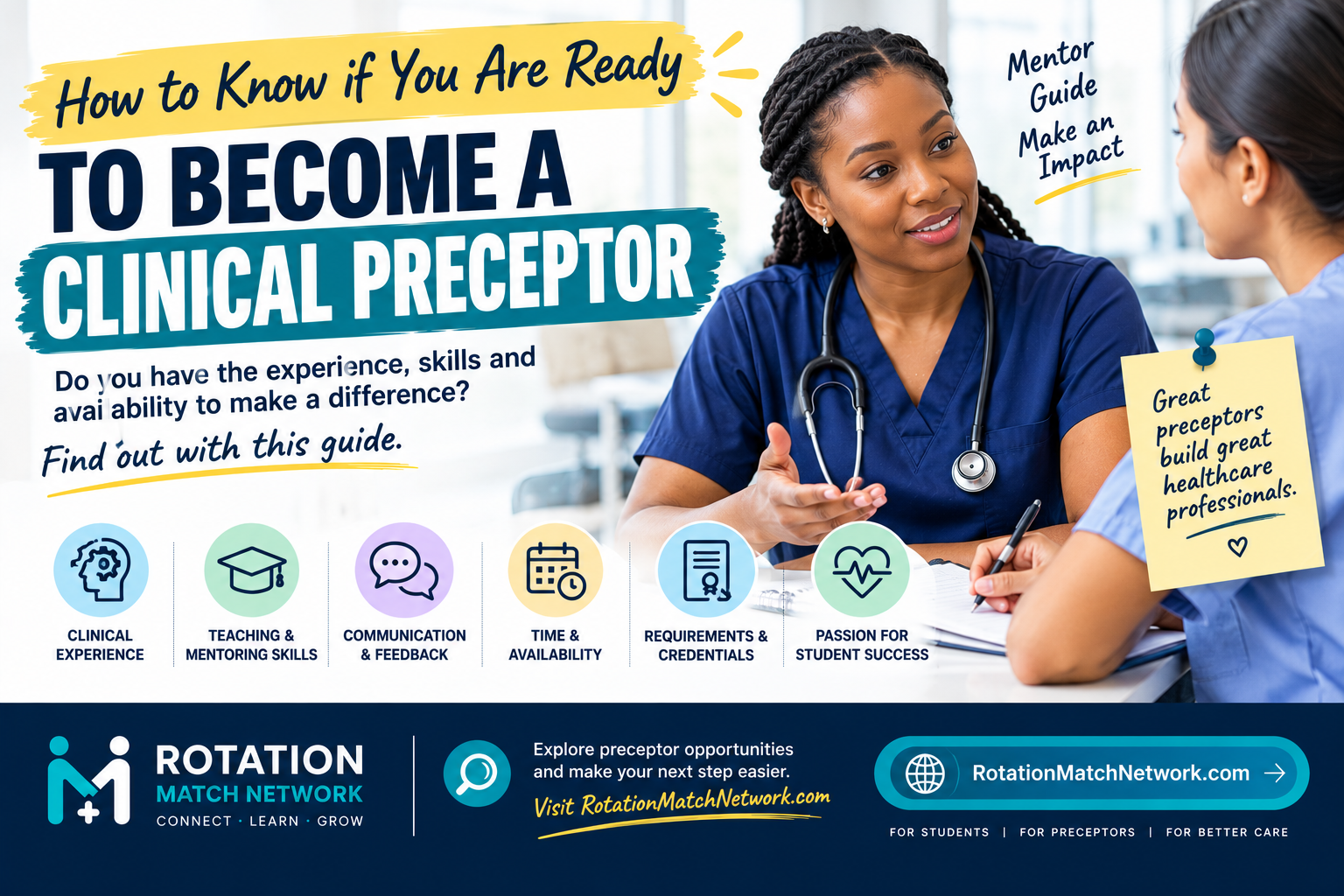
How to Know if You Are Ready to Become a Clinical Preceptor
Becoming a clinical preceptor is more than agreeing to let a student follow you around during a shift.
A clinical preceptor plays an important role in helping healthcare students turn classroom knowledge into real clinical skills. You provide guidance, answer questions, demonstrate professional practice, and give students opportunities to learn in a real healthcare environment.
But how do you know if you are actually ready to become a clinical preceptor?
You may be an experienced healthcare professional but still wonder if you have enough experience to teach. You may also be interested in mentoring students but worry that your schedule is already too busy.
The good news is that becoming a preceptor does not mean you need to know everything.
What matters is whether you have the clinical experience, professional confidence, communication skills, availability, and willingness to teach that students need.
What Is a Clinical Preceptor?
A clinical preceptor is an experienced healthcare professional who supervises and guides a student during a clinical rotation.
Depending on the profession and program, preceptors may work with nursing students, FNP students, PMHNP students, PA students, CRNA students, and other healthcare learners.
The preceptor's role can include:
• Supervising students during clinical activities
• Helping students connect theory with practice
• Demonstrating appropriate clinical techniques
• Asking questions that encourage clinical reasoning
• Providing feedback on student performance
• Helping students understand professional expectations
• Creating opportunities for students to develop practical skills
The exact responsibilities depend on the student's program, the clinical setting, and the requirements of the educational institution.
1. Do You Have Enough Clinical Experience?
One of the first questions to ask yourself is whether you have enough professional experience to guide a student.
There is no universal number of years that automatically makes someone a great preceptor. Requirements can vary by profession, university, program, and clinical site.
What matters is whether you have developed enough practical knowledge and confidence in your area of practice to appropriately supervise and guide a student.
Ask yourself:
Am I comfortable making clinical decisions in my area of practice?
Can I explain why I approach patient care in a particular way?
Can I recognize when a student needs additional guidance?
If you can confidently answer these questions, you may already have an important foundation for becoming a clinical preceptor.
2. Do You Enjoy Teaching or Mentoring Others?
You do not have to be a professional educator to be a good clinical preceptor.
However, you should have a genuine interest in helping someone learn.
Students will ask questions. Sometimes they will ask very basic questions. Sometimes they will make mistakes. Sometimes they will need you to explain the same concept in a different way.
A good preceptor understands that learning takes time.
If you enjoy explaining concepts, sharing your experience, answering questions, and helping newer professionals grow, precepting may be a natural fit for you.
3. Can You Communicate Clearly?
Clinical knowledge is valuable, but knowledge alone does not make someone an effective preceptor.
You need to be able to communicate expectations clearly.
For example, a student should understand:
• What you expect from them
• What they are allowed to do
• What they should observe
• When they should ask for help
• How you will provide feedback
• How you will communicate about schedules and clinical activities
Good communication also means being approachable.
Students should feel comfortable asking questions when they are unsure about something, particularly when patient safety is involved.
4. Are You Comfortable Giving Constructive Feedback?
Students need feedback to improve.
That means a preceptor should be able to recognize both strengths and areas that need improvement.
Effective feedback should be:
Specific: Explain exactly what the student did well or needs to improve.
Timely: Give feedback close to the experience whenever possible.
Constructive: Focus on helping the student improve rather than simply pointing out mistakes.
Professional: Keep feedback respectful and appropriate.
You do not need to be harsh to be honest.
A student can be corrected while still feeling supported.
5. Do You Have Enough Time?
This is one of the most important questions to ask before becoming a clinical preceptor.
You may have excellent clinical skills and enjoy mentoring, but if your schedule does not allow you to properly supervise a student, the experience may become frustrating for both of you.
Consider:
• Your typical work schedule
• Your patient workload
• How many days you can dedicate to students
• Your expected availability during the rotation
• Whether you can provide adequate supervision
• Whether you have enough time to answer questions and give feedback
Being honest about your availability is better than accepting a student and discovering later that you cannot give them the attention they need.
6. Is Your Clinical Setting Suitable for Students?
Your own expertise is only part of the equation.
The environment where you practice also needs to provide meaningful learning opportunities.
Ask yourself:
Does my clinical setting expose students to the patients, conditions, procedures, or experiences they need?
For example, a student completing a specific specialty rotation may need exposure to a particular patient population or clinical environment.
A suitable clinical setting should also allow students to participate at a level appropriate to their training and program requirements.
7. Do You Understand Your Professional Scope?
Before taking a student, you should have a clear understanding of your professional responsibilities and scope of practice.
You should also understand the boundaries of what a student is permitted to do.
Students are learners, not independent practitioners.
Their responsibilities should be appropriate to their education, experience, program requirements, and applicable laws and regulations.
When in doubt, communicate with the student's school or clinical coordinator before allowing an activity that may fall outside the student's permitted role.
8. Are You Willing to Set Clear Expectations?
Many clinical rotation problems can be avoided when expectations are discussed before the student's first day.
Before the rotation begins, consider discussing:
• Schedule and attendance
• Dress code
• Communication methods
• Documentation expectations
• Professional conduct
• Patient interaction
• Clinical responsibilities
• Questions and feedback
• What happens if the schedule changes
Clear expectations give both the student and preceptor a better understanding of how the rotation will work.
9. Are You Willing to Learn Too?
Precepting is not only about what you can teach a student.
Students can also bring new perspectives, questions, research, technology, and ideas into the clinical environment.
A student may ask why a certain process is done a particular way. That question may encourage you to think critically about your own practice.
Good preceptors remain open to learning.
You do not need to pretend you know everything.
In fact, showing students how you approach a question when you do not immediately know the answer can teach them an important professional skill.
10. Can You Balance Teaching With Patient Care?
Patient care remains the priority.
A student should never compromise patient safety or the quality of care.
Before becoming a preceptor, think about how you will balance your clinical responsibilities with teaching.
You may need to explain procedures, answer questions, review a student's work, or provide feedback while also managing your normal workload.
If your workplace is extremely busy, consider whether you have the support and flexibility necessary to make the arrangement work.
11. Do You Meet the Student's Program Requirements?
Being ready to precept does not necessarily mean you are eligible to precept every student.
Different programs can have different requirements for clinical preceptors.
A school may consider factors such as:
• Professional credentials
• Clinical experience
• Specialty
• Licensure
• Location
• Practice setting
• Years of experience
• Availability
• Required documentation
Before accepting a student, review the requirements for that particular program.
A good match should work for both sides.
12. Are Your Credentials and Documents Up to Date?
If you are planning to become a clinical preceptor, make sure your professional information is current.
Depending on the program and clinical placement, you may need to provide documentation such as:
• Professional license
• Resume or CV
• Professional certifications
• Specialty credentials
• Practice information
• Liability or insurance information, where required
• Other documents requested by the student's program
Keeping these documents organized can make the onboarding process much easier.
13. Are You Ready to Be More Than a Supervisor?
A clinical preceptor is not simply someone who watches a student complete clinical hours.
Students often remember preceptors who helped them understand what professional practice actually looks like.
You can make a difference by:
• Sharing practical knowledge
• Encouraging questions
• Explaining your clinical reasoning
• Giving honest feedback
• Allowing appropriate hands-on learning
• Discussing real clinical situations
• Encouraging professional confidence
Your experience can help students understand the difference between knowing something in a textbook and applying it in practice.
A Simple Clinical Preceptor Readiness Checklist
Before accepting your first student, ask yourself:
☐ Do I have appropriate clinical experience?
☐ Am I confident in my area of practice?
☐ Do I enjoy teaching or mentoring?
☐ Can I communicate expectations clearly?
☐ Am I comfortable giving constructive feedback?
☐ Do I have enough availability?
☐ Is my clinical setting appropriate for students?
☐ Are my professional credentials and documents current?
☐ Do I understand the student's scope and program requirements?
☐ Can I prioritize patient safety while supervising a student?
☐ Am I willing to support the student's learning and professional development?
If you can answer yes to most of these questions, you may be ready to explore becoming a clinical preceptor.
What If You Are Interested but Not Sure You Are Ready?
You do not have to figure everything out alone.
Start by reviewing your professional credentials, understanding the requirements for the students you want to precept, and considering how much time you can realistically dedicate.
You can also speak with an educational institution or clinical placement platform to understand what students are looking for and what requirements you may need to meet.
Most importantly, do not feel that you need to be a perfect teacher before becoming a preceptor.
You need to be a competent professional who is willing to guide, teach, communicate, and learn alongside a student.
How Rotation Match Network Can Help Preceptors Connect With Students
Once you decide that you are ready to become a clinical preceptor, the next question is often:
How do I find students who need a clinical rotation?
Rotation Match Network makes it easier for healthcare professionals to create a preceptor profile, showcase their specialty and availability, and connect with students looking for clinical placements.
Preceptors can manage student requests, review applications, provide required information, and communicate with students through the platform.
Instead of relying entirely on personal contacts or responding to scattered requests, you can use Rotation Match Network to make the process more organized.
If you are ready to explore becoming a clinical preceptor, visit RotationMatchNetwork.com and create your preceptor profile.
Becoming a Preceptor Can Be Part of Your Professional Impact
Healthcare professionals spend years building knowledge, skills, and experience.
Precepting gives you an opportunity to pass some of that knowledge on to the next generation.
You may help a student become more confident. You may introduce them to a specialty they eventually pursue. You may teach a clinical skill they remember throughout their career.
You do not need to know everything.
You need to be willing to teach what you know, guide what you can, and help a student grow safely and professionally.
If you have the experience, the willingness to teach, and the time to support a student, you may be more ready to become a clinical preceptor than you think.
Ready to connect with students looking for clinical opportunities? Visit RotationMatchNetwork.com and start your preceptor journey.