
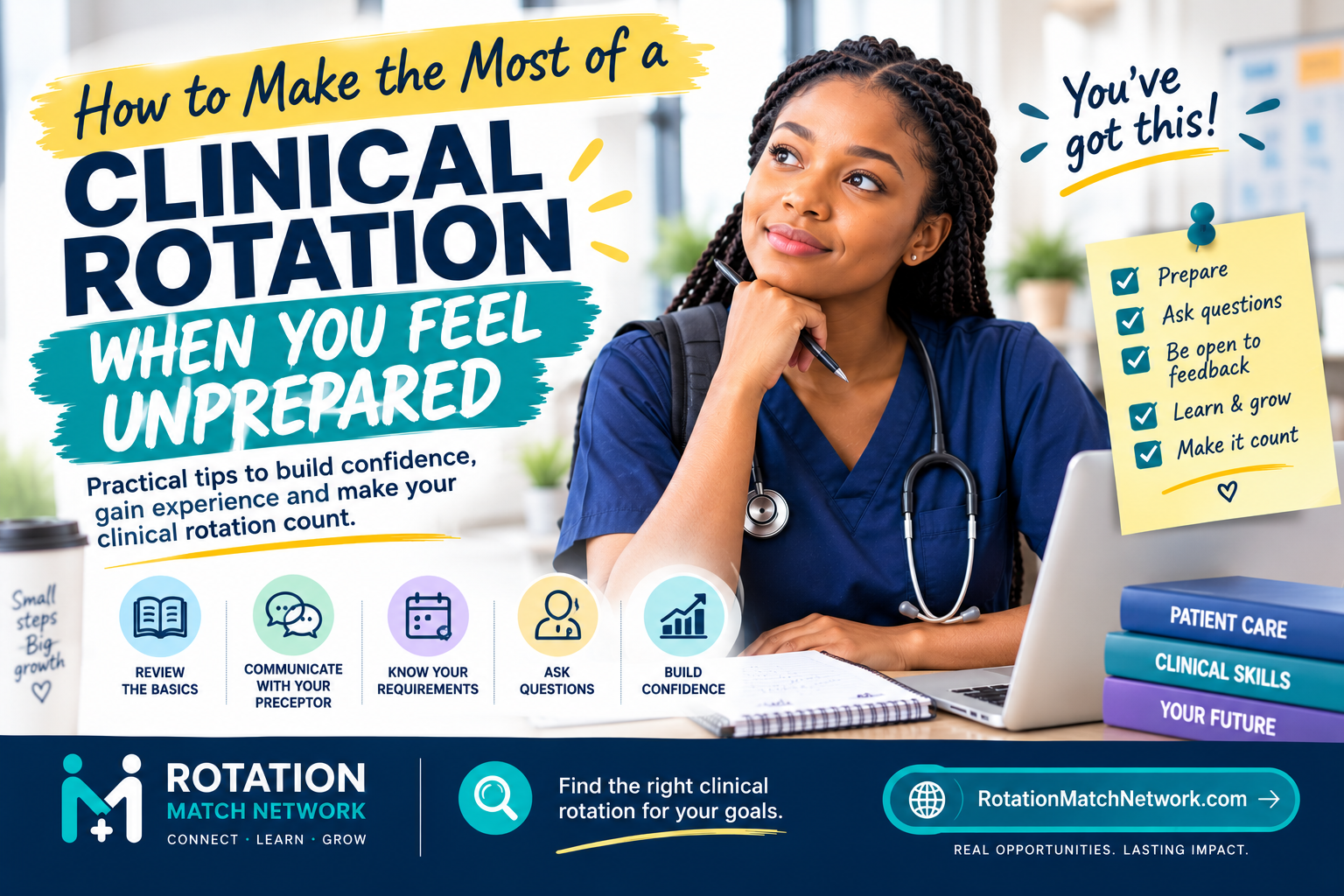
How to Make the Most of a Clinical Rotation When You Feel Unprepared
Starting a clinical rotation can be exciting, but it can also be intimidating.
You may have spent months studying, completing assignments, passing exams, and preparing for your program, yet still feel like you are not ready when it is finally time to work with real patients.
You might be thinking:
“What if I forget something?”
“What if my preceptor asks me a question I cannot answer?”
“What if I do not know what to do?”
If you feel this way, you are not alone.
Feeling unprepared for a clinical rotation does not necessarily mean you are unqualified. Clinical rotations are designed to help you take what you have learned in the classroom and develop the confidence and practical skills needed in real clinical settings.
The goal is not to know everything before you begin.
The goal is to show up prepared to learn.
Here is how to make the most of your clinical rotation even when you do not feel completely ready.
1. Accept That You Are Still Learning
One of the biggest mistakes students make is believing they are supposed to know everything before their first clinical day.
You are a student.
You are there to learn.
Your preceptor does not expect you to have the same knowledge, experience, or clinical judgment as a practicing healthcare professional.
What they will expect is that you are:
• Prepared
• Professional
• Willing to learn
• Open to feedback
• Curious
• Responsible
• Respectful of patients and staff
Instead of thinking, “I should know everything by now,” try thinking:
“I am here to learn how to apply what I know.”
That change in mindset can make a significant difference.
2. Review the Basics Before Your First Day
You do not need to spend every night trying to memorize an entire textbook.
Focus on the knowledge most relevant to your clinical setting.
Review common:
• Conditions
• Medications
• Assessments
• Clinical terminology
• Procedures
• Patient complaints
• Treatment approaches
• Documentation practices
For example, if you are beginning a primary care rotation, review common conditions and presentations you are likely to encounter.
If you are entering a mental health rotation, refresh your knowledge of common psychiatric conditions, medications, assessments, and therapeutic communication.
The goal is not to become an expert overnight.
It is to make the first few days less unfamiliar.
3. Know Your Clinical Rotation Requirements
Feeling unprepared can sometimes come from simply not knowing what is expected of you.
Before your rotation begins, review your school's requirements.
Know:
• How many clinical hours you need
• What competencies you need to complete
• What patient populations you need exposure to
• What procedures or experiences you need to document
• What paperwork is required
• What your school expects from your preceptor
• When your rotation must be completed
Understanding your requirements gives you a roadmap.
It also makes it easier to communicate with your preceptor about what you need to accomplish.
4. Talk to Your Preceptor Before the Rotation Starts
Do not wait until your first clinical day to ask important questions.
If you have access to your preceptor before the rotation begins, communicate with them.
Ask about:
Where should I report on my first day?
What time should I arrive?
What should I wear?
What should I bring?
What will my typical schedule look like?
What should I review before starting?
Are there any specific expectations I should know about?
These questions may seem simple, but knowing the answers can remove a lot of first day anxiety.
Professional communication before the rotation also gives your preceptor an early impression of your preparedness.
5. Prepare Your Clinical Documents
Nothing makes a student feel more unprepared than discovering that an important document is missing at the last minute.
Before your rotation begins, make sure your required documents are complete and up to date.
Depending on your program and clinical site, these may include:
• Resume or CV
• Professional license
• Immunization records
• Background check
• CPR or BLS certification
• Drug screening
• Health clearance
• Liability documentation
• School approval
• Other compliance documents
Requirements vary between programs and clinical sites, so always confirm what your school and placement require.
Keeping your documents organized also makes the transition into your rotation smoother.
6. Prepare Your Questions in Advance
If you are nervous about not knowing what to say during your rotation, prepare questions before you arrive.
You do not need to walk into the clinical setting with a list of 100 questions.
Start with a few useful ones:
“Why did you choose this treatment approach?”
“What would you consider when assessing this patient?”
“What findings would concern you in this situation?”
“What would you do differently if the patient presented with a different symptom?”
“What should I read about after today's cases?”
Good questions show that you are thinking.
They also turn everyday patient encounters into learning opportunities.
7. Do Not Be Afraid to Say “I Don't Know”
This may be one of the most important lessons you learn during clinical training.
You will eventually be asked a question you cannot answer.
It happens.
Instead of guessing, be honest.
You can say:
“I am not sure, but I would like to look into it.”
Then actually look into it.
Patient safety should always come first. It is better to acknowledge what you do not know and seek guidance than to provide an unsafe answer simply because you are afraid of looking unprepared.
A good preceptor can help you turn knowledge gaps into learning opportunities.
8. Pay Attention to How Your Preceptor Thinks
Clinical rotations are not only about watching what your preceptor does.
Pay attention to why they do it.
When appropriate, ask yourself:
Why did they ask that question?
Why did they choose that assessment?
Why was that treatment considered?
What information influenced the decision?
What would change the management plan?
This is how you begin developing clinical reasoning.
You are moving from memorizing information to understanding how that information is applied to real patients.
9. Keep a Learning List
You will encounter things during your rotation that you do not fully understand.
Write them down.
Keep a simple list on your phone, notebook, or approved learning tool.
Your list might include:
• A medication you have never encountered
• A diagnosis you want to understand better
• A procedure you observed
• A clinical abbreviation
• A question you forgot to ask
• A case that interested you
At the end of the day, choose a few items to research.
This turns your rotation into a continuous learning process.
10. Ask for Feedback
Do not wait until the final week to discover how your preceptor thinks you are doing.
Ask for feedback regularly.
You can simply say:
“Is there anything you think I should improve on?”
Or:
“What is one thing I could do better during my next clinical day?”
Constructive feedback may feel uncomfortable at first, but it can help you improve much faster.
Remember, feedback is not necessarily criticism.
It is information you can use to become better.
11. Take Initiative, But Know Your Limits
Being proactive is a great quality in a clinical student.
If there is an appropriate opportunity to participate, ask.
You might say:
“Would it be okay if I observed this?”
or
“If appropriate, could I participate in this assessment?”
However, never perform a clinical activity outside your training, authorization, or program requirements.
A strong student knows when to take initiative and when to ask for supervision.
12. Build a Good Relationship With Your Preceptor
Your preceptor can have a major influence on your clinical experience.
Be punctual.
Communicate clearly.
Come prepared.
Ask thoughtful questions.
Accept feedback professionally.
Show appreciation.
And most importantly, respect their time.
You do not need to impress your preceptor by pretending to know everything.
You will make a stronger impression by showing that you are dependable, teachable, and genuinely interested in learning.
13. Use Every Patient Encounter as a Learning Opportunity
Even when a patient encounter seems routine, there may be something to learn.
Pay attention to:
• How the patient is greeted
• How the history is taken
• How sensitive questions are asked
• How information is explained
• How clinical decisions are made
• How documentation is completed
• How the healthcare team communicates
Clinical education is not limited to dramatic cases.
Some of the most useful lessons come from everyday patient interactions.
14. Do Not Compare Yourself to Other Students
You may meet students who seem extremely confident.
Someone may know more medications.
Someone else may be better at patient interviews.
Another student may already have healthcare experience.
That does not mean you are behind.
Everyone enters clinical rotations with a different background.
Focus on your own progress.
Ask yourself:
What do I know now that I did not know before this rotation?
What skill am I becoming more comfortable with?
What do I need to improve next?
That is a much healthier way to measure your growth.
15. If Your Rotation Is Not a Good Fit, Speak Up Early
Sometimes feeling unprepared is not the real problem.
You may discover that your clinical rotation is not providing the experience you expected.
Perhaps the patient population is different from what you need.
Maybe your schedule is not working.
Maybe you are not getting enough exposure to your required clinical experiences.
Or perhaps communication with your preceptor has become difficult.
Do not ignore the problem.
Start by communicating professionally with your preceptor.
If the issue continues or affects your academic requirements, contact your school or clinical coordinator.
And if you are approved to seek another placement, start looking early rather than waiting until your deadline is close.
How Rotation Match Network Can Help You Find the Right Clinical Opportunity
Feeling prepared for a clinical rotation begins before your first day.
It starts with finding a placement that actually matches your specialty, location, schedule, and program requirements.
That is where Rotation Match Network can help.
Rotation Match Network allows students to search available clinical rotation opportunities by location and specialty, review preceptor details and requirements, submit requests with preferred dates and hours, upload required documents, and track application progress.
The platform is designed to bring students and preceptors together while keeping important parts of the placement process organized in one place.
If you are preparing for an upcoming clinical rotation, visit RotationMatchNetwork.com to explore available opportunities and begin your search.
Finding the right preceptor early can give you more time to understand the placement, complete your documents, communicate with your preceptor, and prepare for the experience.
A Quick Clinical Rotation Preparation Checklist
If you feel unprepared, start with these basics:
☐ Understand your program requirements
☐ Confirm your clinical dates
☐ Know your preceptor and clinical site
☐ Complete your required documents
☐ Review important topics related to your specialty
☐ Ask your preceptor about expectations
☐ Prepare a few questions
☐ Plan your transportation and schedule
☐ Bring the required clinical equipment
☐ Keep track of your clinical hours
☐ Ask for feedback
☐ Keep a list of topics you need to review
You do not have to master everything before your first day.
You just need to take the next useful step.
Feeling Unprepared Does Not Mean You Are Not Ready
There is a difference between being unprepared and being inexperienced.
You are supposed to gain experience during your clinical rotation.
You are supposed to encounter things you have never seen before.
You are supposed to ask questions.
You are supposed to receive feedback.
That is what clinical education is for.
Instead of waiting until you feel completely confident, focus on becoming prepared enough to learn.
Review your basics.
Understand your requirements.
Communicate with your preceptor.
Ask questions.
Stay curious.
Accept feedback.
And keep improving.
Your first clinical rotation does not need to be perfect.
It needs to be a place where you can learn, grow, and gradually become more confident in your ability to provide safe and professional patient care.
And when you are ready to find a clinical placement that fits your goals, Rotation Match Network can help you start the search.
Find the right preceptor. Prepare with confidence. Make your clinical rotation count.
Visit RotationMatchNetwork.com to get started.