How to Prepare for Your First Day of Clinical Rotation: A Complete Student Guide
Your first day of clinical rotation is one of those moments that can feel exciting and stressful at the same time.
You have spent months completing coursework, studying for exams, and preparing for the next stage of your healthcare education. Now, you are finally getting the opportunity to take what you have learned in the classroom and apply it in a real clinical environment.
But preparing for your first clinical rotation involves more than knowing where the facility is or deciding what to wear.
Before you walk through the doors on your first day, you need to make sure your clinical placement is confirmed, your required documents are complete, your communication with your preceptor is clear, and you understand what is expected of you.
This is where having the right clinical rotation process can make a significant difference.
With Rotation Match Network, students can search for available preceptors, submit placement requests, track applications, manage compliance documents, and monitor their placement progress in one organized workspace.
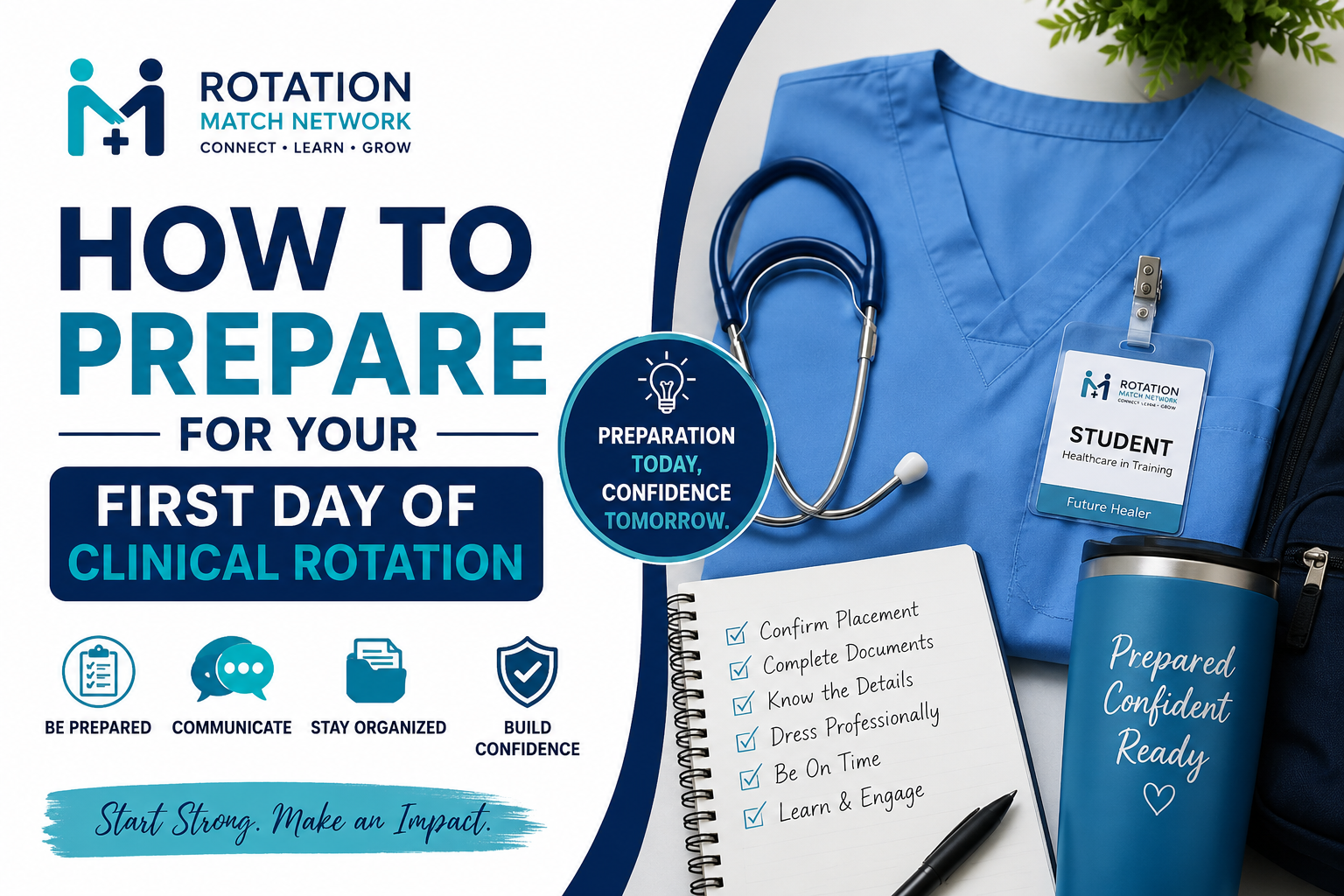
Here is everything you should do to prepare for your first day of clinical rotation.
1. Make Sure Your Clinical Placement Is Confirmed
Before worrying about your first day, make sure you actually have a confirmed clinical placement.
One of the biggest mistakes students make is assuming that an initial conversation with a potential preceptor means their clinical rotation is secured. A placement usually involves several steps, including finding an appropriate preceptor, submitting a request, receiving approval, completing required documentation, and receiving final confirmation.
This is why it is important to keep track of your placement status.
Rotation Match Network allows students to search for preceptors based on factors such as location, specialty, and start date. Students can submit requests and monitor their applications from their dashboard instead of trying to keep track of multiple conversations and email threads.
A confirmed clinical placement gives you the foundation you need to prepare confidently for your first day.
2. Complete Your Clinical Compliance Requirements
Clinical rotations often come with documentation and compliance requirements.
Depending on your program and clinical site, you may need to provide items such as immunization records, background checks, certifications, identification, health documentation, or other school specific requirements.
Do not wait until the week before your rotation begins to find out that something is missing.
Review your program's requirements early and make sure every required document has been submitted and approved.
Keeping these documents organized is one of the areas where Rotation Match Network can make the process easier. The platform provides students with a centralized place to upload and track compliance documents, helping them stay aware of what has been submitted and what still needs attention.
Being clinically prepared starts before you ever meet your preceptor.
3. Communicate With Your Preceptor Before Your First Day
Do not show up on your first day without knowing what your preceptor expects from you.
Once your placement is confirmed, communicate with your preceptor about important details such as:
Your first day and start time
The location where you should report
Where you should park
What you should wear
Whether you need to bring identification
What equipment or supplies you should bring
Where you should meet your preceptor
Any orientation requirements
Your expected clinical schedule
Your preceptor may also have specific expectations that are not included in your school's general rotation guidelines.
Good communication before your first day shows that you are organized, responsible, and serious about your clinical education.
Rotation Match Network helps keep student and preceptor communication connected to the placement process, giving students a more organized way to manage their clinical journey.
4. Know the Dress Code
Your appearance is part of your professional first impression.
Before your first day, find out exactly what your clinical site expects you to wear. Depending on your program and placement, this could include scrubs, a lab coat, professional clothing, closed toe shoes, an identification badge, or other required attire.
If you are unsure, ask your preceptor or program coordinator rather than making assumptions.
Make sure your clothes are clean, comfortable, professional, and appropriate for the clinical environment.
Also consider practical details such as your shoes. You may spend several hours standing or walking, so comfortable professional footwear can make a major difference during a long clinical day.
5. Review Your Clinical Goals
You do not need to know everything before starting your clinical rotation.
However, you should understand what your program expects you to learn.
Review your course objectives, clinical requirements, expected hours, and competencies before your first day.
Think about the areas where you feel confident and the areas where you would like more experience.
You can even write down a few questions you hope your clinical experience will help you answer.
Going into your rotation with clear learning goals can help you become more intentional about your experience rather than simply trying to get through the required hours.
6. Research Your Clinical Site and Specialty
Take some time to learn about where you will be completing your rotation.
Understand the type of facility, patient population, specialty, and services you are likely to encounter.
For example, a student completing a PMHNP rotation may want to review common psychiatric conditions and medications, while an FNP student may want to refresh their knowledge of common primary care presentations.
You do not need to memorize everything.
The goal is simply to arrive prepared enough to understand what you are seeing and ask better questions.
7. Prepare the Things You Will Need
The night before your first clinical day is not the time to start looking for everything you need.
Prepare your clothes, identification, notebook, pens, laptop or tablet if permitted, required clinical equipment, water, and anything else your program or preceptor has requested.
Check the route to your clinical site and plan your transportation.
If possible, give yourself extra travel time. Arriving early is much better than arriving stressed and late.
A simple preparation routine can help you start your first day feeling calm and focused.
8. Be Ready to Learn, Not to Prove That You Know Everything
One of the most important things to remember during your first clinical rotation is that you are there to learn.
You are not expected to know everything.
Ask questions when you do not understand something. Listen carefully when your preceptor gives you feedback. Take notes when appropriate and look for opportunities to improve.
A good student is not the person who never makes mistakes.
A good student is someone who listens, accepts correction, takes responsibility, and makes an effort to improve.
Your relationship with your preceptor can have a significant impact on your clinical experience, so approach the relationship with humility and professionalism.
9. Arrive Early
This may sound obvious, but punctuality matters.
Aim to arrive early enough to settle in before your scheduled start time.
If something unexpected happens and you know you will be late, communicate with your preceptor as soon as possible.
Do not wait until your scheduled start time to explain where you are.
Your first few interactions can influence how your preceptor views your professionalism, so make reliability a priority from day one.
10. Keep Track of Your Rotation Progress
Preparing for your first day is only one part of a successful clinical rotation.
Once your rotation begins, you will still need to keep track of your applications, placement information, documents, deadlines, and other requirements.
This is one reason having everything organized in one place can be so valuable.
Rotation Match Network gives students a centralized dashboard where they can view applications, receive status updates, manage compliance requirements, and stay organized throughout their rotation process.
Instead of searching through emails, messages, folders, and different websites to figure out where things stand, students can manage much of their clinical placement journey from one workspace.
Your First Clinical Day Starts Before You Arrive
Your first day of clinical rotation does not actually begin when you walk into the facility.
It begins when you start preparing.
Finding the right preceptor, confirming your placement, completing compliance requirements, communicating with your preceptor, understanding expectations, and organizing your documents are all part of becoming clinically ready.
That preparation becomes much easier when you have a system that keeps your clinical placement process organized.
Rotation Match Network was designed to help students do exactly that.
From searching for preceptors and submitting placement requests to tracking applications and managing compliance documents, Rotation Match Network brings the important parts of clinical placement into one secure workspace.
So when your first day finally arrives, you can spend less time worrying about paperwork and placement logistics and more time focusing on what actually matters: learning, gaining clinical experience, and becoming the healthcare professional you are working toward becoming.
Ready to Start Preparing for Your Clinical Rotation?
Finding a preceptor is often one of the most challenging parts of preparing for clinical education. You do not have to navigate the process alone.
With Rotation Match Network, you can search for available preceptors, submit placement requests, organize your clinical documents, and track your placement progress from one platform.
Start preparing for your clinical rotation today and take the next step toward a more organized clinical experience.
Find your preceptor. Prepare with confidence. Start your rotation ready.
Primary keyword:
clinical rotation preparation
Secondary keywords:
how to prepare for clinical rotation
first day of clinical rotation
clinical rotation tips for students
how to prepare for your first clinical rotation
clinical rotation checklist
clinical placement
find a clinical preceptor
clinical rotation preceptor
clinical rotation requirements
clinical rotation documents