How to Write a Message That Gets a Preceptor to Respond
Finding the right clinical preceptor is one of the most important steps in your healthcare education. However, before you can secure a clinical rotation, you need to make a strong first impression—and that often starts with a single message.
Many healthcare students spend hours searching for preceptors, only to receive little or no response. While availability plays a role, the way you introduce yourself can significantly influence whether a preceptor chooses to reply.
Healthcare professionals are busy. Between caring for patients, completing documentation, attending meetings, and managing their own responsibilities, they often receive numerous requests from students seeking clinical placements. A generic or poorly written message can easily be overlooked.
The good news is that writing a message that stands out is easier than you might think. With the right approach, you can increase your chances of getting a response and building a positive relationship with a potential preceptor.
Why Your First Message Matters
Think of your first message as a professional introduction. Before a preceptor knows your qualifications, academic achievements, or career goals, they only know what you communicate in that initial email or message.
A thoughtful, respectful, and well-organized message demonstrates professionalism, attention to detail, and genuine interest. These qualities matter just as much as your academic record.
Your goal is not simply to ask for a clinical rotation. Your goal is to make it easy for a preceptor to understand who you are, what you need, and why they should consider working with you.
Common Mistakes Students Make
Many students unintentionally reduce their chances of receiving a response by making avoidable mistakes.
Some of the most common include:
- Sending the same generic message to every preceptor.
- Writing long messages with unnecessary details.
- Failing to introduce themselves properly.
- Forgetting to mention their program or specialty.
- Using unprofessional language or grammar.
- Asking for a rotation without explaining why they chose that particular preceptor.
- Sending repeated follow-up messages within a short period.
Remember, preceptors appreciate professionalism and respect for their time.
What Every Great Outreach Message Should Include
A strong message should answer the questions a preceptor is most likely to ask.
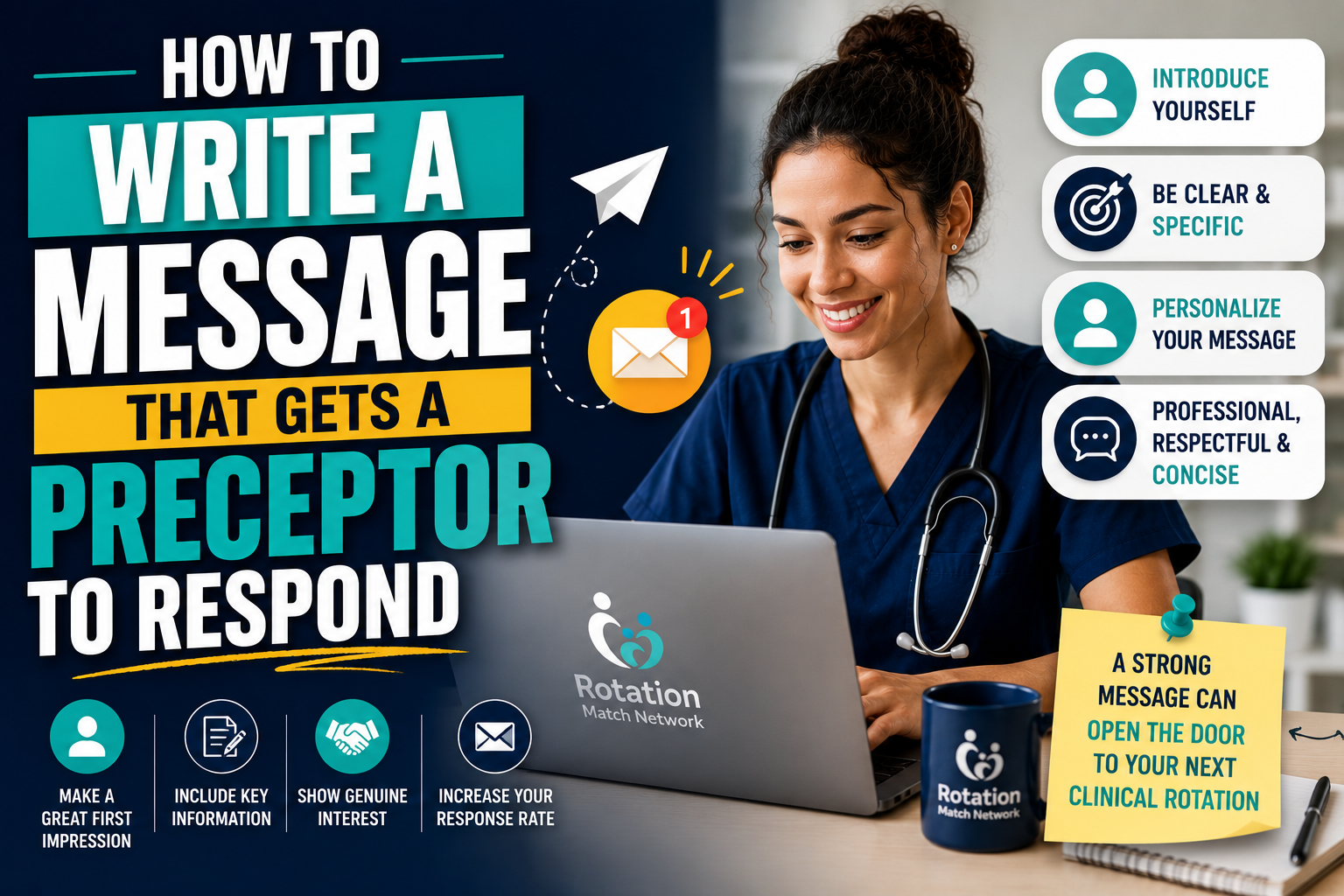
Introduce Yourself
Start by sharing your name and the healthcare program you are enrolled in.
For example:
"Hello, my name is Sarah Johnson, and I am a Psychiatric Mental Health Nurse Practitioner student at ABC University."
This immediately gives the preceptor important context.
Explain What You Are Looking For
Clearly state the type of clinical rotation you need.
Include details such as:
- Your specialty.
- The semester or rotation period.
- The required number of clinical hours.
- Your expected start date.
Being specific helps the preceptor quickly determine whether they are available.
Personalize Your Message
One of the biggest mistakes students make is copying and pasting the same message to dozens of providers.
Instead, explain why you are reaching out to that particular clinician.
Perhaps you admire their specialty, practice setting, or experience.
A personalized message shows genuine interest and demonstrates that you have taken the time to learn about them.
Keep It Brief
Healthcare professionals do not have time to read lengthy emails.
Aim for a concise message that still provides all the essential information.
In most cases, three to five short paragraphs are enough.
End with a Clear Call to Action
Finish your message by inviting the preceptor to continue the conversation.
For example:
"If you have availability or would be willing to discuss this opportunity further, I would greatly appreciate the chance to speak with you. Thank you for your time and consideration."
A polite closing leaves a positive impression.
Example of a Poor Outreach Message
Hi.
I need a preceptor for school. Can you help me? Please let me know.
While this message is short, it provides almost no information.
The preceptor is left wondering:
- Who is the student?
- What program are they enrolled in?
- What specialty do they need?
- When do they need the rotation?
- Why are they contacting this particular provider?
Without these details, many requests go unanswered.
Example of a Strong Outreach Message
Dear Dr. Smith,
My name is Emily Brown, and I am a Family Nurse Practitioner student at ABC University. I am currently seeking a clinical preceptor for my Fall 2026 primary care rotation, which requires 180 clinical hours beginning in September.
I came across your practice while researching experienced primary care providers in the area and was impressed by your commitment to comprehensive patient care. I would be honored to learn from your experience.
If you have availability or would be open to discussing this opportunity, I would greatly appreciate the chance to speak with you at your convenience.
Thank you for your time and consideration. I look forward to hearing from you.
This message is professional, personalized, and provides all the information a preceptor needs to make an informed decision.
Should You Follow Up?
Yes—but do so respectfully.
If you have not received a response after about one week, it is perfectly acceptable to send a polite follow-up message.
Keep it brief.
Simply remind the preceptor of your previous email, express continued interest, and thank them again for their time.
Avoid sending multiple messages within a few days or repeatedly calling the office, as this may have the opposite effect.
Additional Tips for Better Responses
Small details can make a big difference.
To improve your chances of receiving a response:
- Use a professional email address.
- Double-check your spelling and grammar.
- Address the preceptor by their correct title.
- Attach requested documents only if appropriate.
- Respond promptly if the preceptor replies.
- Be courteous in every interaction.
Professional communication reflects the type of healthcare professional you are becoming.
How Rotation Match Network Can Help
Reaching out to preceptors can feel overwhelming, especially when you are unsure where to begin.
Rotation Match Network simplifies the process by connecting healthcare students with qualified preceptors through a secure, user-friendly platform. Instead of relying solely on cold emails or personal referrals, students can discover clinical opportunities, manage communications, and stay organized throughout their clinical placement journey.
By combining professional communication with the right tools and resources, you can make your search more efficient and improve your chances of securing the clinical experience you need.
Final Thoughts
A well-written message will not guarantee an immediate "yes," but it can significantly improve your chances of receiving a response.
Remember that every email or message you send reflects your professionalism, communication skills, and respect for the preceptor's time. By introducing yourself clearly, personalizing your outreach, and communicating with confidence and courtesy, you can stand out from the many students seeking clinical placements.
The right preceptor may be just one thoughtful message away. Take the time to make your first impression count.
SEO Focus Keywords
- Clinical preceptor
- How to find a clinical preceptor
- Clinical rotation
- Clinical placement
- PMHNP preceptor
- FNP preceptor
- Healthcare students
- Preceptor outreach
- Clinical rotation tips
- Rotation Match Network