Preceptor Not Responding? What to Do When Your Clinical Rotation Request Gets No Response
You found a preceptor.
You sent your clinical rotation request.
And then... nothing.
No acceptance. No rejection. No message.
Just silence.
If you are waiting for a preceptor to respond to your clinical rotation request, you are not alone. One of the most frustrating parts of securing a clinical placement is not always finding a potential preceptor. Sometimes, it is simply getting a response.
So, what should you do when a preceptor does not respond?
First, Don't Panic
A preceptor not replying does not automatically mean they are rejecting you.
Remember that most preceptors are busy healthcare professionals. They may be seeing patients, managing a practice, working shifts, reviewing other student requests, or simply have not had the opportunity to review your message.
Give them a reasonable amount of time before assuming the worst.
At the same time, do not put your entire clinical placement at risk by waiting indefinitely for one person.
How Long Should You Wait Before Following Up?
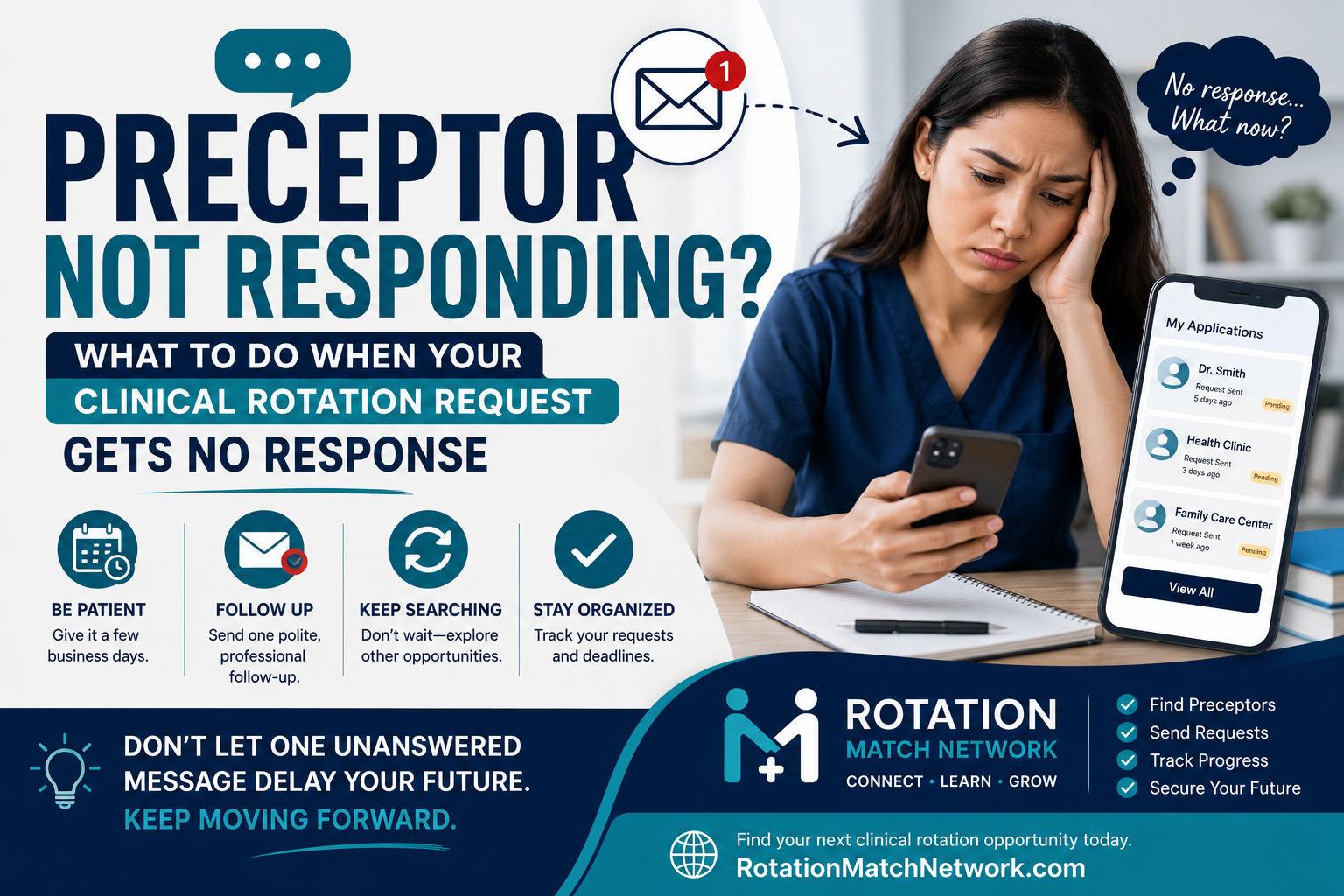
If you have not received a response, a professional follow-up after a few business days is reasonable.
Your follow-up should be:
Short
Polite
Professional
Easy to respond to
Do not send multiple messages in a short period or pressure the preceptor to respond.
Example of a Professional Follow-Up Message
Subject: Follow-Up Regarding Clinical Rotation Request
Hello [Preceptor's Name],
I hope you are doing well. I wanted to follow up regarding my clinical rotation request for [specialty] from [date] to [date].
I remain very interested in the opportunity and would be happy to provide any additional information or documentation you may need.
Thank you for your time, and I look forward to hearing from you.
Best regards,
[Your Name]
That is enough.
You do not need to write a long explanation.
What If the Preceptor Still Does Not Reply?
This is where many students make a mistake.
They keep waiting.
Days become weeks, and suddenly their clinical deadline is approaching.
If you have followed up professionally and still have no response, move on and continue your search.
A lack of response is information too.
It may mean the preceptor is unavailable, no longer accepting students, is too busy to respond, or simply is not the right match for your rotation.
Your goal is not to convince one particular preceptor to accept you.
Your goal is to secure a clinical placement that fits your program, specialty, schedule, and requirements.
Don't Stop Looking While You Wait
If your first clinical rotation request receives no response, continue searching for other opportunities.
This is particularly important when your school's placement deadline is approaching.
Instead of sending one request and waiting, build a reasonable list of potential preceptors whose specialty, location, availability, and requirements match your needs.
This gives you options instead of leaving your entire rotation dependent on one unanswered request.
Use Rotation Match Network to Find Available Opportunities
Searching for preceptors through scattered emails and waiting for responses can make the clinical placement process unnecessarily stressful.
Rotation Match Network gives students a centralized way to search for available clinical rotations by location and specialty, review rotation details, and send placement requests. Students can also track their application status through their dashboard.
Instead of wondering whether there is another preceptor you can contact, you can continue exploring available opportunities while keeping your applications organized.
RMN is designed to facilitate clinical placement coordination between students and preceptors, making it easier to move forward when one opportunity does not work out.
When Should You Move On From a Preceptor?
Consider moving on when:
You have sent a professional follow-up and received no response.
The preceptor's availability no longer matches your rotation dates.
Your clinical deadline is approaching.
The opportunity no longer meets your school's requirements.
You find another preceptor who is a better match.
Moving on does not mean you have failed.
Clinical placement is about finding the right match, not waiting endlessly for one response.
What You Should Never Do
Avoid sending messages such as:
"Why haven't you responded?"
"I need you to respond urgently."
"Please accept my request."
"I'm still waiting."
Even if you are under pressure, these messages can come across as demanding or unprofessional.
Remember that the person you are contacting may eventually become your clinical mentor. Your communication should reflect the professionalism expected of you as a future healthcare professional.
The Bottom Line
If a preceptor does not respond to your clinical rotation request, follow up once professionally, give them reasonable time, and then keep searching.
Do not let one unanswered request delay your entire clinical placement.
The best approach is to stay organized, communicate professionally, and keep multiple options open.
And if you are still searching for a clinical preceptor, Rotation Match Network can help you find available rotation opportunities, submit requests, and track your applications in one place.
Don't let one unanswered message stop your clinical journey. Keep searching. Keep applying. Keep moving forward.
Primary Keyword:
preceptor not responding
Secondary Keywords:
preceptor not replying
clinical rotation request no response
clinical rotation request not answered
what to do if preceptor does not respond
preceptor not responding to email
clinical placement problems
clinical rotation preceptor
clinical placement request
preceptor follow up message
how to follow up with a clinical preceptor