The Hidden Skills Every Student Learns During Clinical Rotations
When you think about clinical rotations, what comes to mind?
You might think about patient assessments, clinical procedures, medications, diagnoses, charting, or finally getting the chance to apply everything you have learned in the classroom.
But clinical rotations teach you much more than medical knowledge.
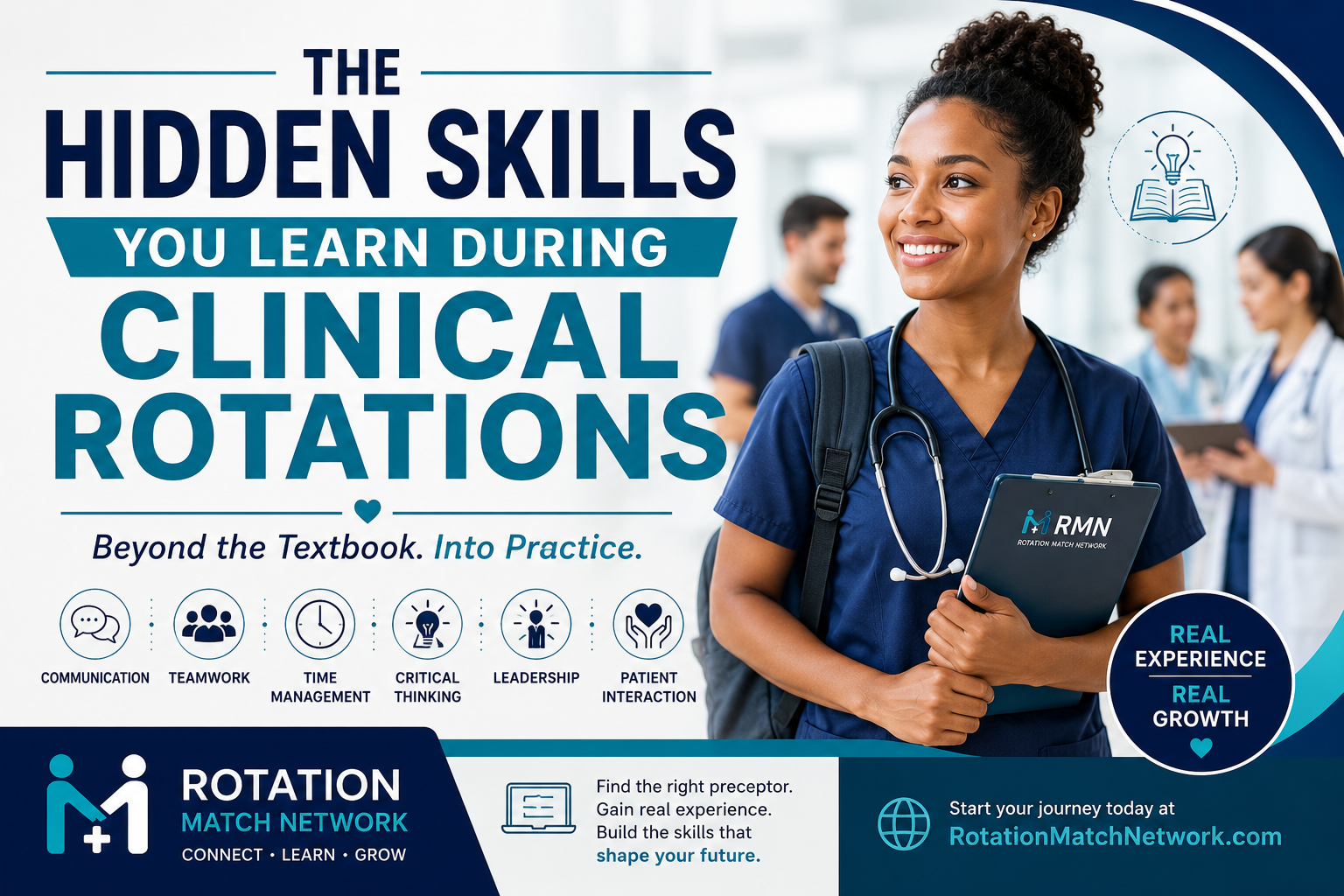
Some of the most valuable skills you develop during a clinical rotation are not found in a textbook or tested on an exam. They are the skills that help you communicate with patients, work with healthcare teams, manage your time, solve problems, respond to feedback, and become more confident in a real clinical environment.
These are the hidden skills that can shape the kind of healthcare professional you become.
And it all starts with getting the right clinical experience.
Clinical Rotation Is Where Classroom Knowledge Meets Real Life
There is a big difference between knowing something academically and knowing how to apply it when you are standing in front of a real patient.
In the classroom, you may have time to think through a question, review your notes, or discuss a scenario with your classmates.
In a clinical setting, things can move much faster.
Patients have different needs. Healthcare professionals communicate constantly. Priorities can change. You may need to ask questions, make decisions, listen carefully, and adapt to situations you did not expect.
That is why clinical rotations are such an important part of healthcare education.
Your clinical experience is not simply about completing required hours. It is an opportunity to develop the professional skills you will eventually rely on throughout your career.
1. Communication
Communication is one of the first skills you will begin developing during your clinical rotation.
You will communicate with patients, preceptors, nurses, physicians, other healthcare professionals, administrative staff, and sometimes patients' families.
You will learn that effective communication is not simply about speaking clearly.
It is also about listening.
You may need to explain something to a patient in language they can understand. You may need to ask your preceptor for clarification. You may need to report information accurately to another member of the healthcare team.
Clinical rotations teach you how to adjust your communication depending on who you are speaking with and what the situation requires.
That is a skill that will stay with you long after your rotation ends.
2. Teamwork
Healthcare is rarely a one person job.
A patient's care may involve nurses, physicians, nurse practitioners, physician assistants, pharmacists, therapists, technicians, administrative professionals, and many other people working toward the same goal.
During your clinical rotation, you begin to understand what it actually means to be part of a healthcare team.
You learn how different professionals contribute to patient care. You learn when to speak up, when to listen, when to ask for help, and how to respect the expertise of others.
You also learn that being a good team member means taking responsibility for your role.
These experiences can help prepare you for the collaborative nature of modern healthcare.
3. Time Management
Clinical days can become busy very quickly.
You may have several patients to follow, documentation to complete, learning objectives to meet, and questions to ask your preceptor.
Learning how to manage all of this is an important part of your development.
Your clinical rotation can teach you how to prioritize tasks, stay organized, avoid unnecessary delays, and make the most of your time.
You will also discover that time management in healthcare is not simply about doing everything quickly.
It is about knowing what needs your attention first.
4. Critical Thinking
You can memorize hundreds of facts and still find yourself challenged when faced with a real patient.
Why?
Because real patients do not always present exactly like textbook examples.
Clinical rotations give you opportunities to observe how experienced healthcare professionals think through real situations.
You begin asking questions such as:
What information is most important?
What could be causing these symptoms?
What should happen next?
When should I ask for help?
What information should be communicated to the rest of the team?
Over time, these experiences can strengthen your ability to analyze information and approach problems logically.
Your preceptor plays an important role here by helping you understand not just what to do, but why it should be done.
5. Confidence
Almost every student feels nervous before starting a clinical rotation.
That is normal.
You are entering an environment where experienced professionals are working with real patients, and you may initially question whether you know enough.
But confidence develops through experience.
The first time you interact with a patient may feel uncomfortable.
The tenth time may feel easier.
Eventually, situations that once made you nervous may become familiar.
That gradual change is one of the most rewarding parts of clinical education.
The goal is not to walk into your first rotation believing you know everything.
The goal is to leave your rotation knowing more than you did when you started and feeling more capable of handling the responsibilities ahead.
6. Professionalism
Clinical rotations teach you what professionalism actually looks like in practice.
It is more than wearing the right clothes or arriving on time.
Professionalism includes how you speak to patients, how you respond to feedback, how you protect patient privacy, how you communicate with your preceptor, and how seriously you take your responsibilities.
You may discover that small things matter.
Showing up prepared.
Being punctual.
Listening when someone is speaking.
Taking responsibility when you make a mistake.
Treating every patient with respect.
These habits can influence how others see you and can become part of your professional identity.
7. Adaptability
Healthcare does not always go according to plan.
A patient may arrive with an unexpected concern. A schedule may change. A procedure may be cancelled. Your preceptor may ask you to focus on something you were not expecting.
Clinical rotations teach you to adapt.
Instead of becoming overwhelmed when things change, you gradually learn how to stay calm, reassess the situation, and determine what needs to happen next.
That ability to adapt is valuable in virtually every healthcare environment.
8. Patient Interaction
One of the biggest differences between classroom learning and clinical education is interacting with real patients.
Patients are people, not case studies.
They have concerns, emotions, expectations, fears, and personal experiences that can influence their healthcare decisions.
Clinical rotations give students the opportunity to learn how to approach patients with empathy and respect.
You begin to understand the importance of introducing yourself properly, listening without interrupting, explaining what you are doing, protecting privacy, and making patients feel heard.
These experiences can shape the way you approach patient care throughout your career.
9. Receiving and Using Feedback
Nobody becomes an excellent healthcare professional without receiving feedback.
During your clinical rotation, your preceptor may point out something you could have done differently or identify an area where you need more practice.
Your first reaction might be to feel discouraged.
But learning how to receive constructive feedback is itself a professional skill.
Instead of seeing feedback as criticism, learn to see it as information that can help you improve.
Ask questions.
Think about what you were told.
Apply the feedback the next time you encounter a similar situation.
The ability to accept feedback and turn it into improvement can make a major difference in your professional development.
10. Leadership
You do not have to be in charge to develop leadership skills.
Clinical rotations can teach you how to take initiative, communicate responsibly, support others, and take ownership of your learning.
For example, instead of waiting for your preceptor to tell you what to do every time, you can prepare questions before your shift, review relevant conditions, volunteer to observe appropriate procedures, and look for opportunities to learn.
Leadership begins with taking responsibility.
Your clinical rotation gives you opportunities to practice that responsibility in a supervised environment.
Why Finding the Right Preceptor Matters
All of these skills develop through experience, and the quality of that experience matters.
Your preceptor is more than the person who signs off on your clinical hours.
A good preceptor can challenge your thinking, answer your questions, provide feedback, expose you to different clinical situations, and help you understand what professional practice actually looks like.
That is why finding a clinical preceptor should not be treated as simply checking a requirement off your academic list.
You are choosing someone who will be part of an important stage of your professional development.
Finding the Right Clinical Preceptor With Rotation Match Network
Finding a suitable preceptor can sometimes become one of the most stressful parts of preparing for a clinical rotation.
Students may have to search for available clinicians, determine whether they match their specialty and location requirements, communicate with potential preceptors, submit requests, and keep track of documentation.
Trying to manage all of this through scattered emails, spreadsheets, messages, and different websites can quickly become overwhelming.
Rotation Match Network was created to make the clinical placement process more organized.
Students can search for available preceptors based on factors such as location, specialty, and start date, then submit placement requests through the platform. Students can also track applications, deadlines, placement progress, and compliance requirements from a centralized dashboard.
That means you can spend less time trying to figure out where your placement stands and more time preparing for the experience itself.
If you are still searching for a clinical preceptor, you can visit RotationMatchNetwork.com to explore your options and begin your placement journey.
Your Clinical Rotation Is About More Than Completing Hours
At the end of your clinical rotation, you may remember the number of hours you completed.
But the skills you developed during those hours may be much more important.
You may become a better communicator.
You may become more comfortable speaking with patients.
You may learn how to work as part of a healthcare team.
You may become better at managing your time.
You may develop stronger critical thinking skills.
You may become more comfortable receiving feedback.
And perhaps most importantly, you may begin to see yourself not simply as a student, but as a future healthcare professional.
That is the real value of clinical education.
Your clinical rotation is not just another requirement standing between you and graduation.
It is where you begin developing the skills, habits, confidence, and professional mindset that you will carry into your career.
Ready to Find Your Clinical Preceptor?
The right clinical experience can make a difference in how much you learn and how prepared you feel when you enter professional practice.
If you are looking for a clinical preceptor, Rotation Match Network can help you organize the process from finding available opportunities to submitting requests and tracking your placement progress.
Find your preceptor. Build your skills. Prepare for your future.
Visit RotationMatchNetwork.com to get started.
Primary keyword: clinical rotation skills
Secondary keywords:
clinical rotation skills for students
skills learned during clinical rotations
what do you learn during clinical rotations
clinical rotation tips
skills gained from clinical experience
clinical skills for healthcare students
healthcare student clinical rotation
clinical rotation preceptor
how to find a clinical preceptor
clinical placement for students