
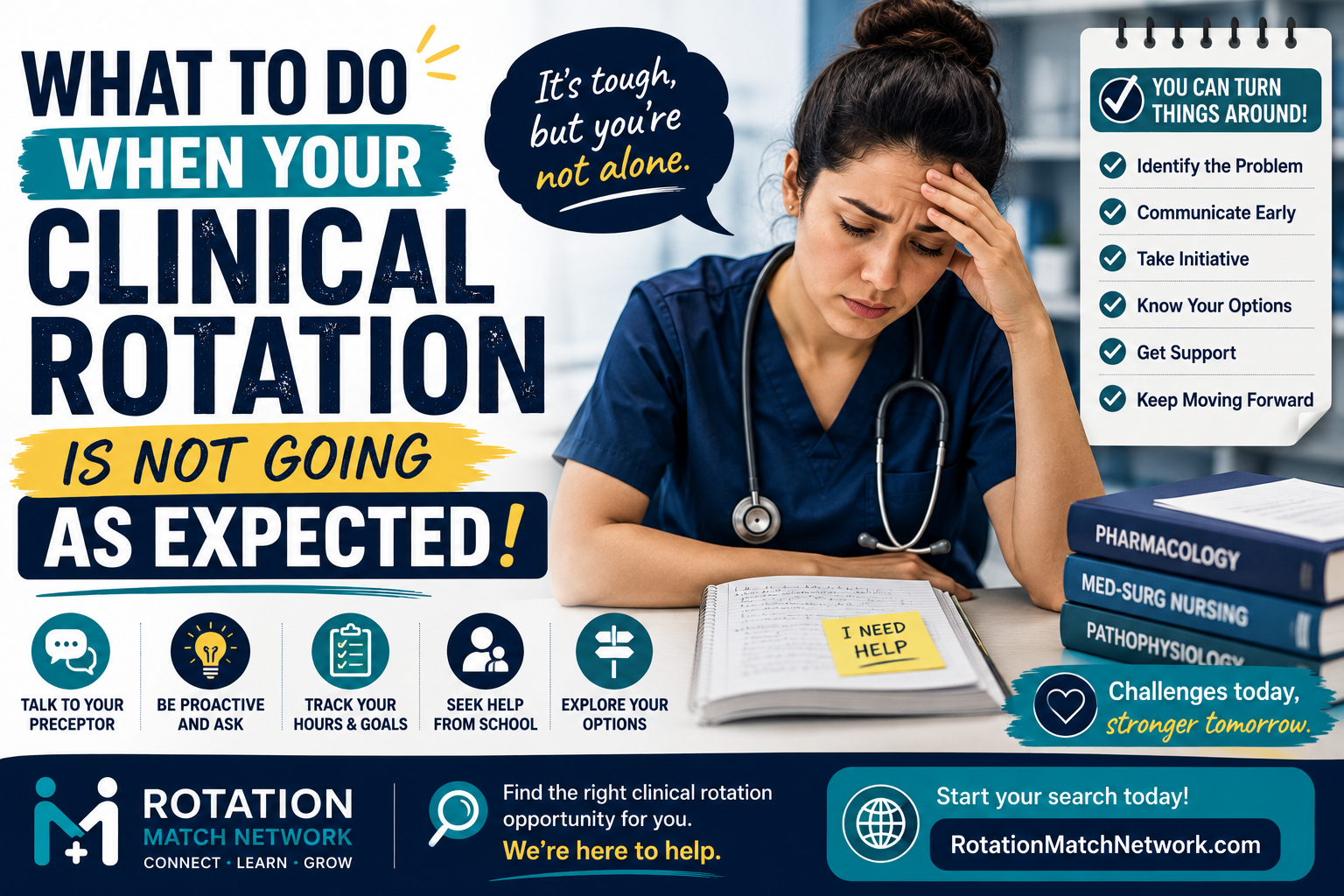
What to Do When Your Clinical Rotation Is Not Going as Expected
You finally secured your clinical rotation.
You thought the hardest part was over.
Then the rotation started, and things did not go the way you expected.
Maybe you are barely seeing patients. Maybe your preceptor is too busy to teach. Perhaps the schedule keeps changing, communication is difficult, or you simply feel like you are not learning enough.
If you are thinking, “My clinical rotation is not going well. What should I do?”, don't panic.
A difficult clinical rotation does not automatically mean you chose the wrong career, have the wrong preceptor, or are going to fail.
Sometimes, the problem can be solved with better communication. Other times, you may need to involve your school or consider a different placement.
Here is how to figure out what to do next.
First, Identify What Is Actually Going Wrong
Before deciding that your clinical rotation is a failure, identify the specific problem.
Ask yourself:
Am I getting enough clinical exposure?
Am I seeing the type of patients my program requires?
Am I getting opportunities to participate and learn?
Is my preceptor providing feedback?
Are my clinical hours being completed as expected?
Is the schedule consistent with what was agreed upon?
Do I understand what my preceptor expects from me?
Am I communicating my concerns clearly?
Knowing the exact problem makes it much easier to find a solution.
1. Talk to Your Preceptor
One of the biggest mistakes students make when a clinical rotation is not going well is staying silent.
Your preceptor may not realize that you need more opportunities to participate, more feedback, or additional guidance.
Instead of waiting and becoming frustrated, have a professional conversation.
For example, you could say:
“I really appreciate the opportunity to learn with you. I would like to make sure I am getting the clinical experiences required by my program. Are there additional opportunities for me to participate in patient care or take on more responsibilities?”
This approach is respectful and solution-focused.
Your preceptor may simply need to understand what you need from the rotation.
2. Don't Be Afraid to Ask Questions
You are there to learn.
You are not expected to know everything before your clinical rotation begins.
If you don't understand something, ask.
If you are unsure about a procedure, ask.
If you want more exposure to a particular type of patient, communicate that.
Good questions show that you are engaged and interested in learning.
However, choose the right time to ask. If your preceptor is dealing with an urgent patient situation, wait until the appropriate moment.
3. Take Initiative
Sometimes a clinical rotation feels disappointing because students spend too much time waiting for learning opportunities to come to them.
When appropriate and within your scope of practice, take initiative.
Ask:
“Is there anything I can help with?”
“Would it be okay for me to observe this?”
“Can I review this patient's case?”
“Could you explain why you chose this approach?”
You can also prepare before each clinical day by reviewing relevant conditions, medications, procedures, and clinical concepts.
The more prepared you are, the more confidently you can participate.
4. Keep Track of Your Clinical Hours and Experiences
Do not rely on your memory.
Keep accurate records of your clinical hours, patient encounters, procedures, learning experiences, and other requirements your program asks you to document.
This becomes particularly important if you later discover that your rotation is not providing the experiences or hours you need.
Your records can help you identify gaps early rather than discovering them at the end of your rotation.
5. Give the Situation Time, But Don't Ignore Serious Problems
Not every uncomfortable first week means your clinical placement is bad.
It can take time to understand a new environment, build a relationship with your preceptor, and become comfortable participating in patient care.
Give yourself some time to adjust.
But there is a difference between normal adjustment and a genuine clinical placement problem.
If you consistently cannot complete your required hours, are not receiving the clinical exposure your program requires, or are experiencing serious communication or professionalism concerns, do not simply hope the problem disappears.
Address it early.
6. Speak With Your School or Clinical Coordinator
If you have tried communicating with your preceptor and the problem continues, contact your school's clinical coordinator or appropriate faculty member.
Explain the situation calmly.
Focus on facts rather than emotions.
For example:
Instead of:
“My preceptor is terrible and doesn't care about me.”
Say:
“I have completed X hours, but I have not been receiving the patient experiences required for my rotation. I discussed this with my preceptor on [date], but the issue has continued.”
Specific information makes it easier for your school to understand the situation and determine what should happen next.
7. Know When It May Be Time to Consider Another Placement
Sometimes a clinical rotation simply isn't the right fit.
If your clinical site cannot provide the experiences required by your program, your schedule cannot be accommodated, or the situation cannot be resolved after appropriate communication, you may need to discuss alternative options with your school.
Do not leave a difficult placement without understanding your school's policies.
Your school may have specific procedures for changing preceptors or clinical sites.
What If You Need a New Clinical Preceptor?
This is where planning ahead can make a major difference.
If your clinical placement needs to change, you may need to find another preceptor quickly.
Instead of starting from scratch with scattered searches, emails, and messages, use a platform designed to connect students with clinical opportunities.
Rotation Match Network helps students search for clinical rotation opportunities based on factors such as specialty and location, review rotation details, submit requests, and track applications.
That can be especially useful when you need to explore alternative opportunities rather than waiting for one placement to work out.
The earlier you identify a placement problem, the more options you have.
What If Your Preceptor Is Not Responding?
If your clinical rotation is not going as expected because your preceptor is not responding, don't repeatedly send messages or assume the worst.
Send a short, professional follow-up.
If you still receive no response, continue exploring other options rather than allowing one unanswered request to put your entire rotation at risk.
For more guidance, read our article on What to Do When a Preceptor Does Not Respond to Your Clinical Rotation Request.
What If You Feel Like You Are Not Learning Enough?
This is one of the most common concerns students have during clinical rotations.
Start by asking yourself whether you are actively looking for opportunities to learn.
Prepare before each shift.
Ask thoughtful questions.
Request feedback.
Review your patient encounters.
Reflect on what you learned and what you still need to improve.
And talk to your preceptor about your learning goals.
You may discover that a simple conversation changes the entire experience.
Remember: A Difficult Rotation Does Not Define You
A challenging clinical rotation can make you question yourself.
You may wonder:
“Am I good enough?”
“Did I choose the wrong program?”
“Why does everyone else seem to be doing fine?”
Try not to make major conclusions based on one difficult experience.
Clinical rotations are learning environments. You are developing clinical knowledge, communication skills, confidence, judgment, teamwork, and professionalism.
You are also learning how to work with different personalities and clinical environments.
Those experiences matter.
How to Make Your Next Clinical Rotation Better
If you have another rotation coming up, use what you learned from this experience.
Before accepting a placement, ask about:
The expected schedule
Clinical hours
Patient population
Learning opportunities
Preceptor expectations
Student responsibilities
Communication
Required documentation
Your school's specific requirements
The more you know before accepting a placement, the fewer surprises you are likely to encounter.
Find the Right Clinical Match From the Start
A successful clinical rotation is about more than simply finding someone willing to take a student.
It is about finding a good match between the student's requirements, the preceptor's specialty, availability, clinical environment, and learning opportunities.
That is the idea behind Rotation Match Network.
RMN provides students with a centralized way to search for clinical rotation opportunities, review available placements, submit requests, and keep track of their applications.
Instead of waiting until your clinical placement becomes a problem, start your search early and make informed decisions about your rotation.
Final Thoughts
If your clinical rotation is not going as expected, don't suffer in silence and don't immediately assume that you have failed.
Identify the problem.
Talk to your preceptor.
Ask for what you need.
Take initiative.
Track your hours and experiences.
Give the situation a reasonable opportunity to improve.
And if the problem continues, speak with your school or clinical coordinator.
Most importantly, remember that securing a clinical rotation is only part of the process. Finding the right clinical match can make a significant difference in your learning experience.
Whether you are looking for your first clinical placement or need to explore another opportunity, Rotation Match Network can help you take the next step.
Your clinical rotation may not be going the way you planned. That doesn't mean your clinical journey has to go off track.