
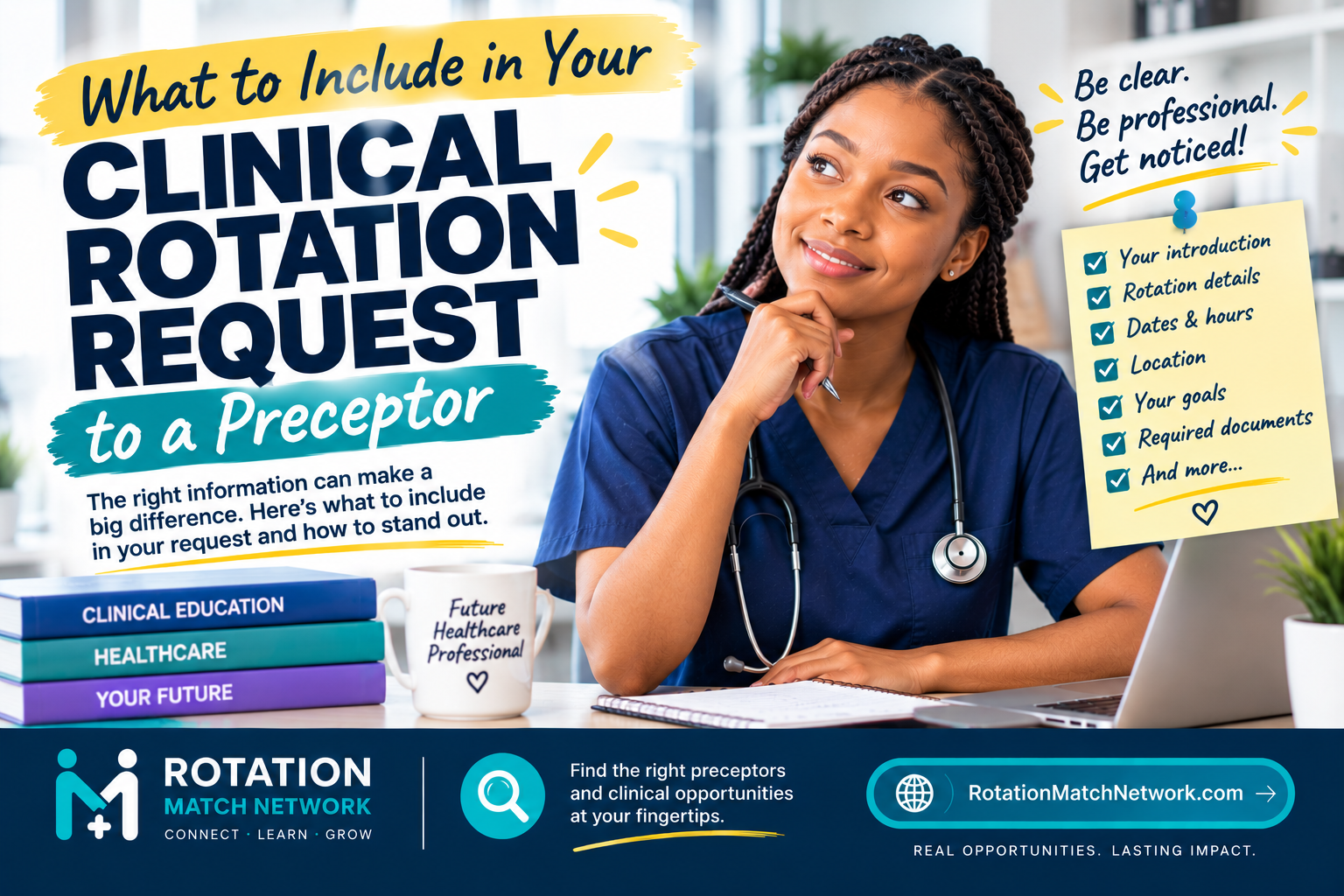
What to Include in Your Clinical Rotation Request to a Preceptor
Finding a clinical preceptor is an important step in your healthcare education. But finding the right preceptor is only half the process.
You also need to send a clinical rotation request that gives the preceptor enough information to understand who you are, what you need, and whether you are a good fit for their available rotation.
A vague request can easily be overlooked.
A clear, professional, and complete request can make a much better first impression.
Whether you are a PMHNP, FNP, PA, CRNA, or another healthcare student looking for clinical placement, here is what to include in your clinical rotation request to a preceptor.
Why Your Clinical Rotation Request Matters
Preceptors can receive requests from multiple students, sometimes for the same dates or specialty.
Your request is often one of the first opportunities a preceptor has to understand your needs.
Think of it as a short professional introduction.
The preceptor should be able to quickly understand:
• Who you are
• What program you are enrolled in
• What type of rotation you need
• When you need the rotation
• How many hours you need
• Where you are located or willing to travel
• What your school requires
• Why the rotation is a good fit
The more relevant information you provide, the easier it is for a preceptor to evaluate your request.
1. Introduce Yourself Clearly
Start with a short introduction.
Include your name, program, and current stage of training.
For example:
“Hello Dr. Smith, my name is Sarah Johnson. I am a PMHNP student currently completing my clinical training and I am looking for a preceptor for my upcoming psychiatric mental health rotation.”
You do not need to write a long personal story.
Keep your introduction professional and focused on the rotation.
2. State Exactly What Rotation You Need
Do not make the preceptor guess what you are looking for.
Clearly state your specialty and rotation requirements.
For example:
“I am seeking a 120 hour psychiatric mental health rotation focused on adult patients.”
If your program has specific requirements, mention the relevant ones.
Being specific helps the preceptor determine quickly whether they can provide the experience you need.
3. Include Your Preferred Rotation Dates
Your availability is one of the most important parts of a clinical rotation request.
Include:
Start date
End date
Preferred clinical days
Any scheduling limitations
For example:
“My preferred rotation dates are October 5 through December 15, with availability on Mondays, Wednesdays, and Fridays.”
If your schedule is flexible, say so.
If your school requires specific dates, make that clear.
On Rotation Match Network, students are asked to provide their preferred rotation dates and hours when sending a request, making these details an important part of the application process.
4. State How Many Clinical Hours You Need
A preceptor needs to know how much time you are requesting.
Instead of saying:
“I need a clinical rotation this semester.”
Say:
“I am seeking 160 clinical hours to be completed between October and December.”
This allows the preceptor to compare your request with their availability.
It can also prevent misunderstandings later.
5. Mention Your Location
Location matters when requesting a clinical rotation.
Tell the preceptor where you are located and, if applicable, how far you are willing to travel.
For example:
“I am based in Houston and am available for clinical placements within the surrounding area.”
If you are open to telehealth, you can mention that as well if it is permitted by your program.
Rotation Match Network allows students to search available rotations based on location and specialty, making it easier to identify opportunities that may fit their placement needs.
6. Explain Your Program Requirements
Your preceptor may work with students from different schools and programs.
Do not assume they know your school's requirements.
Briefly explain anything important.
For example:
“My program requires exposure to adult psychiatric patients and completion of 160 clinical hours. I will also need my clinical hours and evaluation completed according to my school's requirements.”
If your school has specific compliance requirements, make sure you understand them before submitting your request.
7. Mention Your Relevant Experience
You do not need to write your entire resume into the request.
Instead, mention experience that is relevant to the rotation.
For example:
“I previously worked as a registered nurse in an outpatient behavioral health setting, which strengthened my interest in psychiatric mental health.”
Or:
“I have previous experience working with pediatric patients and am particularly interested in developing my skills in pediatric primary care.”
This gives the preceptor a quick idea of your background.
8. Highlight What You Hope to Learn
A strong clinical rotation request should not only explain what you need.
It should also show that you are interested in learning.
For example:
“I am particularly interested in strengthening my skills in psychiatric assessments, medication management, and patient education during this rotation.”
This helps the preceptor see that you have thought about your clinical goals.
It also makes your request feel more personal.
9. Confirm That Your Documents Are Ready
Preceptors may want to know whether you are prepared to begin the onboarding process.
Depending on your program and clinical site, this could include documents such as:
• Resume or CV
• Professional license
• BLS or CPR certification
• Immunization records
• Background check
• Drug screening
• Liability insurance
• Health clearance
• School approval
Do not attach documents that were not requested, especially if they contain sensitive information.
Instead, let the preceptor know that your required documents are available and ready when needed.
Rotation Match Network provides students with a document upload process and checks required application materials such as a nursing license and resume before applying.
10. Explain Why You Are Interested in That Preceptor
This is where you can make your request feel less like a copy and paste message.
If the preceptor's specialty, patient population, clinical setting, or experience aligns with your goals, mention it.
For example:
“I am particularly interested in your practice because of your experience working with adult patients with mood and anxiety disorders, which aligns closely with my current learning goals.”
A personalized request shows that you actually looked at the preceptor's profile.
11. Be Professional and Respectful
Your clinical rotation request is also a reflection of your professionalism.
Avoid messages such as:
“Hi, I need a preceptor. Are you available?”
It may be short, but it does not give the preceptor enough information to make a decision.
Instead, provide the essential details in a clear and respectful way.
Remember that your preceptor is taking time out of their professional schedule to review your request.
Make the process easy for them.
12. Do Not Make the Request Too Long
Being thorough does not mean writing an essay.
A good clinical rotation request should be:
Clear.
Specific.
Professional.
Personalized.
Easy to read.
The preceptor should be able to understand your request within a few moments.
Save lengthy explanations for situations where they are actually necessary.
A Simple Clinical Rotation Request Template
Here is a basic structure you can use when contacting a potential preceptor:
Subject: Clinical Rotation Request
Hello Dr. [Last Name],
My name is [Name], and I am a [program/year] student at [school]. I am currently looking for a clinical preceptor for my upcoming [specialty] rotation.
I am required to complete [number] clinical hours between [start date] and [end date]. I am available on [days/times] and am located in [location].
I am particularly interested in your practice because [specific reason]. My clinical goals include [briefly mention 1 to 2 goals].
I have my required clinical documents ready and would be happy to provide any additional information needed.
Thank you for considering my request. I would greatly appreciate the opportunity to learn from you.
Best regards,
[Full Name]
[Program]
[School]
What Not to Include in a Clinical Rotation Request
Knowing what to leave out is just as important.
Avoid:
A Generic Copy and Paste Message
If every preceptor receives exactly the same message, your request may feel impersonal.
Missing Dates
A preceptor cannot determine availability if they do not know when you need the rotation.
Unclear Hour Requirements
Always state how many clinical hours you need.
Too Much Personal Information
Your request should focus on your education, clinical requirements, experience, and goals.
Demanding Language
You are requesting an opportunity, not demanding one.
Unprofessional Communication
Poor grammar, excessive abbreviations, or casual language can create a poor first impression.
How Rotation Match Network Makes Clinical Rotation Requests Easier
Finding a preceptor and sending a professional request can be time consuming when you are relying on scattered emails, social media messages, and personal contacts.
Rotation Match Network gives students a centralized way to search for available clinical opportunities and submit placement requests.
Students can search rotations by location and specialty, review the preceptor's requirements and rotation details, provide preferred dates and hours, attach additional required documents, and track the status of their application through their dashboard.
This means you can spend less time wondering where to find a preceptor and more time preparing a request that actually represents you.
If you are looking for a clinical preceptor, visit RotationMatchNetwork.com and explore available rotation opportunities.
Before You Send Your Clinical Rotation Request
Use this quick checklist:
☐ Introduced yourself
☐ Mentioned your healthcare program
☐ Clearly stated your specialty
☐ Included your required clinical hours
☐ Included your preferred dates
☐ Mentioned your location
☐ Explained important school requirements
☐ Mentioned relevant experience
☐ Included your clinical learning goals
☐ Confirmed that required documents are ready
☐ Personalized the request
☐ Checked your spelling and grammar
☐ Used a professional tone
If you can check all of these boxes, your request is likely to be much clearer and easier for a preceptor to evaluate.
Your Request Is Your First Impression
A clinical rotation request may seem like a small part of the placement process, but it can make a significant difference.
Preceptors need enough information to understand whether your rotation needs match their availability and clinical setting.
So before you click Send Request, take a few minutes to make sure your request answers the questions a preceptor is likely to have.
Who are you?
What rotation do you need?
When do you need it?
How many hours do you need?
What are your clinical goals?
Why are you a good fit for this opportunity?
Make those answers clear, keep your message professional, and personalize it whenever possible.
And if you are still searching for the right clinical opportunity, Rotation Match Network can help you find available preceptors and submit your clinical rotation requests in one organized platform.
Visit RotationMatchNetwork.com to start your search and take the next step toward securing your clinical rotation.