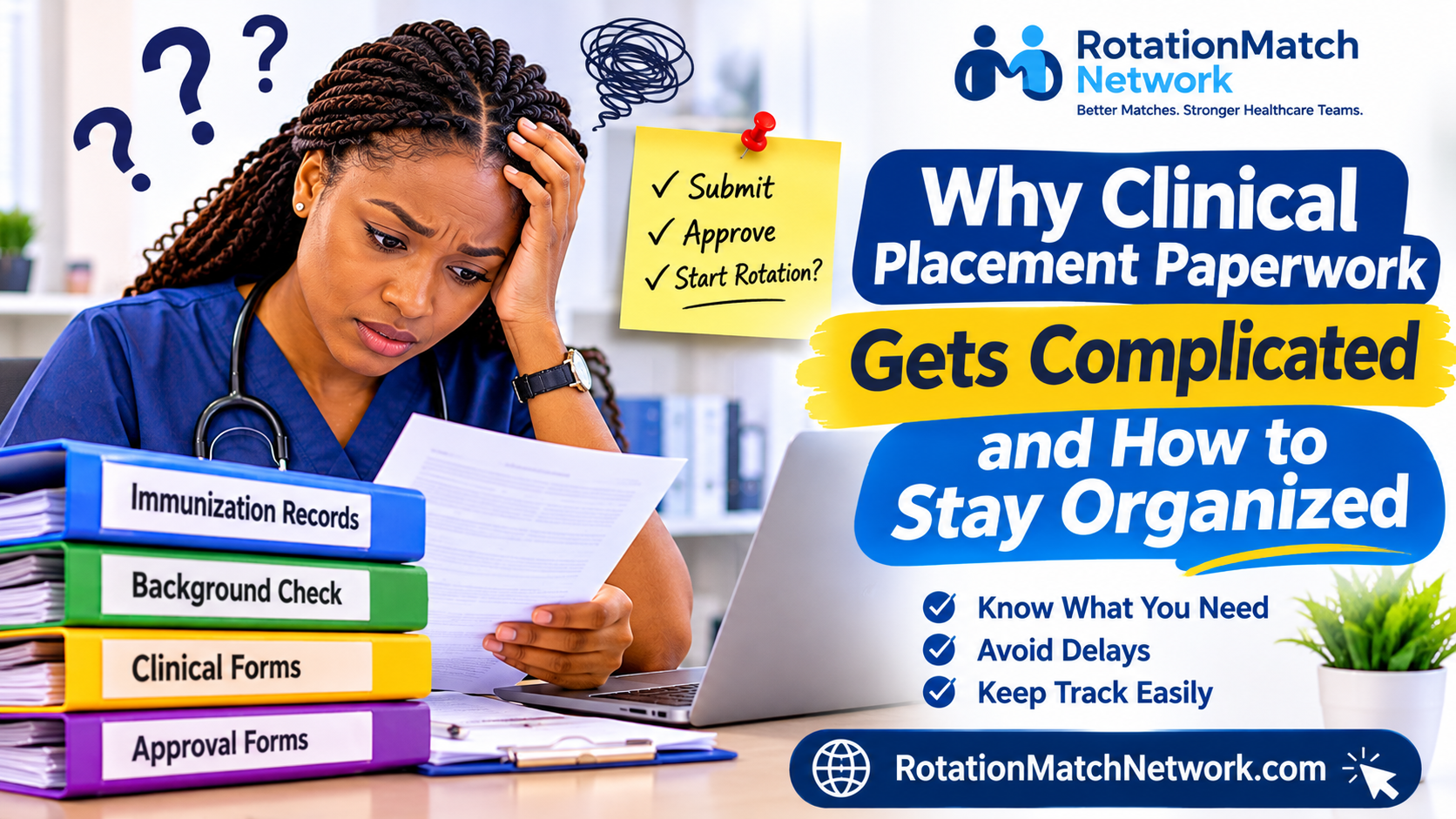
Why Clinical Placement Paperwork Gets Complicated and How to Stay Organized
Primary Keyword: clinical placement paperwork
Secondary Keywords: clinical rotation paperwork, clinical placement requirements, clinical rotation documents, clinical compliance documents, clinical placement checklist, nursing clinical placement requirements, clinical rotation onboarding, preceptor documentation, clinical placement process, how to organize clinical rotation documents
Suggested URL: /blog/why-clinical-placement-paperwork-gets-complicated-and-how-to-stay-organized
Why Does Clinical Placement Paperwork Get So Complicated?
Securing a clinical placement is an important milestone for every healthcare student. However, finding a preceptor and getting an acceptance is not always the end of the process. Before starting a rotation, students often have to complete several documents, meet compliance requirements, submit approvals, and ensure everything is available when needed.
For many students, this is where things become stressful.
One document may be missing, another may have expired, and a school or clinical site may request additional information. Sometimes, students submit the same paperwork multiple times because they are unsure which version is current or who is responsible for reviewing it.
Clinical placement paperwork can become complicated because several people and organizations are involved in the process. Students, preceptors, universities, and clinical sites may all have different requirements and deadlines.
The good news is that with proper planning and an organized approach, managing clinical rotation documents does not have to be overwhelming.
In this guide, we explain why clinical placement paperwork gets complicated, the documents students may need, common mistakes to avoid, and practical ways students and preceptors can stay organized.
What Is Clinical Placement Paperwork?
Clinical placement paperwork refers to the documents and administrative requirements students must complete before and sometimes during their clinical rotations.
These documents help schools and clinical facilities confirm that students meet the necessary academic, professional, and compliance requirements for their placements.
Depending on the healthcare program, school, and clinical site, the paperwork may include:
- Student information and placement application forms
- Immunization and vaccination records
- Background check results
- Drug screening results
- CPR or Basic Life Support certification
- Health screening or medical clearance
- Professional liability insurance
- HIPAA or patient confidentiality training certificates
- Clinical affiliation agreements
- Preceptor information and credential verification
- Learning objectives and clinical course requirements
- Clinical schedules and hour-tracking forms
Not every student will need all these documents. Requirements vary by school, specialty, state, and clinical facility. Students should always confirm their program's specific checklist before submitting anything.
7 Reasons Clinical Placement Paperwork Gets Complicated
Understanding why the process becomes difficult is the first step toward managing it better.
1. Different Schools Have Different Requirements
One of the biggest challenges is that clinical placement requirements are not always the same across healthcare programs.
For example, a Family Nurse Practitioner (FNP) student may have different placement and documentation requirements from a Psychiatric-Mental Health Nurse Practitioner (PMHNP), Certified Registered Nurse Anesthetist (CRNA), or Physician Assistant (PA) student.
Even students in the same specialty may have different requirements depending on their university or clinical site.
A document accepted by one program may not satisfy another program's requirements.
How to manage it:
Start with the official clinical placement checklist provided by your school. Do not rely entirely on another student's experience, even if they are in the same program. Confirm every requirement with your clinical placement coordinator.
2. Documents Have Different Expiration Dates
Some clinical compliance documents remain valid for several years, while others must be renewed more frequently.
For example, a CPR certification may expire on a specific date, while a background check or drug screening may need to meet a particular recency requirement set by the school or clinical site.
This creates a challenge when students secure a preceptor months before their rotation begins.
A document that was valid when the student applied may no longer be accepted by the time the placement starts.
How to manage it:
Create a document tracker that includes:
- Document name
- Date obtained
- Expiration date, if applicable
- Submission deadline
- Approval status
- Renewal date, where necessary
Review your tracker regularly so you can identify documents that need attention before they become a problem.
3. Students Must Submit Documents to Multiple People
Clinical placement paperwork may involve several departments and individuals.
A student might submit academic documents to the university, compliance documents to a clinical placement office, and additional information to a clinical facility or preceptor.
When communication happens across different email accounts, portals, and messaging platforms, it becomes easy to lose track of what has been submitted.
For instance, a student may assume that submitting documents to their university means the clinical site has also received them. That may not be the case.
How to manage it:
Keep a record of where each document has been submitted and who is responsible for reviewing it.
After submitting important paperwork, save the confirmation email or notification. If you are unsure whether a document has been received, follow up rather than assuming everything is complete.
4. Missing or Incomplete Documents Delay Approval
Sometimes, students submit their paperwork without checking whether every required section has been completed.
A missing signature, incorrect date, incomplete form, or unreadable document can delay the review process.
In some cases, students may only discover the problem when their school or clinical site requests a correction.
This can be frustrating, especially when the clinical rotation start date is approaching.
How to manage it:
Before submitting any document, check that:
- All required fields are completed.
- Names and personal details are accurate.
- Required signatures are included.
- Dates are correct.
- Scanned copies are readable.
- The document is in the requested format.
- The file has been uploaded to the correct location.
A few minutes of checking can prevent unnecessary back-and-forth communication.
5. Requirements Can Change During the Placement Process
Clinical placement requirements are not always fixed from the beginning.
A school may introduce an updated compliance requirement, or a clinical facility may request additional documentation before approving a student.
This can happen even after a student has found a preceptor.
The challenge is knowing which requirements have changed and whether previously submitted documents are still acceptable.
How to manage it:
Stay in contact with your school's clinical placement office. Check official announcements and emails regularly, and ask for clarification whenever a new requirement is introduced.
Avoid relying on old checklists or information shared by students from previous academic sessions.
6. Students Start Preparing Too Late
Many students focus heavily on finding a preceptor but delay organizing their compliance documents.
Unfortunately, securing a clinical placement does not automatically mean a student is ready to begin.
Some documents take time to obtain, process, renew, or approve. Waiting until a few weeks before the rotation can create unnecessary pressure.
How to manage it:
Start preparing your paperwork as soon as you understand your program's requirements.
You do not have to wait until a preceptor accepts your request before organizing your documents. Having them ready can make the placement process smoother and help you respond quickly when opportunities become available.
7. Poor Communication Between Students, Preceptors, and Schools
Clinical placement involves coordination. When the people responsible for different parts of the process do not communicate clearly, important information can get lost.
A preceptor may not know whether a student has completed the required compliance documents. A student may assume that the school has approved a placement when the review is still pending.
These misunderstandings can lead to delays and confusion.
How to manage it:
Communicate important updates clearly and promptly. Confirm who is responsible for each requirement, ask questions when information is unclear, and keep written records of important decisions.
Students should not assume that a preceptor is responsible for every school requirement, just as preceptors should not assume that a student's documents have already been approved.
How to Stay Organized With Clinical Placement Paperwork
Now that we understand why clinical placement paperwork becomes complicated, here are practical ways to make the process easier.
1. Create a Master Clinical Placement Checklist
Instead of keeping track of requirements in your head, create one checklist containing every document your school and clinical site require.
Divide the checklist into categories such as:
Personal and academic documents
- Student identification
- Enrollment verification
- Academic or program information
- Clinical placement application
Health and compliance documents
- Immunization records
- Health screening or medical clearance
- Background check
- Drug screening, if required
- CPR or BLS certification
- HIPAA training certificate
- Professional liability insurance, if required
Placement documents
- Preceptor information
- Preceptor credentials
- Clinical site details
- Affiliation agreement, where applicable
- Clinical schedule
- Learning objectives
Add a status beside each item, such as Not Started, In Progress, Submitted, Approved, or Needs Renewal.
This gives you a clear picture of what is complete and what still needs attention.
2. Keep Digital Copies of Your Documents
Digital storage makes it easier to retrieve and submit documents whenever they are requested.
Create a dedicated folder on your computer or secure cloud storage for your clinical placement paperwork.
You can organize it into subfolders such as:
- Immunization Records
- Certifications
- Background Checks
- School Documents
- Preceptor Information
- Clinical Agreements
Use clear file names that make documents easy to identify.
For example:
CPR_Certification_2026.pdf
Immunization_Record.pdf
Background_Check_2026.pdf
Avoid vague file names such as Document1, NewFile, or FinalCopy2.
Because some clinical documents contain sensitive personal and health information, use secure storage, strong account protection, and only share them through channels approved by your school or clinical site.
3. Track Expiration Dates and Submission Deadlines
A document can be complete but still unusable if it expires before the required clinical period.
Use a calendar, spreadsheet, or reminder application to track important dates.
For example, set reminders:
- 60 days before a document expires.
- 30 days before a submission deadline.
- One week before an important approval date.
These reminders give you enough time to renew documents or resolve issues without rushing.
4. Submit Documents as Early as Possible
Do not wait until every requirement is due before submitting your paperwork.
If your school allows documents to be submitted individually, complete and submit them as they become available.
This can help the placement office identify missing information early and give you time to make corrections.
However, always follow the submission process specified by your program.
5. Follow Up on Pending Approvals
Submitting a document does not always mean it has been approved.
Keep track of documents that are awaiting review. If you have not received confirmation within the expected timeframe, contact the relevant department.
A simple follow-up message can help you establish whether anything else is needed.
Example follow-up message:
Hello,
I am following up on the clinical placement documents I submitted on [date]. I would like to confirm whether they have been received and if there are any outstanding requirements I need to complete.
My intended rotation start date is [date], so I would appreciate any update on the approval process.
Thank you for your assistance.
6. Keep Communication in One Place
When possible, maintain a central record of important placement conversations.
Save relevant emails, approval notifications, document requests, and schedule confirmations in your clinical placement folder.
If you communicate through different channels, record the important decisions and dates in your tracker.
This makes it easier to retrieve information when questions arise.
7. Review Your Paperwork Before Your First Clinical Day
Before starting your rotation, review your checklist one final time.
Confirm that:
- All required documents have been submitted.
- Your school has approved the placement.
- Your clinical site has confirmed any required compliance checks.
- Your preceptor information is correct.
- Your rotation dates and schedule are confirmed.
- Any required agreements have been completed.
- You understand what documents you must bring or have available.
Do not assume that having a preceptor automatically means every administrative requirement has been satisfied. Confirm your readiness with the appropriate school and clinical site representatives.
Clinical Placement Paperwork Checklist for Students
Here is a simple checklist you can use when preparing for your next clinical rotation.
| RequirementStatus | |
| Confirm school-specific placement requirements | ☐ |
| Complete clinical placement application | ☐ |
| Prepare immunization records | ☐ |
| Complete required background checks | ☐ |
| Complete drug screening, if required | ☐ |
| Obtain valid CPR/BLS certification, if required | ☐ |
| Complete HIPAA training, if required | ☐ |
| Confirm liability insurance requirements | ☐ |
| Submit preceptor information and credentials | ☐ |
| Complete required affiliation agreements | ☐ |
| Confirm clinical dates and schedule | ☐ |
| Obtain final placement approval | ☐ |
This is a general checklist. Your school or clinical site may require additional documents.
How Preceptors Can Stay Organized With Student Documentation
Students are not the only ones responsible for keeping clinical placement paperwork organized. Preceptors also need a reliable way to manage information and respond to placement requests.
If you regularly accept clinical students, managing multiple requests through emails and separate messages can become difficult.
You may receive requests from students with different specialties, preferred dates, clinical hour requirements, and documentation needs.
Without an organized process, it can be difficult to remember which students have submitted their information, which requests are pending, and which placements have been confirmed.
Here are a few ways preceptors can improve their documentation process.
Maintain an Updated Preceptor Profile
Keep your professional information, specialty, clinical location, and availability accurate.
This helps students understand whether your experience and placement opportunities align with their program requirements.
Upload Relevant Documents
Where requested by the platform or placement process, upload your relevant professional and credential documents.
Having the necessary information available can help students access your profile more easily and understand your qualifications when considering a placement.
Review Student Requests Regularly
Check incoming placement requests and review the student's specialty, preferred dates, clinical hours, and other relevant information.
Respond promptly, even if you are unable to accommodate the request.
Keep Placement Information Updated
If your availability changes, update your schedule and communicate the changes to affected students.
Keeping your information current helps prevent scheduling misunderstandings and unnecessary delays.
How Rotation Match Network Helps Students and Preceptors With Clinical Placement Coordination
Managing clinical placement paperwork can become overwhelming when information is scattered across emails, documents, and different communication channels.
Rotation Match Network provides a platform where healthcare students and preceptors can connect and coordinate clinical placement requests.
For students, the platform allows you to create a profile, explore available preceptors by specialty and location, review relevant placement information, and submit requests with your preferred dates and clinical hours.
Students can also upload required documents through the platform as part of their placement process.
For preceptors, Rotation Match Network provides an opportunity to create a professional profile, share clinic and availability information, upload relevant documents, and review student requests.
This helps make important placement information easier to access and supports a more organized coordination process.
If you are a student preparing for your next clinical rotation, visit RotationMatchNetwork.com to explore available preceptors and submit your placement requests.
If you are a healthcare professional interested in mentoring students, you can also visit RotationMatchNetwork.com to create your preceptor profile, upload your documents, and share your availability.
Frequently Asked Questions About Clinical Placement Paperwork
What paperwork is needed for a clinical placement?
Clinical placement paperwork varies by school, program, and clinical site. Common requirements include immunization records, background checks, drug screening, CPR or BLS certification, HIPAA training, liability insurance, preceptor information, and placement application forms. Always confirm your program's official requirements.
Why does clinical placement approval take so long?
Approval can take time because several people or departments may need to review the student's documents, verify credentials, confirm compliance, and approve the placement. Missing documents, expired certifications, incomplete forms, and delayed communication can also slow the process.
When should I start preparing my clinical rotation documents?
Start as soon as your school provides its clinical placement requirements. Preparing early gives you time to obtain documents, complete background checks, renew certifications, and resolve missing information before your rotation begins.
What happens if I submit incomplete clinical placement paperwork?
Your school or clinical site may return the documents for correction or request additional information. This can delay approval and potentially affect your rotation start date. Review all documents carefully before submission.
Do clinical placement documents expire?
Yes. Some documents, such as CPR certifications, background checks, immunization-related records, and other compliance documents, may have validity periods or renewal requirements. These vary by school and clinical site, so students should monitor expiration dates and confirm current requirements.
How can I keep track of my clinical rotation documents?
Use a master checklist or spreadsheet to record each document, its submission deadline, expiration date, and approval status. Store digital copies in clearly labelled folders and keep confirmation messages after submitting documents.
Do preceptors need to upload documents for clinical placements?
Preceptors may be required to provide professional credentials and other documentation depending on the school, clinical site, and placement process. Keeping relevant documents and profile information updated can make it easier for students to review their qualifications and coordinate placement requests.
Where can I find clinical preceptors for my placement?
Students can visit RotationMatchNetwork.com to search for available preceptors by specialty and location, review placement information, and submit clinical rotation requests.
Final Thoughts
Clinical placement paperwork can be complicated, but most of the stress comes from poor planning, unclear requirements, missing documents, and delayed communication.
The best way to stay organized is to start early, maintain a clear checklist, track expiration dates, keep digital copies, and follow up on pending approvals.
For students, being organized can make the journey from finding a preceptor to starting a clinical rotation much smoother.
For preceptors, maintaining updated profiles, sharing relevant documents, and responding to placement requests can make coordination easier.
Whether you are preparing for your next clinical rotation or looking to mentor healthcare students, RotationMatchNetwork.com can help you connect with the right people and manage the placement process more efficiently.
Visit RotationMatchNetwork.com today to get started.