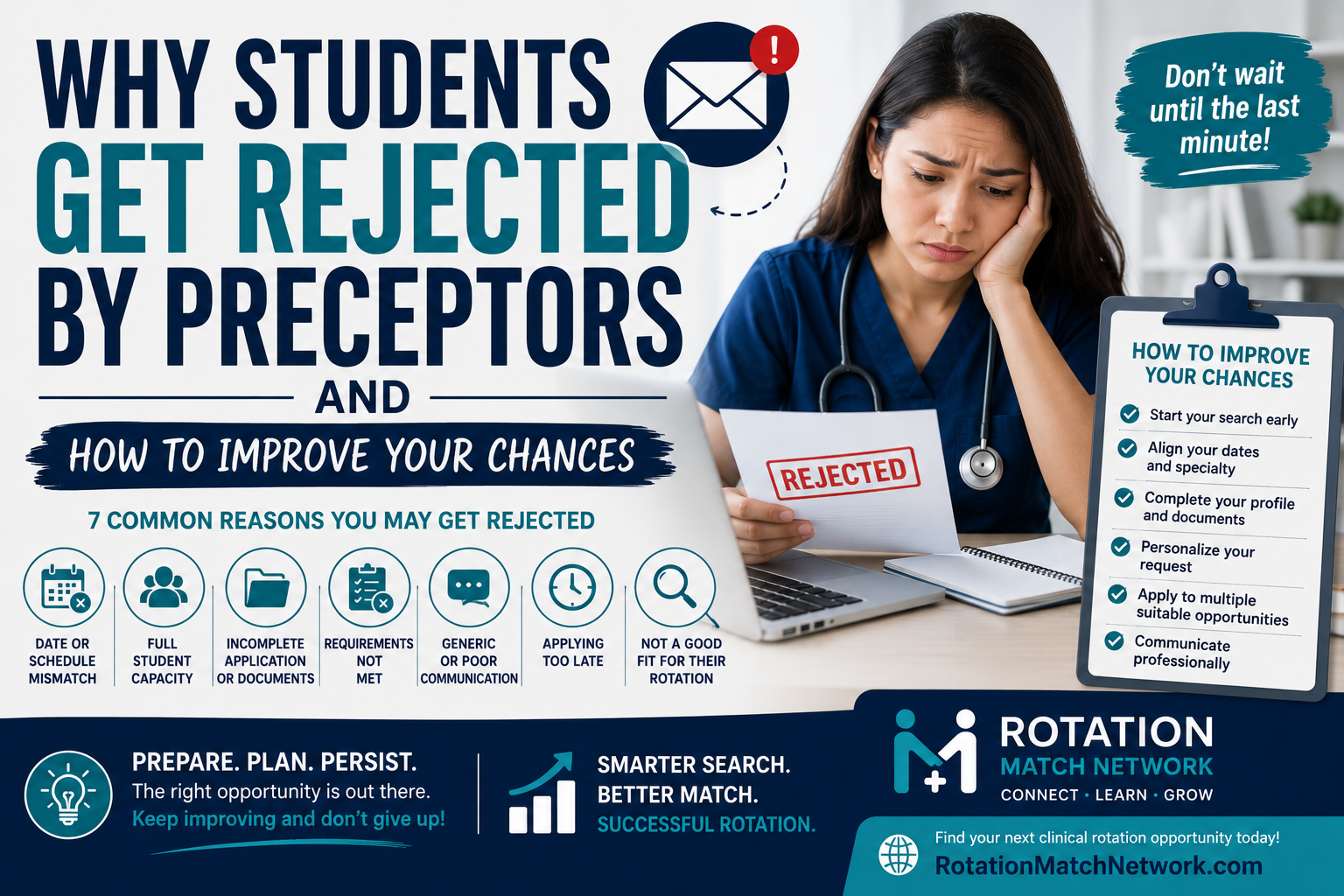
Why Students Get Rejected by Preceptors and How to Improve Your Chances
Getting rejected by a clinical preceptor can be frustrating.
You find an opportunity that looks perfect, submit your clinical rotation request, and hope for a positive response. Then you receive a rejection—or sometimes no response at all.
It is easy to wonder:
“What did I do wrong?”
The truth is, a preceptor rejection does not necessarily mean you are unqualified. Preceptors may decline students because of availability, rotation dates, specialty requirements, clinical capacity, or simply because another student is a better match.
However, there are also things students can do to improve their chances of securing a clinical rotation.
Here are some of the most common reasons students get rejected and what you can do about them.
1. Your Rotation Dates Do Not Match
One of the simplest reasons a preceptor may reject a student is scheduling.
A preceptor may be interested in taking students but already has their clinical calendar filled for the requested dates.
Before submitting a request, carefully check the preceptor's available dates and make sure they align with your school's requirements.
If the dates do not match, look for another opportunity rather than assuming the preceptor is rejecting you personally.
2. Your Specialty Does Not Match
A preceptor needs to be able to provide the clinical experience required by your program.
For example, if you need a specific specialty or patient population, applying to a preceptor whose practice does not meet those requirements may result in a rejection.
Don't simply search for an available preceptor. Search for the right preceptor.
RMN allows students to search available rotations by specialty and location and review the specific requirements of an opportunity before submitting a request.
3. Your Application Is Incomplete
A preceptor may be less likely to consider a request if important information is missing.
Before applying, make sure your profile and required documents are ready.
Depending on your program, this may include:
Your resume
Professional license
Certifications
Required clinical documents
Preferred rotation dates
Required clinical hours
Additional information requested by the preceptor
RMN's student application process requires students to have their clinical documents ready and allows additional documents to be attached when submitting a request.
The easier you make it for a preceptor to understand who you are and what you need, the easier it is for them to evaluate your request.
4. Your Request Is Too Generic
A generic message can make your request feel like one of many.
Compare:
“Hi, I need a preceptor for my clinical rotation. Are you available?”
with a message that explains who you are, what program you are in, your specialty, required dates, and why the opportunity fits your clinical requirements.
Your request does not need to be long.
It needs to be clear, professional, and relevant.
A preceptor should be able to quickly understand:
Who are you?
What program are you in?
What rotation do you need?
When do you need it?
What are your requirements?
5. You Apply Without Reading the Requirements
Before submitting a request, take the time to understand what the preceptor is looking for.
If an opportunity has specific requirements and you do not meet them, your application may be rejected before the preceptor even considers your request.
This is why reviewing the rotation details before applying is so important.
On RMN, students can view a rotation's specific details and preceptor requirements before sending a request.
Read first. Apply second.
6. You Wait Until the Last Minute
Timing can make a significant difference.
If your clinical rotation begins in a few weeks and you are just starting your search, you may have fewer available options.
Preceptors may already be booked, and your preferred dates may no longer be available.
Start your search early, submit requests early, and give yourself enough time to consider alternatives if your first choices do not work out.
Do not wait until your clinical deadline is approaching to start looking for a preceptor.
7. You Are Relying on Only One Preceptor
This is one of the biggest mistakes students can make.
You find one preceptor who looks perfect and wait for their response.
If they decline or do not respond, you have lost valuable time.
Instead, continue exploring suitable opportunities while your requests are being reviewed.
RMN allows students to browse available rotations, submit requests, and track their applications from their dashboard.
That means you can stay organized rather than keeping track of different opportunities through scattered emails and messages.
8. Your Communication Needs Improvement
Even before your rotation begins, your communication says something about your professionalism.
Avoid messages that are:
Too casual
Demanding
Extremely long
Poorly written
Filled with unnecessary information
Instead, keep your communication polite, direct, and professional.
Remember that you are communicating with a healthcare professional who may eventually supervise you in a clinical environment.
What Should You Do After a Rejection?
First, don't take it personally.
A preceptor may reject your request because their schedule is full, they have reached their student capacity, your dates do not work, or the opportunity does not match your requirements.
If appropriate, thank them for reviewing your request.
Then keep looking.
A rejection from one preceptor does not mean you will not secure a clinical rotation.
It simply means that particular opportunity was not the right match.
How to Improve Your Chances of Getting Accepted
Before sending your next clinical rotation request, run through this checklist:
☑ Your profile is complete
☑ Your resume is ready
☑ Your required documents are uploaded
☑ Your specialty matches the rotation
☑ Your dates are correct
☑ Your required hours are clear
☑ You meet the preceptor's requirements
☑ Your request is personalized and professional
☑ You have started your search early
☑ You are exploring more than one suitable opportunity
Small improvements can make the placement process much easier.
Find the Right Match, Not Just Any Preceptor
Clinical placement is ultimately about finding a good match between a student's requirements and a preceptor's specialty, availability, and expectations.
That is where having an organized platform can make a difference.
Rotation Match Network connects students with available clinical rotation opportunities and allows students to search by specialty and location, review requirements, submit requests, and track their application progress in one place.
Instead of sending random requests and hoping something works, you can approach your clinical placement search more strategically.
The goal isn't to get every preceptor to say yes.
The goal is to find the right preceptor who can meet your clinical requirements and provide a valuable learning experience.
Final Thoughts
Getting rejected by a clinical preceptor can be disappointing, but it does not have to stop your search.
Check your dates.
Review the requirements.
Complete your documents.
Improve your request.
Communicate professionally.
Start early.
And most importantly, keep your options open.
Your first request may not be the one that works out. Your second may not either.
What matters is continuing to search until you find the right clinical placement.
Don't let one rejection become the reason you miss your rotation deadline.
Start your search with Rotation Match Network and take the next step toward securing your clinical rotation.